
Related News
- 00
0000-00
How to size heavy-duty loaders for North American mining operations - 00
0000-00
How altitude affects mining excavator performance in Latin America - 00
0000-00
Caterpillar Launches New Cat 6060 and Upgraded Autonomous Mining System - 00
0000-00
When does eco-friendly construction equipment pay for itself? - 00
0000-00
Will a wheel loader quick coupler fit your existing attachments?
As 2026 budgets tighten and fleet complexity grows, heavy equipment maintenance is becoming a bigger financial risk for contractors and asset owners. For financial decision-makers, rising parts prices, labor shortages, downtime exposure, and stricter emissions compliance can quickly erode margins. This article examines what is driving maintenance costs upward and how smarter planning can protect uptime, asset value, and capital efficiency.
Why are heavy equipment maintenance costs rising so fast in 2026?
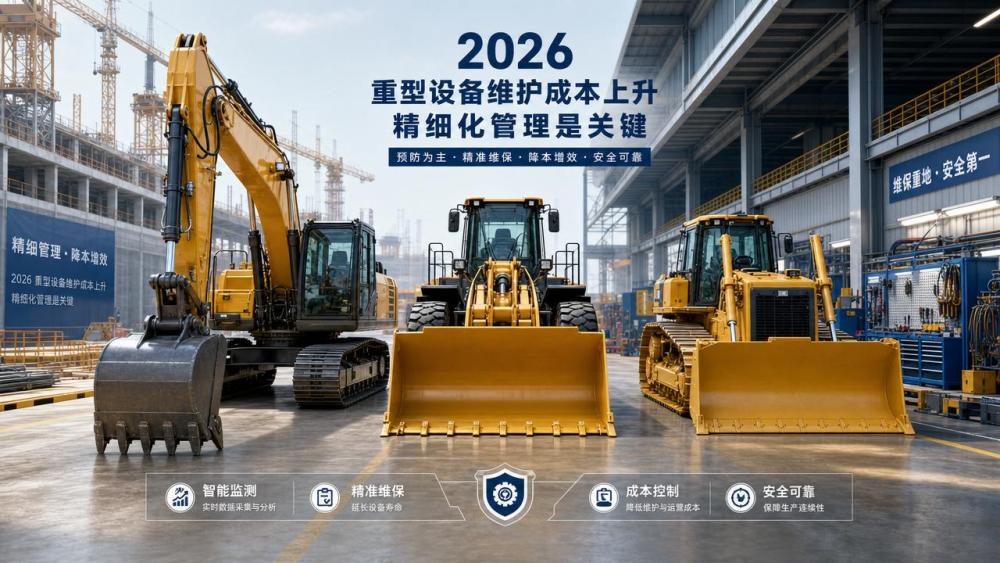
For finance teams, heavy equipment maintenance is no longer a routine operating expense. It is a moving budget line affected by inflation, supply chain volatility, machine electrification, telematics expansion, and tighter emissions rules across global infrastructure markets.
This shift matters most in fleets built around crawler excavators, wheel loaders, motor graders, bulldozers, and skid steer loaders. These machines now combine traditional hydraulic wear points with software, sensors, aftertreatment systems, and connectivity hardware that increase diagnostic complexity and service cost.
EMD tracks these cost drivers from both the equipment side and the project economics side. That perspective is essential for financial approvers, because maintenance inflation rarely appears as one large invoice. It spreads through labor rates, idle asset time, delayed projects, higher spare parts inventory, and shortened resale windows.
- Parts pricing is rising due to steel costs, electronics content, logistics uncertainty, and longer lead times for hydraulic pumps, control valves, undercarriage components, and sensors.
- Skilled technicians are harder to retain, especially for mixed fleets that include advanced electro-hydraulic controls, GPS grading systems, and emissions aftertreatment.
- Downtime is more expensive because project schedules are tighter and replacement rental rates have climbed in many markets.
- Compliance work is expanding, particularly where non-road diesel emissions standards and site-level sustainability reporting are becoming stricter.
The biggest cost pressure points for asset-heavy fleets
Not all maintenance categories inflate at the same speed. A useful budgeting approach is to separate predictable wear from disruption-driven cost. Filters, fluids, hoses, and pins can be forecasted with reasonable confidence. Unplanned failures, software faults, and parts unavailability create the real margin shock.
The table below helps financial approvers prioritize the heavy equipment maintenance categories most likely to affect total ownership cost in 2026.
For CFOs, controllers, and procurement heads, the lesson is clear: the main issue is not just maintenance price inflation. It is the growing interaction between technical complexity and project revenue risk. A delayed excavator can disrupt trucking, grading, and downstream site work at the same time.
Which machines create the highest maintenance cost exposure?
Different machine classes fail differently, and budget models should reflect that. EMD’s sector focus on earthmoving equipment is useful here because finance teams often use one maintenance assumption across the fleet, even though machine architecture and work cycles vary sharply.
Application-specific risk by equipment type
The next table compares common heavy equipment maintenance risk patterns across core machine categories used in infrastructure, quarrying, road building, and urban works.
The finance takeaway is practical. Excavators and bulldozers often create larger single-event repair exposure. Loaders and skid steers create repeat wear costs that can be underestimated because each invoice looks manageable on its own. Graders combine mechanical wear with precision technology risk, which makes downtime more expensive on critical road and runway schedules.
How should financial approvers evaluate heavy equipment maintenance budgets?
A stronger budget framework starts with separating maintenance into controllable, condition-based, and disruption-driven categories. This makes approvals more accurate than relying on last year’s spend plus an inflation factor.
A practical review checklist before approving spend
- Check utilization by machine class, not just fleet total. High-hour excavators and dozers deserve a different reserve model than mixed-use skid steers.
- Separate planned service spend from failure recovery spend. If those categories are blended, root causes stay hidden.
- Price downtime explicitly. Compare the cost of preventive service with standby labor, equipment rental, schedule penalties, and idle support vehicles.
- Review parts lead times for critical components. A low quoted price is less meaningful if a hydraulic pump or sensor keeps a machine down for weeks.
- Include compliance exposure. Machines facing emissions inspections, low-emission jobsite requirements, or sustainability reporting may need earlier service intervention.
What metrics matter more than raw repair cost?
Financial approvers should push operations teams to report heavy equipment maintenance using decision-grade metrics. Cost per operating hour is useful, but incomplete. Mean time between failures, service response time, parts fill rate, and percentage of planned versus unplanned maintenance reveal whether spending is protecting productivity or simply reacting to breakdowns.
EMD’s intelligence-led approach is relevant because it links machine technology trends with commercial consequences. For example, more advanced electro-hydraulic control may improve digging precision and fuel efficiency, but it also changes fault diagnosis, software dependencies, and technician training requirements. Finance teams should price that complexity in early, not after the first major outage.
Preventive, predictive, or run-to-failure: which maintenance strategy costs less?
There is no universal answer, but there is a useful decision model. Preventive maintenance is usually the baseline for fleets with moderate utilization and tight project schedules. Predictive maintenance becomes more attractive where telematics, fluid analysis, and fault-code data are already available. Run-to-failure should be limited to low-criticality items with manageable downtime consequences.
The table below compares strategy fit from a heavy equipment maintenance and capital control perspective.
For most contractors and asset owners in 2026, the lowest-cost path is a blended model. Use preventive maintenance for routine intervals, predictive methods for high-value components, and only limited run-to-failure for items that do not threaten safety, compliance, or project continuity.
What hidden costs do many finance teams miss?
The direct invoice is only part of heavy equipment maintenance cost. The larger financial risk often sits off the service order.
- Idle crew cost when one failed machine stalls multiple linked operations on site.
- Premium freight for urgent parts that were not forecasted in spare inventory plans.
- Rental substitution cost when market demand tightens equipment availability during peak season.
- Reduced residual value caused by poor maintenance history, unresolved fault codes, or visible undercarriage neglect.
- Compliance-related penalties or operating restrictions where emissions systems are not maintained correctly.
This is where EMD’s market and technical intelligence can support sharper approvals. By understanding the evolution of hydrostatic systems, precision grading controls, remote operation architecture, and decarbonization-related equipment changes, finance leaders can ask better questions before cost overruns occur.
How can companies control heavy equipment maintenance costs without harming uptime?
Five actions that usually deliver the fastest financial return
- Prioritize assets by project criticality. Protect the machines that can stop revenue generation, not just the most expensive machines on paper.
- Standardize inspection routines across sites. Small differences in lubrication, filtration, and contamination control create major cost gaps over time.
- Track failure modes by component family. Grouping hydraulic, drivetrain, and electronic issues separately makes sourcing and training decisions more accurate.
- Use lifecycle-based replacement planning. Sometimes replacing an aging machine is cheaper than funding another year of high-risk maintenance and downtime.
- Align service contracts with response time and parts availability, not just labor rate. Cheap service can become expensive when support is slow.
Compliance and decarbonization should be part of the maintenance plan
As fleets move toward lower-emission and more autonomous equipment, maintenance planning must widen beyond mechanical service. Battery systems, control software, advanced sensors, and connectivity layers will change future cost structures. Even where diesel remains dominant, aftertreatment reliability and emissions conformity are already affecting operating economics.
For financial approvers, that means 2026 budgets should not treat heavy equipment maintenance as a backward-looking cost center. It is a forward-looking readiness budget tied to uptime, compliance, asset life, and procurement timing.
FAQ: practical questions financial decision-makers ask
How do I know if heavy equipment maintenance spend is too high or simply normal?
Start by comparing planned versus unplanned maintenance share. If emergency repairs are rising faster than utilization, your spend is likely inefficient. Also review downtime hours, parts rush orders, and repeat failures by component. A stable budget with unstable reliability is still a warning sign.
Should we repair aging excavators and bulldozers or replace them?
Use a full lifecycle view. Compare the next 12 to 24 months of projected maintenance, expected downtime, fuel efficiency, compliance exposure, and resale deterioration against replacement cost. If repair spending is concentrated in major systems and machine availability is falling, replacement may protect capital better than repeated patchwork repairs.
What should be included in a maintenance approval request?
At minimum, ask for machine hours, fault history, root cause, downtime impact, parts lead time, repair-or-replace comparison, and any emissions or safety implications. This turns a maintenance request into a business case instead of a reactive cost submission.
Is predictive maintenance worth the investment for mixed fleets?
Usually yes, but not everywhere at once. Begin with the assets that create the highest revenue interruption when they fail, such as production excavators, grading equipment on critical road works, or loaders in continuous material handling. Pilot the method where data quality and financial exposure are strongest.
Why choose us for heavy equipment maintenance intelligence and planning support?
EMD brings together equipment insight, market tracking, and commercial analysis across crawler excavators, wheel loaders, motor graders, bulldozers, and skid steer loaders. That combination helps financial approvers move beyond generic maintenance budgeting and toward machine-specific, project-aware decisions.
We can support discussions around maintenance cost structure, fleet risk prioritization, machine category comparison, project-fit evaluation, emissions-related service exposure, and the impact of automation or precision systems on lifecycle budgets.
- Ask us to help review maintenance assumptions for excavators, loaders, graders, dozers, or compact equipment by application and duty cycle.
- Consult us on equipment selection, replacement timing, and maintenance-related capital planning for infrastructure and earthmoving fleets.
- Discuss delivery timing, parts risk, compliance considerations, technical comparisons, and custom intelligence needs tied to procurement or investment decisions.
- Request support for quotation-stage evaluation, fleet planning logic, and scenario-based analysis before approving major service or replacement budgets.
If your 2026 budget is under pressure, now is the right time to evaluate heavy equipment maintenance as a strategic financial variable rather than a routine repair line. Better information leads to better approvals, stronger uptime, and healthier asset returns.