
Related News
- 00
0000-00
How to size heavy-duty loaders for North American mining operations - 00
0000-00
How altitude affects mining excavator performance in Latin America - 00
0000-00
Caterpillar Launches New Cat 6060 and Upgraded Autonomous Mining System - 00
0000-00
When does eco-friendly construction equipment pay for itself? - 00
0000-00
Will a wheel loader quick coupler fit your existing attachments?
For procurement teams balancing uptime, capital efficiency, and project risk, heavy equipment rental often delivers a smarter path than ownership. From crawler excavators and wheel loaders to graders and skid steers, rental can reduce upfront costs, improve fleet flexibility, and match machine capability to changing job demands. This article explores when renting creates stronger financial and operational value for modern infrastructure and earthmoving projects.
In earthmoving, roadbuilding, quarry support, and utility installation, machine demand rarely stays constant for 12 straight months. One quarter may require two 20-ton excavators and a dozer, while the next may need a compact track loader, a motor grader, and high-reach loading support for only 6 to 10 weeks.
That variability is exactly why heavy equipment rental has become a strategic procurement tool rather than a short-term emergency fix. For buyers responsible for cost control, equipment availability, and supplier risk, the decision is no longer simply rent versus buy. It is about asset utilization, cash timing, emissions compliance, operator productivity, and the speed of matching the right machine to the right workfront.
For organizations managing multiple project types across changing regions, rental can protect budgets and schedules in ways ownership cannot. It also supports access to newer machines, telematics, and attachment options without locking capital into underused assets.
Where Heavy Equipment Rental Creates the Strongest Value
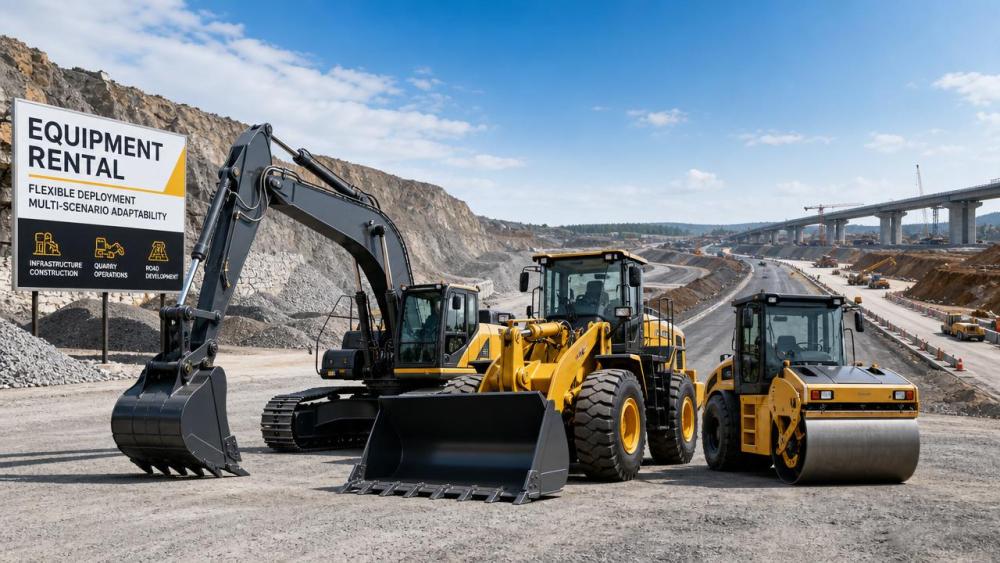
Heavy equipment rental is most effective when workload is variable, project duration is limited, or technical requirements shift by site. This is common in infrastructure packages lasting 3 to 9 months, in phased utility work, and in seasonal grading or site-preparation programs.
It is also highly relevant when procurement teams need to avoid 3 major ownership burdens at once: large upfront capital outlay, uncertain residual value, and maintenance exposure over a 5- to 8-year lifecycle.
1. Short-Duration or Intermittent Projects
When a machine is needed for 4 weeks, 12 weeks, or one specific project phase, ownership often weakens the business case. A wheel loader used only during stockpile movement, or a grader required only during final surface preparation, may sit idle for 60% to 80% of the year if purchased.
In these situations, heavy equipment rental converts fixed ownership cost into a time-bound operating expense. That makes budget approval easier, especially for procurement teams working under annual CAPEX controls or project-specific P&L accountability.
2. Specialized Machine or Attachment Requirements
Modern jobs rarely require one generic machine configuration. Excavators may need GPS-ready systems, tiltrotators, rock buckets, or low-ground-pressure track setups. Skid steers may need cold planers, trenchers, sweepers, or augers depending on the task mix.
Rental gives buyers access to specific capability without carrying the full cost of low-frequency attachments. If an attachment is only used 20 to 40 days per year, renting can be operationally cleaner and financially safer than purchasing.
3. Fleet Flexibility During Demand Swings
Contractors and industrial project owners often face sudden volume changes. A delayed permit, weather impact, or acceleration order can change machine needs within 7 to 14 days. Rental allows procurement teams to scale from one excavator to three, or swap a 14-ton class unit for a 30-ton class machine, without liquidating owned assets.
That flexibility matters in mining support, highway expansion, airport grading, and urban infrastructure, where production bottlenecks can cost more than the rental premium itself.
The comparison below shows where rental tends to outperform ownership from a procurement perspective.
The key takeaway is not that rental is always cheaper on a daily rate. It is that heavy equipment rental often lowers total decision risk when workload, specifications, and timing are uncertain.
Common Procurement Signals That Favor Rental
- Planned machine use is below 120 to 150 days per year.
- Project duration is under 9 months or split across multiple phases.
- Machine class may change after geotechnical or design updates.
- New emissions requirements may affect machine eligibility within 12 to 24 months.
- Attachment needs vary by site, crew, or material condition.
Financial Drivers Behind Rent-Over-Buy Decisions
Procurement decisions in heavy machinery should be based on total cost of use, not purchase price alone. A crawler excavator or bulldozer may appear cost-effective when spread across a 5-year depreciation schedule, but that assumption breaks down if idle time, transport, service downtime, insurance, and resale exposure are high.
Heavy equipment rental improves financial control in 4 ways: preserving cash, matching cost to revenue timing, reducing maintenance variability, and limiting residual value risk. These factors matter even more when interest rates, used equipment pricing, and regional demand are unstable.
Cash Preservation and Budget Timing
Large earthmoving machines can tie up significant capital before the first cubic meter is moved. Rental frees procurement teams from making a six-figure or seven-figure commitment for assets that may not be fully utilized across the next 24 to 36 months.
For companies bidding multiple contracts at once, preserved cash can be redirected to labor, fuel, mobilization, safety systems, or more strategic purchases such as continuously used base fleet units.
Maintenance Cost Variability
Owned machines bring scheduled service, unscheduled repairs, parts availability issues, and technician coordination. A single undercarriage event, hydraulic pump failure, or emissions-related repair can significantly alter actual cost per operating hour.
With rental, much of that exposure shifts to the supplier, depending on contract scope. Buyers should still confirm wear-item policy, damage responsibility, and service response windows, but the maintenance burden is usually more predictable.
The table below outlines a practical procurement lens for evaluating cost drivers beyond the rental rate or purchase invoice.
A disciplined total-cost review often reveals that buying is only superior when utilization is consistently high, maintenance support is already in place, and machine specifications are unlikely to change over the asset life.
Residual Value and Technology Obsolescence
Ownership also carries market timing risk. Resale values can shift with commodity cycles, regional construction volume, and emissions regulation changes. Machines purchased at a peak may lose pricing strength faster than expected 36 months later.
Rental reduces exposure to those variables. This is particularly valuable in segments facing faster change, including compact equipment, telematics-enabled fleets, semi-autonomous controls, and lower-emission machine platforms.
Operational Reasons Procurement Teams Choose Rental
Financial logic matters, but uptime drives outcomes in earthmoving. A delayed excavation sequence, failed loading cycle, or missed grading tolerance can affect labor productivity, trucking coordination, and downstream subcontractors within the same shift.
Heavy equipment rental helps operations by improving access speed, equipment fit, fleet elasticity, and service support. These benefits become more visible on multi-site programs and fast-track infrastructure jobs.
Faster Access to the Right Machine Class
A procurement team may initially specify a mid-size excavator, then discover that trench depth, rock content, or truck pairing requires a larger machine. With rental, it is often possible to switch classes within days rather than carry a sizing mistake for years.
That matters when choosing between a compact loader for urban works, a large wheel loader for bulk handling, or a GPS-integrated grader for surface tolerance targets such as ±10 mm to ±20 mm on final layers.
Reduced Downtime Exposure
Downtime is not only a maintenance issue. It is a supplier response issue. Strong rental partners can support replacement machines, field service dispatch, and contract flexibility when a unit underperforms or site conditions change.
For procurement, response terms should be written clearly. A 24-hour callback is not the same as a 24-hour machine replacement. Buyers should define target windows for troubleshooting, technician arrival, and replacement mobilization.
Operational Checks Before Signing a Rental Agreement
- Confirm machine age band or hour range if that matters for reliability.
- Review attachment compatibility, coupler type, and hydraulic flow requirements.
- Check mobilization lead time, especially for remote sites or oversize transport.
- Verify service coverage radius and emergency contact process.
- Set acceptable standards for tires, tracks, teeth, cutting edges, and cab condition.
Compliance and Emissions Flexibility
Non-road emissions requirements are tightening in many markets, and project owners are placing more scrutiny on fleet age, fuel burn, and environmental reporting. Heavy equipment rental can help buyers secure newer units that align better with project or regional compliance expectations.
This is useful when entering a market with different regulatory requirements, or when a project owner asks for lower-emission fleet declarations without a full fleet replacement cycle.
How to Decide: A Procurement Framework for Renting or Buying
The most reliable approach is not ideological. It is a structured evaluation using utilization, project duration, service support, and technical fit. In practice, many high-performing fleets blend owned base assets with rented peak-demand or specialized units.
Procurement teams can apply a simple 4-part framework to reduce decision bias and align sourcing with actual field conditions.
Step 1: Measure Expected Utilization
Estimate operating days and hours over the next 12 months, not just the next project. If expected utilization is below 1,000 to 1,200 hours annually for a given machine type, rental often deserves strong consideration.
Step 2: Define Technical Variability
List the 3 to 5 most likely changes in site demand: bucket size, attachment flow, lift reach, blade control, transport restrictions, or ground condition. High variability usually pushes the decision toward heavy equipment rental.
Step 3: Score Supplier Support
Evaluate rental partners on machine availability, delivery lead time, field service, invoice transparency, and replacement commitment. A lower rate loses value if delivery takes 10 days longer or service support is weak in the operating region.
Step 4: Compare All-In Risk
Ownership may still be the right answer for core machines used daily across multiple contracts. But if demand, geography, or specification is uncertain, procurement should compare risk-adjusted cost rather than nominal hourly cost.
The matrix below can help teams make more consistent sourcing decisions across excavators, loaders, graders, bulldozers, and skid steers.
This framework is especially effective when procurement, operations, and finance review the same criteria before release of purchase orders or rental agreements. It reduces reactive sourcing and improves machine-to-project fit.
Common Mistakes to Avoid
- Comparing only daily rate versus ownership payment without idle-cost analysis.
- Ignoring transport, fuel burn, and attachment swap implications.
- Selecting the lowest rental quote without testing support capability.
- Overbuying machine size for occasional peak demand.
- Underestimating compliance, telematics, or operator training needs.
Final Takeaway for Buyers Managing Modern Earthmoving Fleets
Heavy equipment rental beats buying when machine demand is uncertain, utilization is moderate, specifications are shifting, or project schedules are too dynamic to justify long-term asset exposure. For procurement teams, the advantage is not just lower upfront cost. It is better timing, stronger flexibility, and reduced risk across maintenance, compliance, and residual value.
In practical terms, rental is often the smarter choice for specialized excavators, temporary wheel loader capacity, project-specific motor graders, supplemental bulldozers, and attachment-driven skid steer work. Buying remains important for base fleet assets with stable usage, but rental is frequently the better answer for peaks, transitions, and uncertainty.
If your team is evaluating fleet strategy for upcoming infrastructure, site development, quarry, or municipal works, a structured rent-versus-buy review can reveal where capital should be protected and where equipment access should stay flexible. Contact us to discuss your application, compare machine options, and get a tailored sourcing plan for your next project.