
Related News
- 00
0000-00
How to size heavy-duty loaders for North American mining operations - 00
0000-00
How altitude affects mining excavator performance in Latin America - 00
0000-00
Caterpillar Launches New Cat 6060 and Upgraded Autonomous Mining System - 00
0000-00
When does eco-friendly construction equipment pay for itself? - 00
0000-00
Will a wheel loader quick coupler fit your existing attachments?
Choosing among the top construction equipment manufacturers in 2026 requires more than comparing brand size or price lists. For business evaluators, the real advantage lies in understanding each OEM’s strengths in excavators, loaders, graders, bulldozers, and skid steers, as well as their progress in electrification, autonomy, and efficiency. This guide highlights the manufacturers shaping global infrastructure decisions and long-term fleet value.
How should business evaluators compare construction equipment manufacturers in 2026?
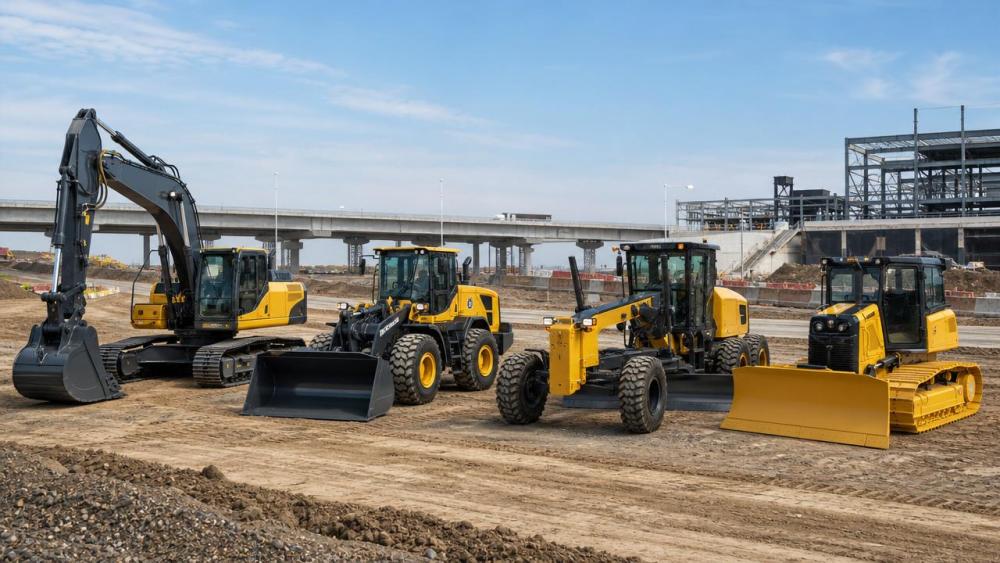
The phrase construction equipment manufacturers covers a wide range of OEMs, but procurement decisions rarely fail because of brand awareness alone. They fail when evaluators focus on brochure claims instead of machine-role fit, service responsiveness, lifecycle cost, and regional compliance.
In 2026, the leading manufacturers are being judged on five equipment pillars: crawler excavators, wheel loaders, motor graders, bulldozers, and skid steer loaders. These categories now sit at the center of infrastructure spending, mine development, airport expansion, utility trenching, and compact urban projects.
EMD tracks this market from a technical and strategic angle. Its intelligence focus is useful for business evaluators because it connects hydraulic breakout force, grading precision, hydrostatic efficiency, attachment flexibility, remote-control readiness, and decarbonization trends into one decision framework.
- Assess the manufacturer by equipment category, not by overall brand image alone.
- Measure fleet value through uptime, fuel or energy efficiency, resale strength, and service access.
- Check whether the OEM is investing in autonomy, telematics, and lower-emission product lines.
- Review performance under harsh duty cycles, not only under ideal test conditions.
What defines a top construction equipment manufacturer today?
For commercial evaluation teams, top construction equipment manufacturers are not simply the biggest factories. They are the companies that combine application depth, stable supply chains, operator-friendly control systems, emissions compliance, digital support, and consistent parts availability across target regions.
The market has also become more segmented. One OEM may lead in crawler excavators for quarry and civil work, while another performs better in compact skid steers for municipal fleets. A third may stand out in precision graders where 3D machine control and surface tolerance matter more than raw engine power.
Core evaluation dimensions
The table below helps compare construction equipment manufacturers through criteria that matter during supplier shortlisting, capital budgeting, and bid-stage risk review.
A strong score across these dimensions usually indicates that a manufacturer can support both near-term procurement and long-term fleet planning. Weakness in even one area, especially parts support or compliance, can erode a low purchase price advantage very quickly.
Which equipment categories reveal the real strengths of manufacturers?
Many business evaluators compare construction equipment manufacturers through aggregate brand reputation. A better method is to examine where each OEM demonstrates engineering depth and stable field performance. EMD’s five-pillar lens is especially useful here.
Crawler excavators
Excavators expose a manufacturer’s hydraulic intelligence. Buyers should review breakout force, electro-hydraulic control smoothness, attachment compatibility, fuel efficiency, and reliability under repetitive high-load digging cycles.
Wheel loaders
Loaders reveal efficiency in material transfer. Key metrics include bucket fill factor, cycle time, drivetrain responsiveness, payload accuracy, and durability in abrasive environments such as aggregates, ports, and mining support yards.
Motor graders
Graders matter where surface precision drives contract quality. Manufacturers with strong grader platforms typically support GPS, laser, and 3D machine control systems with stable blade response and repeatable finish quality.
Bulldozers and skid steers
Dozers show tractive effort, undercarriage durability, and hydrostatic transmission tuning. Skid steers show compact versatility, zero-radius maneuverability, and attachment ecosystem maturity. Together they reveal whether the OEM serves both mega-projects and dense urban jobs.
How do application scenarios change the best manufacturer choice?
There is no single best answer across all job types. Construction equipment manufacturers should be matched to project conditions, operator skill levels, logistics constraints, and reporting requirements. The wrong fit often comes from copying another company’s fleet rather than evaluating actual site needs.
The scenario table below shows how different applications shift the OEM selection logic.
This scenario view helps evaluators avoid overpaying for features that do not add contract value. It also identifies where a specialized OEM may outperform a larger competitor in a narrow but critical use case.
What procurement teams should verify before shortlisting construction equipment manufacturers
A shortlist should not be built from sales decks alone. It should come from a structured review process that balances technical fit, commercial stability, and implementation risk. This is where EMD’s market intelligence perspective becomes practical rather than theoretical.
- Define duty cycle clearly. Record material type, shift length, travel distance, slope, attachment use, and operator profile.
- Request machine-level data. Ask for operating weight, bucket range, hydraulic flow, transmission type, grading integration, and maintenance intervals.
- Check supply chain resilience. Confirm lead times for machines, wear parts, filters, undercarriage items, and hydraulic components.
- Review after-sales structure. Verify whether support is handled by a direct branch, dealer, distributor, or third-party service contractor.
- Model total ownership cost. Include fuel, consumables, maintenance labor, downtime risk, financing terms, and residual value assumptions.
Business evaluators often face compressed timelines. A disciplined checklist prevents emotional decisions, especially when two manufacturers appear similar on headline specifications but differ sharply in support quality or digital maturity.
How do technology trends reshape the top construction equipment manufacturers list?
The competitive landscape in 2026 is influenced by three linked trends: decarbonization, autonomy, and precision control. Manufacturers that move early in these areas are gaining attention from contractors and fleet owners trying to future-proof capital expenditure.
Electrification
Electrified compact equipment is becoming more relevant in urban, indoor, and low-noise projects. Evaluators should check charging practicality, battery service policy, thermal management, and whether energy savings offset acquisition cost in their duty cycle.
Autonomy and remote operation
In hazardous mines and isolated worksites, low-latency remote control architecture is no longer experimental marketing. It is a practical differentiator. Manufacturers with serious remote-operation roadmaps may offer stronger long-term value where labor risk and safety exposure are high.
Data and machine intelligence
The best construction equipment manufacturers increasingly support telematics, predictive maintenance alerts, productivity dashboards, and machine guidance integration. For business evaluators, this matters because digital evidence can justify procurement choices to finance, operations, and compliance teams.
Which compliance and risk factors are often underestimated?
Many procurement delays do not start on the jobsite. They start in documentation, emissions alignment, import readiness, or training gaps. A lower-price offer from construction equipment manufacturers can become expensive if supporting paperwork or field readiness is incomplete.
- Confirm engine emissions stage suitability for the destination market and project owner requirements.
- Check operator safety features, visibility design, emergency shutoff logic, and maintenance access points.
- Verify that telematics, software, and grade-control systems can be supported locally after delivery.
- Review spare parts stocking strategy for filters, pins, bushings, cutting edges, hydraulic hoses, and undercarriage wear items.
Where standards are involved, teams typically review general regional emissions compliance, common machinery safety expectations, and project-specific technical documentation. The exact standard set depends on geography and end-use, so evaluators should confirm requirements before approval rather than after shipment.
FAQ: what do buyers ask most about construction equipment manufacturers?
How should I compare two manufacturers with similar specifications?
Move beyond engine power and operating weight. Compare hydraulic response, field service reach, parts lead time, digital support, attachment ecosystem, warranty terms, and expected resale strength. Similar specifications can still produce very different ownership outcomes.
Are premium brands always the better procurement choice?
Not always. Premium brands may justify cost in high-utilization or high-risk environments where downtime is expensive. In lighter-duty or short-horizon projects, a more value-oriented OEM can make sense if support, compliance, and maintenance planning are solid.
What matters most for excavator and loader selection?
For excavators, focus on hydraulic efficiency, breakout performance, controllability, and attachment compatibility. For loaders, prioritize cycle time, payload consistency, drivetrain durability, and serviceability. These factors affect both daily output and long-term cost.
How long is a typical delivery evaluation cycle?
That depends on fleet size, configuration complexity, attachment package, and regional stock availability. Evaluators should ask for both standard lead time and worst-case lead time, along with service parts readiness and commissioning support after arrival.
Why work with EMD when assessing construction equipment manufacturers?
EMD is built for decision-makers who need more than general market commentary. Its value lies in connecting macro infrastructure cycles with equipment-level performance signals across excavators, wheel loaders, graders, bulldozers, and skid steer loaders.
For business evaluators, that means clearer support in areas that directly affect procurement outcomes: parameter confirmation, application-based product selection, comparative supplier review, autonomy and electrification trend tracking, and risk screening around emissions and operational fit.
If you are reviewing construction equipment manufacturers for an upcoming tender, fleet refresh, or regional expansion, contact EMD to discuss machine parameters, equipment category matching, delivery cycle considerations, grade-control readiness, remote-operation potential, compliance checkpoints, and commercial quotation direction. That conversation is especially valuable when you need a sharper shortlist, not just more brochures.