
Related News
- 00
0000-00
How to size heavy-duty loaders for North American mining operations - 00
0000-00
How altitude affects mining excavator performance in Latin America - 00
0000-00
Caterpillar Launches New Cat 6060 and Upgraded Autonomous Mining System - 00
0000-00
When does eco-friendly construction equipment pay for itself? - 00
0000-00
Will a wheel loader quick coupler fit your existing attachments?
For aftermarket maintenance teams, hydraulic machinery failures are more than technical setbacks—they are direct drivers of costly downtime, missed service targets, and rising parts expenses. From pressure loss and seal wear to valve sticking and pump damage, understanding the root causes behind recurring breakdowns is essential for faster diagnostics and more reliable repairs. This guide highlights the failures that matter most and how to reduce their operational impact.
Across excavators, wheel loaders, bulldozers, motor graders, and skid steer loaders, hydraulic machinery sits at the center of breakout force, steering response, attachment control, and travel efficiency. When one failure mode is misdiagnosed, a machine can lose 15%–40% of usable productivity in a single shift, while a delayed parts decision can stretch repair time from 6 hours to 3 days.
For service planners and field technicians, the goal is not only to replace failed parts. It is to identify the upstream cause, prevent repeat visits, and protect machine availability over the next 250–500 operating hours. That is especially important in earthmoving fleets where harsh dust, shock loads, heat cycles, and long idling periods accelerate wear inside every hydraulic circuit.
Why Hydraulic Failures Escalate Downtime So Quickly
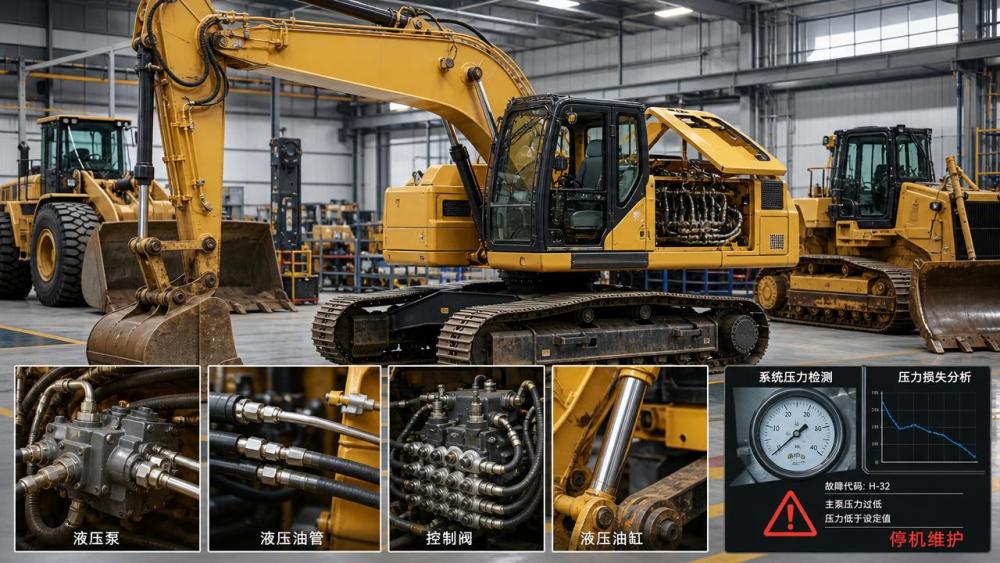
Hydraulic machinery failures are rarely isolated events. A leaking rod seal may begin as a minor oil loss, but after 2–3 weeks it can trigger contamination ingress, cylinder scoring, and unstable actuator speed. In high-duty crawler excavators or loaders, that chain reaction often affects bucket cycle times, lifting precision, and travel smoothness before operators report a total failure.
Downtime costs rise fastest when the failure occurs in a critical subsystem: main pump, control valve bank, swing circuit, steering circuit, or final hydraulic drive support functions. In many service environments, the real expense is not the component alone. It also includes technician dispatch, fluid replacement, cleanup, machine transport, and idle operator hours across 1–2 shifts.
The hidden cost structure behind a “simple” hydraulic fault
A hydraulic machinery breakdown usually creates layered losses. First comes direct repair cost. Second comes lost production. Third comes repeat service if the root cause was missed. A valve spool sticking because of varnish, for example, may be treated as a solenoid issue. If oil cleanliness is not corrected to the required target, the same fault can return within 50–100 hours.
- Direct cost: seals, hoses, pumps, valves, filters, and hydraulic oil
- Indirect cost: delayed project milestones, idle attachments, operator downtime
- Escalation risk: secondary wear in motors, cylinders, and pressure-compensated circuits
- Service burden: repeat diagnosis, flushing, and unplanned overtime
Machines most exposed to repeat hydraulic issues
Although all heavy equipment depends on hydraulics, some operating profiles are more failure-prone. Skid steer loaders using multiple attachments may see faster coupling wear. Bulldozers working in high-load push cycles can overheat oil during prolonged low-speed torque demand. Motor graders relying on blade precision are more sensitive to valve drift and cylinder bypass than machines doing rough bulk handling.
The table below shows how common hydraulic machinery failure effects differ by equipment type and why maintenance teams should prioritize diagnosis differently.
The main takeaway is that hydraulic machinery faults should be ranked by production criticality, not only by replacement cost. A modestly priced control valve issue may shut down a high-value excavator faster than a larger but non-critical leak elsewhere in the machine.
The Failures That Most Often Drive Up Downtime Costs
Aftermarket maintenance teams usually see the same 6–8 hydraulic machinery failure categories repeatedly. The difference between average and high-performing service operations is how quickly they separate symptom from cause. Below are the most common failure patterns with the strongest impact on downtime, parts consumption, and repeat repair rates.
1. Pressure loss from internal leakage
Internal leakage is one of the most expensive hidden problems in hydraulic machinery because it often develops gradually. Worn pump elements, valve clearances, or cylinder piston seals may allow oil to bypass without obvious external leakage. Operators then report weak breakout force, slow lifting, or drifting functions, especially once oil temperature moves above 60°C–75°C.
If technicians replace only a relief valve or adjust pressure settings without confirming internal bypass, the machine may return with the same complaint within days. On excavators and graders, this failure can reduce control precision long before total breakdown occurs.
Key indicators
- Slow actuator movement under load but acceptable speed when unloaded
- Hydraulic oil temperature rising 10°C–15°C above normal during repeated cycles
- Frequent need to increase engine speed to maintain normal response
2. Seal wear and contamination ingress
Seal wear is often treated as a routine consumable issue, but in hydraulic machinery it is also a contamination pathway. Once rod seals, wipers, or rotary seals lose lip tension, fine dust and moisture can enter the system during every stroke or rotation. In quarry, demolition, and road base work, contamination levels can increase sharply within 100–200 hours.
This problem is especially damaging for electro-hydraulic systems where spool clearances are tight and response quality matters. A single contaminated cylinder rebuild can send abrasive particles through valves, pumps, and pilot circuits if flushing is incomplete.
3. Valve sticking and unstable spool movement
Valve sticking typically shows up as delayed response, jerky movement, or a function that works only after warm-up. Common causes include degraded oil, varnish, fine particulate contamination, or weak solenoid performance. In hydraulic machinery used for precision grading or attachment control, even a brief spool hesitation can affect quality and safety.
Maintenance teams should be careful not to over-focus on electrical symptoms. The coil may energize correctly at 24 V, while the spool itself still drags due to contamination or scoring. Cleaning, filtration correction, and flow testing are often more important than replacing electronic parts first.
4. Pump wear, cavitation, and aeration
Pump damage is one of the highest-cost hydraulic machinery failures because it can contaminate the whole system. Cavitation from inlet restriction, collapsed suction hoses, low reservoir level, or cold-start abuse creates metal wear quickly. Aeration from loose fittings or low oil levels causes foaming, erratic movement, and poor lubrication inside rotating groups.
If a pump fails catastrophically, downtime expands beyond pump replacement. The system may require line flushing, tank cleaning, filter replacement, and valve inspection. In many real-world service cases, the secondary cleanup labor equals or exceeds the pump installation time.
5. Hose, fitting, and coupling failures
External leaks are easy to spot, but they still create major downtime in hydraulic machinery working under pressure spikes and vibration. Hose failures usually trace back to 4 root causes: abrasion, incorrect bend radius, impulse fatigue, or fitting looseness. On skid steer attachments and loader quick coupler circuits, coupling wear can also create pressure drop and intermittent function loss.
A burst hose may seem minor if a replacement is available within 1 hour, but oil loss, cleanup, environmental handling, and air bleeding can stretch the actual service event well beyond the visible repair itself.
6. Overheating and fluid degradation
When hydraulic machinery runs consistently above the intended oil temperature range, viscosity drops and wear accelerates. Heat may come from cooling package blockage, fan issues, excessive internal leakage, or duty cycles that keep relief valves open too often. Once oil oxidizes, varnish and sludge can affect valve response and shorten seal life.
A useful field rule is to treat recurring temperatures above 82°C–85°C as a diagnostic event, not as a normal operating condition. Waiting until temperatures exceed 90°C usually means part life has already been compromised.
How Maintenance Teams Can Diagnose Faster and Avoid Repeat Repairs
Reducing hydraulic machinery downtime depends on diagnostic discipline. The fastest repair is not always the first part replaced. It is the shortest path to the real cause. For most fleets, building a repeatable 5-step process can cut unnecessary part swaps and improve first-time fix rates over the next service cycle.
A practical 5-step diagnostic sequence
- Confirm the symptom under load, not only at idle or no-load conditions.
- Check fluid level, fluid condition, visible leaks, hose collapse, and filter restriction indicators.
- Measure pressure, flow, and temperature at the relevant test points.
- Isolate whether the loss is mechanical, hydraulic, electro-hydraulic, or contamination-driven.
- Inspect upstream causes before releasing the machine back to service.
This sequence is especially effective on crawler excavators and wheel loaders where multiple circuits interact. A technician who verifies pressure but ignores flow may miss pump wear. A technician who changes seals without checking rod finish may trigger another leak within 20–50 hours.
Diagnostic checkpoints that should not be skipped
The table below outlines a service-oriented checklist for hydraulic machinery faults that often appear similar at first glance but require different corrective actions.
The value of this checklist is consistency. When service teams document the same 4–6 checkpoints on every major hydraulic machinery complaint, pattern recognition improves and unnecessary component replacement drops over time.
Common troubleshooting mistakes that increase cost
- Replacing pumps before confirming suction condition and contamination level
- Changing hoses without correcting clamp support or routing
- Rebuilding cylinders without checking rod straightness or bearing wear
- Flushing only the failed branch instead of the whole affected return path
- Using a fluid grade that does not match ambient temperature or OEM guidance
Each of these errors can turn a 1-day hydraulic machinery repair into a repeat intervention within the next week. For aftermarket teams measured on turnaround time and comeback rate, disciplined root-cause control is often more valuable than parts speed alone.
Prevention Strategies That Protect Uptime in Heavy Earthmoving Fleets
The best way to control hydraulic machinery downtime is to prevent high-cost failures before they spread. In mixed fleets supporting excavation, loading, grading, and dozing, prevention should focus on contamination control, temperature management, hose life planning, and interval-based inspection tied to actual duty severity rather than calendar dates alone.
Build inspection intervals around operating reality
A machine in light utility work and a machine in abrasive quarry service should not share the same hydraulic inspection rhythm. Many maintenance teams benefit from a 3-tier approach: quick visual checks every shift, deeper inspection every 250 hours, and fluid or component trend review every 500 hours. In severe dust or high-heat sites, those intervals may need to be shortened by 20%–30%.
Priority prevention actions
- Track oil temperature trends by machine and function, not just by operator report
- Inspect hose abrasion points and clamp security every 100–250 hours
- Replace damaged breathers, wipers, and protective boots before contamination enters
- Review recurring pressure spikes in attachment circuits and coupler lines
Use parts decisions that support repair quality, not only speed
In hydraulic machinery service, fast procurement matters, but correct specification matters more. A lower-cost seal kit with marginal material compatibility may shorten service life in hot-duty cycles. A hose with the right pressure rating but poor impulse resistance may fail early on a compact loader with frequent directional changes. Maintenance teams should check at least 4 factors before approval: pressure class, temperature suitability, contamination sensitivity, and expected duty cycle.
For strategic spare planning, the most effective stock usually includes filters, high-turn hose assemblies, seal kits for common cylinders, quick couplers, and sensors or solenoids tied to recurring electro-hydraulic faults. That reduces waiting time without overloading inventory with low-use major components.
Align field service with machine intelligence
As earthmoving equipment moves toward smarter control systems, hydraulic machinery diagnosis is becoming more data-assisted. Pressure deviation alarms, temperature trend logs, and control response data can help technicians isolate faults before visible failure occurs. On advanced excavators or graders, combining technician inspection with machine data can shorten troubleshooting by 25%–35% in repeat fault scenarios.
That does not replace mechanical skill. It strengthens it. The most reliable maintenance teams combine clean field measurements, visual inspection discipline, and fault history review so that hydraulic problems are corrected once, not multiple times.
What Aftermarket Teams Should Prioritize Next
For fleets running excavators, loaders, graders, bulldozers, and skid steers, hydraulic machinery reliability is directly tied to asset utilization. The failures that drive up downtime costs most are usually the ones that begin small: internal leakage, contamination, overheating, spool sticking, hose fatigue, and inlet-related pump damage. Catching those issues early can protect both repair budgets and machine availability across the next 250 hours and beyond.
If your maintenance team is reviewing recurring hydraulic failures, parts planning, or service response strategy, now is the time to tighten diagnostic workflows and inspection intervals. Contact us to discuss hydraulic machinery fault patterns, compare maintenance priorities across your fleet, and explore more practical solutions for reducing downtime in demanding earthmoving operations.