
Related News
- 00
0000-00
How to size heavy-duty loaders for North American mining operations - 00
0000-00
How altitude affects mining excavator performance in Latin America - 00
0000-00
Caterpillar Launches New Cat 6060 and Upgraded Autonomous Mining System - 00
0000-00
When does eco-friendly construction equipment pay for itself? - 00
0000-00
Will a wheel loader quick coupler fit your existing attachments?
Under severe load cycles, even the best construction machinery components can become hidden failure points that threaten uptime, safety, and compliance. Knowing which parts fail first helps reduce unplanned downtime.
Across excavators, wheel loaders, bulldozers, motor graders, and skid steer loaders, failure rarely starts with one dramatic event. It usually begins with heat, shock, contamination, misalignment, or repeated overload.
For Global Earth-Mover Dynamics, tracking stressed construction machinery components means linking field conditions, component design, hydraulic behavior, and maintenance discipline into one practical reliability picture.
Why failure patterns change by jobsite load scenario
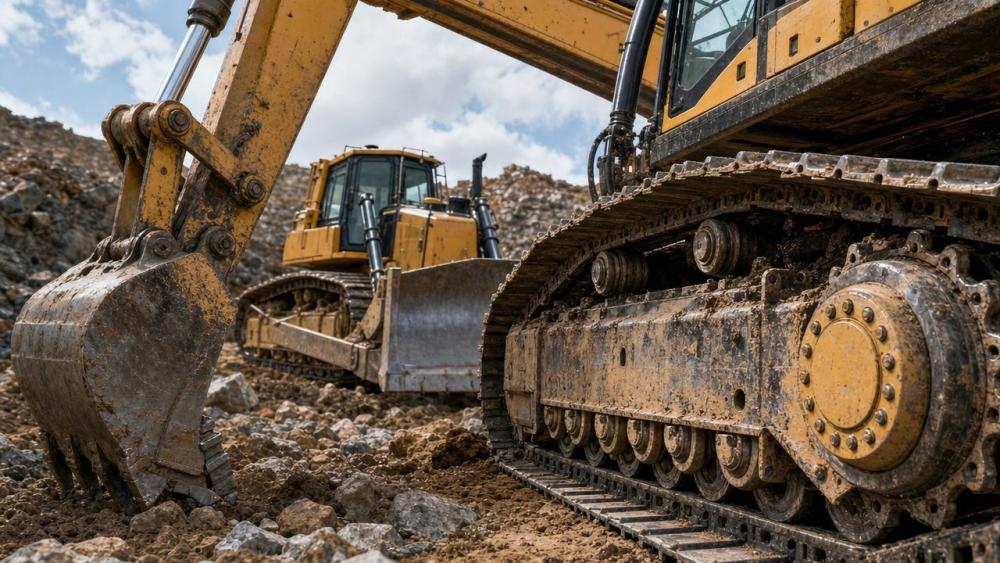
Not all heavy-duty environments attack construction machinery components in the same way. Hard rock excavation creates impact peaks. Fine dust accelerates abrasive wear. Wet clay drives sealing problems and overheating.
Load pattern matters as much as load level. Short shock loads damage pins, bushings, and structures. Long duty cycles punish pumps, bearings, cooling systems, and final drives.
This is why failure analysis should be scenario-based. A loader in quarry service faces very different component stress than a grader maintaining long haul roads or a dozer pushing dense overburden.
Scenario 1: Excavation and rock loading expose the first weak points
Crawler excavators and wheel loaders in rock work often show the earliest wear in hydraulic cylinders, bucket linkage pins, hoses, and boom-foot joints. These construction machinery components absorb repeated peak forces.
When breakout force rises beyond normal cycles, pin bore ovality increases. Bushing lubrication films fail. Fine metal particles then contaminate nearby grease points and accelerate secondary wear.
Core judgment points in this scenario
- Frequent bucket shaking or hammer-like loading
- Visible play in linkage or stick-end joints
- Cylinder rod scoring, seal sweating, or drift
- Hydraulic oil temperature rising during repetitive digging
Hydraulic pumps also suffer under aggressive digging. Cavitation, fluid contamination, and pressure spikes reduce efficiency first, then trigger noise, sluggish response, and internal leakage.
Scenario 2: Dozing and pushing loads damage driveline and undercarriage parts
Bulldozers operate under steady tractive demand, but hidden stress concentrates in track chains, rollers, idlers, sprockets, and final drives. These construction machinery components fail faster when terrain is abrasive or uneven.
Track tension errors are a common trigger. Over-tension increases bearing and bushing loads. Under-tension creates shock, derailment risk, and accelerated tooth wear on sprockets.
Core judgment points in this scenario
- Uneven track wear between left and right sides
- Hot final drive housings after sustained pushing
- Roller leakage or seal damage in muddy work
- Frequent shock from reverse-forward direction changes
In severe pushing work, transmission and torque transfer systems also become critical. Heat buildup can degrade oil quickly, reducing film strength and increasing gear and bearing distress.
Scenario 3: Precision grading stresses control-sensitive systems, not just steel
Motor graders seem lighter-duty than dozers, yet failure risk shifts toward articulation joints, blade circle components, hydraulic valves, and sensing hardware. These construction machinery components support accuracy under constant adjustment.
Repeated fine movements can hide wear for long periods. Small backlash in the circle drive or articulation area gradually harms grading precision before a visible mechanical failure appears.
Core judgment points in this scenario
- Inconsistent blade response under light joystick inputs
- Sensor drift affecting GPS or laser-guided grading accuracy
- Valve contamination causing hesitation or overcorrection
- Articulation looseness during high-speed pass corrections
This scenario proves that overloaded construction machinery components are not always visibly broken. Some failures first appear as performance instability, poor finish quality, or rising fuel consumption.
Scenario 4: Tight-space utility work increases hose, bearing, and attachment failures
Skid steer loaders and compact machines often face constant stop-start cycles, fast attachment swaps, and tight turning. That combination places heavy stress on wheel bearings, quick couplers, auxiliary hydraulics, and lift-arm pivots.
Because these machines appear compact, overload is often underestimated. High attachment flow demand, curb impacts, and side loads can shorten the life of several construction machinery components at once.
Core judgment points in this scenario
- Auxiliary hydraulic coupler leakage after frequent tool changes
- Wheel-end noise during zero-radius turns
- Lift-arm joint wear under pallet or breaker use
- Hose abrasion from routing near moving frames
How different jobsite scenarios change failure priorities
Practical fit recommendations for higher-load equipment fleets
The best response is not replacing every part early. It is matching inspection depth, lubrication intervals, oil analysis, and wear measurement to the real duty cycle of each machine group.
- Use contamination control as a first-line strategy for hydraulic construction machinery components.
- Track temperature trends on pumps, final drives, and wheel ends after high-load shifts.
- Measure pin and bushing clearance before visible looseness becomes structural wear.
- Check undercarriage tension by terrain type, not by one fixed rule.
- Review attachment compatibility and hydraulic flow limits on compact equipment.
- Validate sensor calibration where surface accuracy affects project quality.
EMD intelligence also supports a wider perspective. Emission compliance upgrades, electrified auxiliaries, remote operation systems, and autonomous functions all reshape the stress profile of construction machinery components.
Common misjudgments that hide real overload failure risk
One common mistake is focusing only on broken steel parts. In reality, many failures begin in oil cleanliness, seal life, software response timing, or mounting alignment.
Another mistake is assuming rated capacity equals safe daily practice. Repetitive near-limit cycles can destroy construction machinery components even when no single event exceeds specification.
A third oversight is treating all applications the same. Machines in demolition, quarry work, road finishing, and urban utility service need different inspection triggers and replacement thresholds.
Finally, visual inspection alone is not enough. Thermal trends, vibration, pressure fluctuation, grease condition, and oil particle counts reveal failing construction machinery components much earlier.
Next steps for reducing component failure under load
Start by dividing machines into real operating scenarios, not broad equipment labels. Then map the most exposed construction machinery components in each scenario and define specific warning indicators.
Build a review routine around heat, contamination, looseness, and response delay. These four signals explain a large share of early failure across earthmoving fleets.
For teams tracking heavy equipment reliability, EMD offers an informed lens on how load intensity, hydraulic precision, and infrastructure duty cycles shape component survival in modern machinery systems.
When the right scenario-based checks are applied, construction machinery components last longer, machine availability improves, and the cost of hidden overload drops before it becomes a breakdown event.