
Related News
- 00
0000-00
How to size heavy-duty loaders for North American mining operations - 00
0000-00
How altitude affects mining excavator performance in Latin America - 00
0000-00
Caterpillar Launches New Cat 6060 and Upgraded Autonomous Mining System - 00
0000-00
When does eco-friendly construction equipment pay for itself? - 00
0000-00
Will a wheel loader quick coupler fit your existing attachments?
For dealers, distributors, and agents, the quality of heavy machinery parts is directly tied to downtime risk, customer trust, and long-term profitability. In high-demand sectors like excavation, loading, grading, and dozing, one weak component can trigger costly delays across entire fleets. This article explores how parts quality influences uptime, service reputation, and equipment performance in today’s highly competitive earthmoving market.
In the earthmoving business, downtime is rarely caused by one dramatic failure alone. More often, it starts with a seal that cannot hold pressure for 300 operating hours, a bushing that wears out 20% earlier than expected, or a filtration component that allows contamination into a hydraulic circuit. For channel partners serving crawler excavators, wheel loaders, motor graders, bulldozers, and skid steer loaders, the real cost of poor-quality heavy machinery parts extends far beyond the replacement invoice.
It affects technician schedules, service truck dispatches, warranty negotiations, rental fleet availability, and repeat orders from contractors who depend on uptime to keep projects moving. In a market shaped by tighter delivery windows, stricter emission systems, and increasing machine intelligence, part quality has become a strategic lever rather than a simple purchasing variable.
Why Parts Quality Is a Direct Driver of Downtime Risk
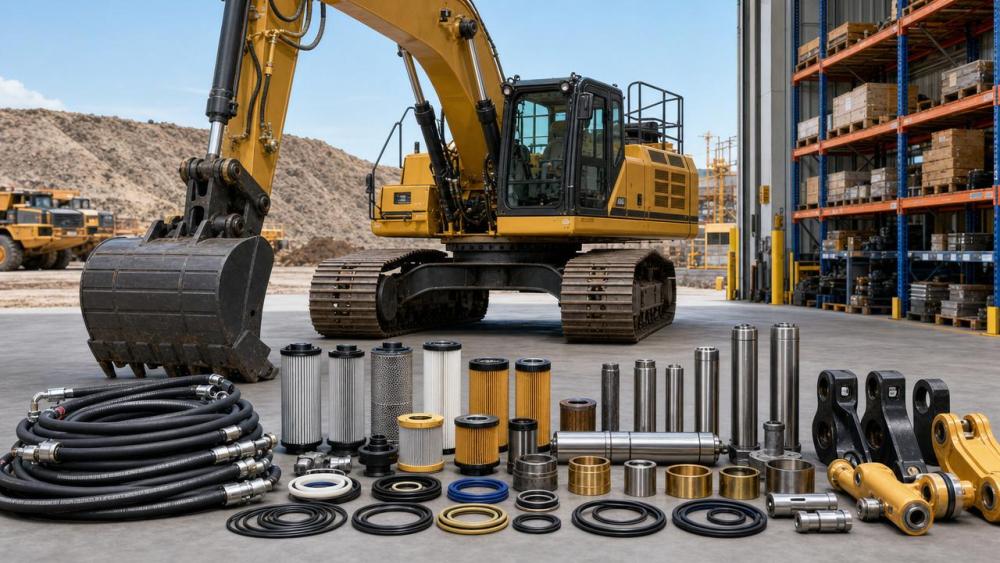
Downtime risk rises when a part fails before its expected service interval, performs inconsistently under load, or creates damage in adjacent systems. On heavy machines operating 8 to 14 hours per day, even a 4-hour stoppage can disrupt haul cycles, grading schedules, or trenching sequences across multiple crews.
For dealers and distributors, this means the quality of heavy machinery parts must be evaluated not only by purchase price, but by fit accuracy, material durability, pressure tolerance, wear rate, and compatibility with OEM or equivalent performance standards. A lower upfront cost may create a higher total cost within 30 to 90 days.
The Chain Reaction Behind One Weak Component
A single substandard part can trigger a sequence of losses. In hydraulic excavators, an inferior hose assembly may burst under peak pressure, causing oil loss, contamination, labor delays, and possible pump damage. In bulldozers, poor undercarriage parts can accelerate track wear, reduce tractive efficiency, and increase fuel burn over a 500-hour maintenance cycle.
Machines used in abrasive or impact-heavy environments face even narrower tolerance for part defects. Wheel loaders in quarry operations, graders on road base preparation, and skid steers working in confined demolition zones all expose components to high vibration, dust ingress, and repeated shock loading. Under these conditions, even a minor metallurgical or sealing weakness becomes operationally significant.
Where Failure Usually Starts
- Hydraulic seals losing integrity within the first 200 to 400 hours
- Pins and bushings showing uneven wear due to hardness inconsistency
- Filters with poor micron control allowing contamination to circulate
- Undercarriage components misaligned by small dimensional deviations
- Electrical sensors producing unstable readings in dust, heat, or vibration
These issues are common across mixed fleets. For agents working across several equipment categories, standardizing quality control on critical heavy machinery parts is one of the most effective ways to reduce emergency service events.
Downtime Costs Are Operational, Commercial, and Reputational
A failed component does more than stop a machine. It can idle a crew of 3 to 10 workers, delay material movement targets, and extend completion milestones by 1 to 3 days depending on jobsite logistics. For rental-heavy customers, machine unavailability can also trigger penalty clauses or force replacement units into service at higher cost.
From a channel perspective, repeat service claims reduce gross margin and consume warehouse, technical, and account-management resources. If customers experience 2 or 3 recurring failures on the same machine family, confidence in the supplier often drops faster than confidence in the machine itself.
The table below highlights how different part categories influence downtime severity and service urgency across common earthmoving applications.
The main takeaway is clear: not all failures are equal, but every category of heavy machinery parts can create downtime if quality control is weak. Dealers who rank parts by system criticality can protect service levels more effectively than those who buy only by unit cost.
How Dealers and Distributors Should Evaluate Heavy Machinery Parts
For channel partners, quality evaluation should follow a structured method. In practical terms, a good part is one that fits correctly on the first installation, performs consistently through its expected maintenance interval, and does not create secondary damage. That requires more than a visual check at receiving.
A useful screening framework includes 4 dimensions: dimensional accuracy, material integrity, operating compatibility, and supplier support responsiveness. Each dimension should be reviewed before adding a new line of heavy machinery parts to warehouse stock or field service inventory.
Four Core Quality Checks Before Stocking
- Confirm dimensional tolerance against OEM drawings or verified samples.
- Review material and process consistency for wear, heat, pressure, or corrosion resistance.
- Test operating fit on representative machine models or high-turn SKUs.
- Assess supplier response time for claims, replenishment, and technical clarification.
In mixed fleets, interchangeability matters. A distributor handling 20 to 50 active machine models cannot afford ambiguity around serial breaks, hydraulic pressure ranges, or software-linked sensor versions. Parts that appear compatible on paper but fail in field conditions are a common source of avoidable returns.
Critical Questions to Ask Suppliers
- What is the typical lead time: 7 to 15 days, or 4 to 6 weeks?
- Is the part validated for high-dust, high-vibration, or cold-start environments?
- Are there documented batch controls for seals, castings, or machined surfaces?
- Can the supplier support fast root-cause analysis within 24 to 72 hours?
- Is packaging designed to prevent rust, deformation, or contamination in storage?
These questions matter because quality is not limited to manufacturing. Storage, labeling, traceability, and technical support all shape whether heavy machinery parts perform reliably once they reach the field.
The comparison below can help distributors separate low-risk parts programs from higher-risk sourcing options.
The strongest sourcing programs usually combine technical validation with disciplined replenishment planning. This reduces both emergency freight costs and the hidden service burden that weak heavy machinery parts create over time.
Parts Quality by Equipment Type: Different Machines, Different Failure Priorities
Not every machine stresses components in the same way. Dealers serving multiple segments need to align part quality standards with actual application loads. What works on a lightly used urban skid steer may fail quickly on a quarry loader or a high-hour crawler excavator.
Crawler Excavators
Excavators place heavy demands on hydraulic cylinders, bucket linkage wear parts, filters, hoses, and swing-related components. Machines working in rock, demolition, or deep trenching often cycle under peak breakout force for long periods. In these conditions, 1 poor sealing surface or a contaminated filtration path can shorten component life dramatically.
For excavator-focused heavy machinery parts, distributors should pay close attention to pressure resistance, contamination control, and pin-bushing wear balance over 250 to 500 service hours.
Wheel Loaders and Bulldozers
Wheel loaders and bulldozers depend heavily on undercarriage or drivetrain durability, cooling system stability, and structural wear resistance. In bulk material handling, repeated shock loading and dust exposure make underbody and articulation-related parts especially sensitive to manufacturing quality.
Dozers also magnify the cost of poor-quality heavy machinery parts because track-related failures are labor-intensive to correct. A part that lasts 15% less than expected can erase margin through labor hours alone, even before secondary wear is counted.
Motor Graders and Skid Steer Loaders
Graders increasingly depend on precision control systems, blade circle wear parts, and sensor reliability. Small inaccuracies can affect surface quality targets, especially in road base or airport applications where tolerances may be measured in millimeters rather than centimeters.
Skid steers operate with high attachment variability. That means couplers, hydraulic auxiliary lines, and compact powertrain components need stable quality across frequent connection cycles. For agents supporting municipal or urban contractors, fast availability of dependable heavy machinery parts is often more important than broad but shallow inventory.
Practical Stocking Priorities by Segment
- Excavators: filters, seals, hoses, pins, bushings, bucket wear components
- Loaders: articulation parts, cooling parts, brake-related components, hydraulic lines
- Bulldozers: undercarriage items, track components, seal groups, final drive support parts
- Graders: blade wear items, circle support parts, sensors, hydraulic control elements
- Skid steers: couplers, auxiliary hydraulic fittings, filters, compact drivetrain service parts
This segmented approach helps distributors align capital with failure probability. In most cases, 20% of SKUs account for 60% to 80% of urgent field demand, making focused stocking strategies more effective than broad, slow-moving inventories.
Building a Low-Downtime Parts Program That Supports Sales Growth
The most resilient channel businesses do not treat parts as a back-end support function. They use parts quality and service reliability to strengthen account retention, increase repeat purchases, and differentiate from low-cost competitors. In practical terms, that means turning heavy machinery parts management into a disciplined uptime program.
A Five-Step Operating Model
- Map top failure points by machine category and operating environment.
- Rank critical SKUs by downtime impact, not only by order volume.
- Qualify suppliers using fit, traceability, and response-time criteria.
- Set reorder points based on 30-day, 60-day, and seasonal demand patterns.
- Track returns, repeat failures, and field feedback every quarter.
This model is especially useful in regions where infrastructure cycles create sudden demand spikes. When project starts accelerate, parts lead times can stretch from 10 days to 5 weeks. Dealers who prepare critical heavy machinery parts inventory in advance are better positioned to capture urgent service business without overcommitting capital.
Common Mistakes That Increase Downtime Exposure
- Buying solely on price without checking application fit or material consistency
- Using one supplier scorecard for both low-risk and mission-critical parts
- Ignoring packaging and storage controls for seals, filters, or electrical items
- Failing to separate fast-moving service parts from low-turn specialty items
- Responding to failures case by case instead of reviewing recurring patterns
When these issues persist, the business usually sees more emergency orders, more field complaints, and lower confidence from fleet customers. By contrast, a disciplined approach to heavy machinery parts quality supports stronger service agreements and more predictable account growth.
What Buyers Value Most From a Parts Partner
Contractors and fleet managers generally look for 3 things: reliable performance, quick availability, and clear technical guidance. They do not want to test questionable components in the field, especially on high-hour equipment where one failure may affect multiple linked systems.
That is why distributors who communicate lifecycle expectations, maintenance intervals, and application limits clearly often win more repeat business than those who compete only on discounting. In a market moving toward smarter, cleaner, and more uptime-sensitive machines, trust is built through consistent execution.
Quality heavy machinery parts reduce more than mechanical failures. They reduce uncertainty across service planning, customer communication, and inventory investment. For dealers, distributors, and agents serving the earthmoving sector, that translates into better machine uptime, stronger reputation, and healthier long-term margins.
If you are refining your sourcing strategy for excavators, loaders, graders, bulldozers, or skid steers, now is the right time to review which parts categories carry the highest downtime risk and where your current supply chain may be exposed. Contact us to discuss your parts program, request a tailored sourcing plan, or learn more about practical solutions for reducing downtime in demanding heavy equipment fleets.