
Related News
- 00
0000-00
How to size heavy-duty loaders for North American mining operations - 00
0000-00
How altitude affects mining excavator performance in Latin America - 00
0000-00
Caterpillar Launches New Cat 6060 and Upgraded Autonomous Mining System - 00
0000-00
When does eco-friendly construction equipment pay for itself? - 00
0000-00
Will a wheel loader quick coupler fit your existing attachments?
Industrial machinery trends in 2026 are changing how fleets are planned, funded, and upgraded across infrastructure, mining, logistics yards, and urban development.
Asset decisions now require sharper timing, deeper data, and stronger alignment between productivity, emissions rules, automation capability, and lifecycle economics.
For excavators, loaders, graders, bulldozers, and skid steers, the winning strategy is no longer simple replacement.
It is selective modernization built around utilization, jobsite variability, operator support, and future control architectures.
Why industrial machinery trends are accelerating fleet change in 2026
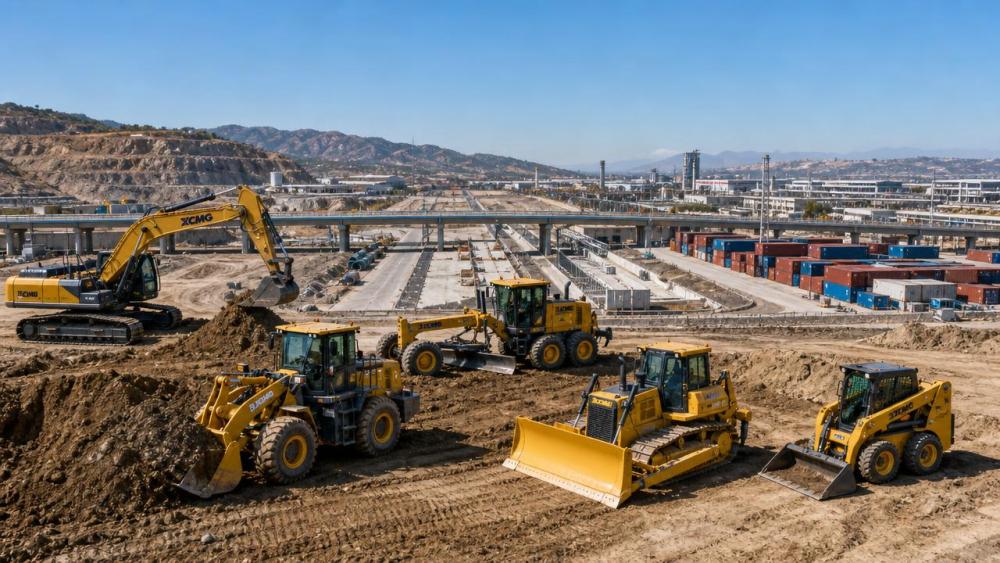
Several industrial machinery trends are converging at once, making old fleet planning assumptions less reliable than they were just three years ago.
Equipment categories once planned separately now interact through telematics platforms, emissions compliance pathways, and mixed-power operating models.
Crawler excavators increasingly anchor data capture on complex sites, while wheel loaders and bulldozers are judged by fuel burn, idle time, and traction efficiency.
Motor graders face higher precision expectations because digital site models are becoming standard on airport, highway, and industrial estate projects.
Skid steers are gaining strategic value because dense urban work demands compact machines with attachment flexibility and short setup cycles.
Across the market, fleet plans are moving from equipment ownership logic toward capability portfolio logic.
That shift is one of the most important industrial machinery trends shaping capital allocation in 2026.
The strongest trend signals now visible across heavy equipment fleets
The clearest signals are not isolated product launches. They are operating patterns appearing across many machine classes and project environments.
- More fleets are extending core assets while upgrading controls, sensors, and remote diagnostics.
- Electrification is growing first in compact, repetitive, and urban-duty applications.
- Autonomy readiness matters even when fully autonomous operation is still limited.
- Mixed fleets are replacing uniform fleets because jobsites now vary faster than equipment cycles.
- Telematics data is becoming a board-level input for replacement timing and asset redeployment.
- Compliance risk is increasingly evaluated alongside maintenance cost and residual value.
These industrial machinery trends suggest that future-ready fleets will be designed around adaptability rather than peak single-task output.
What is driving industrial machinery trends behind the planning shift
The forces behind current industrial machinery trends are both technological and structural.
Together, they are redefining the threshold for what counts as an efficient fleet.
EMD’s coverage of earthmoving equipment shows that these drivers rarely act alone.
Their combined impact is why industrial machinery trends now affect strategy more than short-term purchasing tactics.
How these trends affect excavators, loaders, graders, bulldozers, and skid steers
Different machine families feel these industrial machinery trends in different ways, but planning implications are increasingly connected.
Crawler excavators
Excavators are becoming data-rich production assets, not only digging units.
Fleet value rises when electro-hydraulic control, payload insight, and grade assistance improve repeatability and reduce rework.
Wheel loaders
Loaders are judged more heavily on cycle efficiency, fuel intensity, and loading precision.
In quarries, ports, and bulk yards, utilization analytics increasingly influence replacement timing.
Motor graders
Graders benefit strongly from digital model integration.
Where millimeter-level finish matters, sensor accuracy and operator-assist functions now shape revenue quality as much as blade power.
Bulldozers
Dozers remain vital for heavy push work, but hydrostatic efficiency and blade control are drawing more attention.
Projects increasingly reward precise earth movement, not only raw tractive force.
Skid steer loaders
Skid steers are gaining relevance because attachment density multiplies utilization.
For compact sites, they support a modular fleet model aligned with current industrial machinery trends.
The business impact is spreading beyond equipment ownership decisions
One major result of these industrial machinery trends is that fleet planning now affects scheduling, financing, maintenance structure, and digital infrastructure.
A machine lacking data compatibility may still perform physically, yet weaken jobsite coordination and reporting accuracy.
Likewise, a lower-cost machine can become expensive if it fails future emissions access requirements or remote service expectations.
This is especially relevant in multi-region operations where regulations, labor conditions, and project durations differ sharply.
- Maintenance planning becomes more predictive and software-linked.
- Capital budgeting shifts toward phased upgrades instead of full resets.
- Residual value depends more on digital capability and compliance status.
- Training investment becomes part of equipment ROI calculation.
Where attention should focus as industrial machinery trends reshape priorities
The most useful response is disciplined prioritization.
Not every machine needs every new feature, but every fleet needs a clear modernization logic.
- Map each asset by duty cycle, idle ratio, maintenance burden, and compliance exposure.
- Identify which machines require automation readiness within the next three to five years.
- Separate urban, mining, infrastructure, and yard applications when evaluating electrification potential.
- Audit telematics quality before trusting utilization-based replacement rules.
- Review attachment strategy for skid steers and compact loaders to improve flexibility.
- Track software support life alongside engine and hydraulic service life.
These focus areas convert industrial machinery trends into measurable planning criteria.
A practical framework for the next fleet planning cycle
The next review cycle should combine market scanning with machine-level analysis.
This approach supports better timing, stronger resilience, and clearer investment sequencing.
The next move should be evidence-based and capability-led
Industrial machinery trends in 2026 are not only about new machines.
They are about building fleets that can absorb regulation, digitization, labor shifts, and changing project demands without losing productivity.
A strong next step is to review the fleet as a coordinated operating system.
Assess utilization, emissions exposure, control readiness, and data compatibility across every core machine class.
With a clearer evidence base, industrial machinery trends become less of a disruption and more of a source of durable advantage.