
Related News
- 00
0000-00
How to size heavy-duty loaders for North American mining operations - 00
0000-00
How altitude affects mining excavator performance in Latin America - 00
0000-00
Caterpillar Launches New Cat 6060 and Upgraded Autonomous Mining System - 00
0000-00
When does eco-friendly construction equipment pay for itself? - 00
0000-00
Will a wheel loader quick coupler fit your existing attachments?
In 2026, construction equipment technology is moving beyond incremental upgrades into a new era of electrification, autonomy, precision control, and data-driven performance. For technical evaluators, tracking these shifts is no longer optional—it is essential for benchmarking machine capability, compliance readiness, operating efficiency, and long-term asset value. This article highlights the innovations most likely to reshape excavators, loaders, graders, bulldozers, and compact equipment across global infrastructure markets.
For most technical evaluators, the core question is not which technology sounds most advanced. It is which technologies are mature enough to affect fleet specifications, safety standards, uptime, emissions compliance, and total cost of ownership in 2026.
The short answer is clear. The most important construction equipment technology trends to track are electrified powertrains, smarter hydraulics, onboard machine intelligence, interoperable telematics, advanced grade control, remote and autonomous functions, and designs built around serviceability and energy efficiency.
These are not isolated innovations. They are increasingly connected at the machine, jobsite, and fleet levels. That is why technical assessment now requires more than checking horsepower, bucket size, or operating weight. It requires judging system integration quality and real-world deployment readiness.
What technical evaluators should prioritize when assessing construction equipment technology in 2026
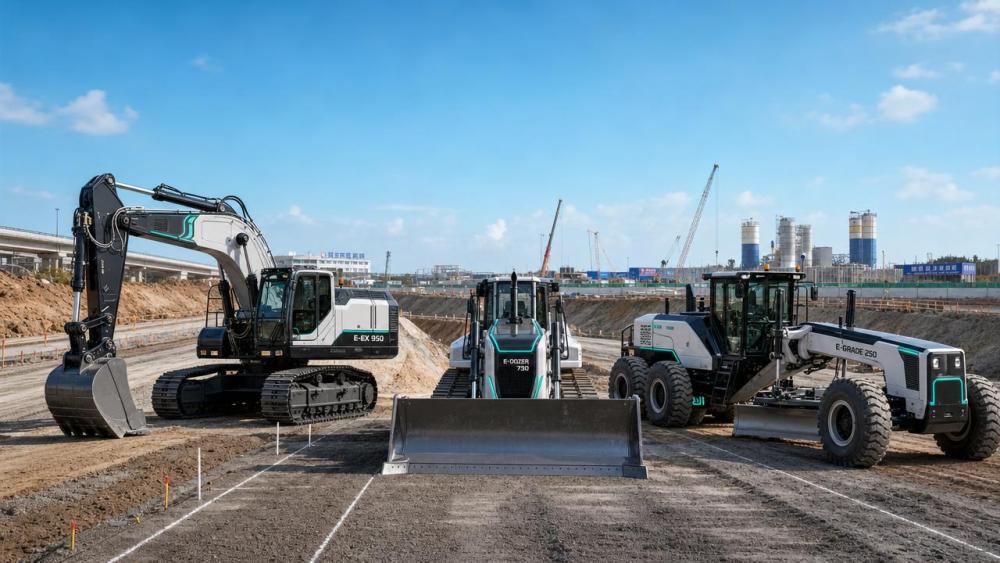
Technical evaluators typically need to separate market hype from usable engineering value. In 2026, the best evaluation framework starts with five filters: application fit, reliability, operator impact, regulatory readiness, and measurable efficiency gains under real duty cycles.
Application fit matters first because technology value changes by machine category. A battery-electric compact loader may deliver immediate advantages in urban indoor work, while a large crawler excavator may benefit more from electro-hydraulic optimization and semi-autonomous digging functions than full electrification.
Reliability remains the decisive filter. A machine with advanced sensing, connectivity, and automation still fails the test if the architecture adds fault points, calibration complexity, or limited field support. Evaluators should examine not only feature lists but also fallback modes and diagnostic accessibility.
Operator impact is another practical priority. Construction equipment technology only delivers value when operators can use it consistently. Interfaces, control logic, display clarity, and workflow simplicity increasingly determine whether advanced features improve productivity or remain underused options.
Regulatory readiness has also moved into the center of equipment evaluation. Emissions rules, noise restrictions, safety expectations, and data reporting requirements vary by region, but global fleets cannot afford technology decisions that create near-term compliance gaps or resale limitations.
Finally, every technology claim should link to measurable jobsite outcomes. Fuel burn per hour, tons moved per liter, cycle time consistency, grading accuracy, idle reduction, tire or undercarriage wear, and mean time to repair are better indicators than promotional language.
Electrification is expanding, but the evaluation criteria differ by machine class
Electrification is one of the most visible construction equipment technology trends, yet its practical value depends heavily on machine size, duty intensity, charging access, and attachment requirements. Technical evaluators should avoid applying one electrification standard across all equipment segments.
In compact and light-duty segments, electric skid steer loaders, mini excavators, and small wheel loaders are becoming more credible for 2026 deployment. Their work cycles, urban access needs, and growing exposure to low-emission zones make electrified platforms increasingly relevant.
For these machines, evaluation should focus on battery durability, thermal management, charging time, real payload impact, and hydraulic performance under sustained operation. Quiet operation and zero tailpipe emissions are advantages, but they do not compensate for weak duty-cycle endurance.
In heavier classes such as crawler excavators, bulldozers, and large loaders, full battery-electric designs remain more application-specific. Here, hybrid systems, energy recovery strategies, electric swing drives, and electrified auxiliary systems may offer stronger near-term value than complete drivetrain replacement.
Evaluators should also look beyond the machine itself. Charging ecosystem compatibility, site electrical capacity, safety procedures for high-voltage servicing, and battery lifecycle support all affect whether an electrified fleet can scale economically across regional operations.
In short, electrification should be judged as a deployment strategy, not a branding feature. The best construction equipment technology choices in 2026 will often be mixed fleets where electric, hybrid, and advanced diesel solutions are matched carefully to task profiles.
Electro-hydraulic control is becoming a major source of efficiency and precision
Hydraulics remain central to earthmoving performance, and one of the most important shifts in construction equipment technology is the move from conventional hydraulic behavior toward electronically managed, sensor-rich, software-optimized control architectures.
For excavators, this means more refined boom, arm, bucket, and swing coordination. Electro-hydraulic proportional control can reduce wasted flow, improve metering accuracy, and support smoother multi-function operation. The result is better controllability, lower fuel consumption, and less operator fatigue.
For wheel loaders and bulldozers, hydraulic intelligence increasingly supports faster response under variable loads, more efficient implement movement, and improved traction-power coordination. In grading equipment, hydraulic precision directly affects blade control quality and final surface consistency.
Technical evaluators should test these systems under realistic work scenarios rather than in demonstration mode. Important indicators include response lag, repeatability, controllability at low speed, heat generation, and how well the machine maintains precision after long operating periods.
Another key factor is tunability. Machines that allow selectable work modes, attachment presets, or operator-specific control profiles may generate meaningful productivity gains. However, tuning should remain transparent and stable, not overly complex or dependent on proprietary service intervention.
This area deserves close attention because it links directly to productivity and fuel efficiency without requiring dramatic changes in operator behavior. In many applications, smarter hydraulics will deliver a faster return than more headline-grabbing autonomous features.
3D guidance, machine control, and site positioning are moving from premium options to baseline expectations
Precision control technologies are no longer limited to flagship projects. In 2026, advanced GNSS, IMU, laser, and camera-based machine guidance systems are becoming essential construction equipment technology, especially for graders, dozers, excavators, and compact machines in constrained sites.
For motor graders, high-accuracy machine control remains one of the clearest productivity multipliers. It can reduce rework, improve material efficiency, and increase pass consistency. Evaluators should assess not only stated accuracy, but calibration speed, signal robustness, and blade response integration.
For excavators, 2D and 3D guidance now increasingly supports trenching, slope shaping, and utility work with less dependence on repeated staking. Here, screen usability, bucket tip tracking accuracy, and compatibility with existing site models are key technical decision points.
Bulldozers benefit from automated blade assistance and terrain-aware control that help maintain grade while reducing overcut and underfill risk. These functions can be especially valuable where labor shortages limit access to highly experienced operators.
Interoperability deserves special scrutiny. Technical evaluators should verify whether machine control systems can exchange data smoothly with survey software, mixed-brand site workflows, and contractor BIM environments. Closed ecosystems may simplify setup but can create long-term procurement constraints.
The value proposition is strongest when accuracy gains, reduced staking costs, and lower material waste are documented with project data. For evaluators, the question is less whether precision technology works and more how easily it fits real operational processes.
Autonomy and remote operation are becoming practical in targeted use cases
Fully autonomous earthmoving across all environments is still limited, but remote and semi-autonomous functions are becoming practical construction equipment technology in mining, hazardous excavation, repetitive loading zones, and selected infrastructure projects with controlled workflows.
Remote operation is particularly important where safety exposure is high. Demolition zones, unstable slopes, tunnels, contaminated sites, and high-risk mining areas all benefit when operators can control machines from protected stations or off-site control rooms.
For technical evaluators, the most important criteria are latency tolerance, signal resilience, fail-safe behavior, camera and sensor visibility quality, and degraded-mode operation. A remote-capable machine is only valuable if control remains predictable during communication interruptions or environmental interference.
Semi-autonomous functions may offer broader near-term adoption than full autonomy. Assisted digging, return-to-grade functions, automated bucket positioning, traction optimization, and path repetition features can improve consistency without removing human oversight from the loop.
These systems should be assessed for explainability and operator trust. If automation logic is difficult to interpret, operators may disable it. Clear feedback, smooth intervention transitions, and auditable event records are increasingly important in both safety and acceptance terms.
In 2026, autonomy should be viewed as a layered capability model. Evaluators should identify which specific tasks can be automated safely and profitably rather than asking whether an entire machine can operate without a human presence.
Fleet telematics is evolving into an evaluation tool, not just a tracking feature
Telematics is no longer just about location and hours. The next phase of construction equipment technology is data systems that support technical benchmarking, predictive maintenance, operator coaching, and cross-fleet performance comparison at a much deeper level.
Modern telematics platforms can expose idle patterns, overload events, fuel inefficiency, battery state trends, hydraulic temperature anomalies, fault frequency, and geofenced usage behavior. For evaluators, this data can validate or challenge OEM performance claims after deployment.
The key issue is data quality and usability. A platform that produces large volumes of isolated machine data without standardized export, exception logic, or actionable visualization creates reporting noise rather than engineering value.
Interoperability is again central. Mixed fleets need telematics environments that can consolidate data from excavators, loaders, graders, bulldozers, and compact equipment across different brands. Evaluators should check API availability, data ownership terms, and integration with maintenance systems.
Predictive maintenance functions are also improving. Machines can increasingly flag component stress patterns before visible failure occurs, but evaluators should verify model reliability. False positives can overwhelm maintenance teams, while false negatives erode confidence quickly.
When implemented well, telematics turns construction equipment technology into a measurable asset strategy. It allows technical teams to compare machine classes by output, downtime risk, and application efficiency, improving procurement and replacement decisions over time.
Serviceability, software support, and upgrade pathways now influence equipment value more than many buyers expect
One of the most underappreciated technology trends in 2026 is the shift from static machine ownership toward software-enabled equipment life cycles. This changes how technical evaluators should think about long-term value and risk.
A machine with strong hardware but weak software support may age quickly. Feature updates, cybersecurity patches, calibration tools, and compatibility with new site systems increasingly affect useful life. The machine is now part mechanical asset, part digital platform.
Serviceability remains equally important. Advanced construction equipment technology often introduces more sensors, controllers, and high-voltage or communication components. If these are difficult to access, diagnose, or replace, downtime costs can rise despite impressive baseline performance.
Evaluators should ask practical questions: Can software updates be done remotely or only through dealer visits? Are diagnostic tools restricted? How modular are sensors and control units? Is documentation detailed enough for high-level internal engineering review?
Parts support and technician training also matter more in a technology-heavy fleet. Even the best automation or precision package can become a liability in remote regions if specialist support is slow or scarce. Global deployment planning must include service ecosystem maturity.
In many procurement decisions, this category becomes a hidden differentiator. The machine that appears slightly less advanced on paper may create more value if it is easier to maintain, update, integrate, and support over a seven- to ten-year operating horizon.
How to build a practical 2026 evaluation checklist for construction equipment technology
For technical evaluators, the best response to a rapidly changing market is a structured assessment model. This helps compare new construction equipment technology across brands and machine classes without being distracted by demonstrations designed for ideal conditions.
Start with use-case definition. Document material type, cycle intensity, attachment profile, terrain, climate, duty hours, site constraints, and operator skill assumptions. Technology should be scored against these realities, not generic category expectations.
Next, evaluate systems by performance domain: powertrain efficiency, hydraulic responsiveness, machine control accuracy, operator interface quality, telematics usefulness, maintainability, and compliance readiness. This creates a balanced view between innovation and deployability.
Then request evidence. Ask for field data, not only brochure specifications. Look for side-by-side productivity records, fuel or energy curves, fault history, update records, and references from comparable projects. Technology confidence should be earned through operational proof.
It is also useful to separate mature features from experimental ones. A mature feature is supported by repeatable field performance, available service capability, and clear integration guidance. Experimental features may still be worth tracking, but they should be valued differently.
Finally, connect evaluation outcomes to lifecycle economics. The right machine technology in 2026 is the one that improves output quality, reduces risk, supports compliance, and remains serviceable as fleet requirements evolve. Technical excellence must translate into operational resilience.
Conclusion: the technologies worth tracking are the ones that improve decisions, not just machines
In 2026, construction equipment technology is becoming more connected, more software-defined, and more application-sensitive than at any previous point in the industry. For technical evaluators, that means assessment methods must evolve alongside the machines themselves.
The most important trends to track are not simply electrification or autonomy in the abstract. They are the specific combinations of electrified systems, intelligent hydraulics, precision machine control, telematics, and serviceable digital architecture that deliver usable advantages in real jobsites.
For excavators, loaders, graders, bulldozers, and compact machines alike, the strongest technologies will be those that improve accuracy, uptime, operator consistency, compliance readiness, and lifecycle efficiency. Those are the metrics that matter when investments face scrutiny.
As global infrastructure work becomes more demanding and more data-driven, technical evaluators will play a central role in separating durable engineering progress from short-lived market noise. In that environment, disciplined technology tracking becomes a direct source of competitive advantage.