
Related News
- 00
0000-00
How to size heavy-duty loaders for North American mining operations - 00
0000-00
How altitude affects mining excavator performance in Latin America - 00
0000-00
Caterpillar Launches New Cat 6060 and Upgraded Autonomous Mining System - 00
0000-00
When does eco-friendly construction equipment pay for itself? - 00
0000-00
Will a wheel loader quick coupler fit your existing attachments?
As 2026 approaches, autonomous construction is moving from trade-show promise to boardroom priority.
The core issue is practical.
Can autonomous construction reduce labor pressure, improve safety, and cut project costs without adding new risks?
For infrastructure, mining, utilities, and urban development, the answer is becoming more nuanced.
Some use cases already generate measurable savings.
Others remain expensive pilots shaped by site complexity, connectivity limits, and weak workflow integration.
Within heavy equipment intelligence, EMD tracks this shift closely across excavators, loaders, graders, bulldozers, and compact machines.
The real opportunity is not full machine independence everywhere.
It is targeted autonomy where repeatable tasks, digital site control, and disciplined fleet management create dependable value.
What does autonomous construction actually mean in 2026?
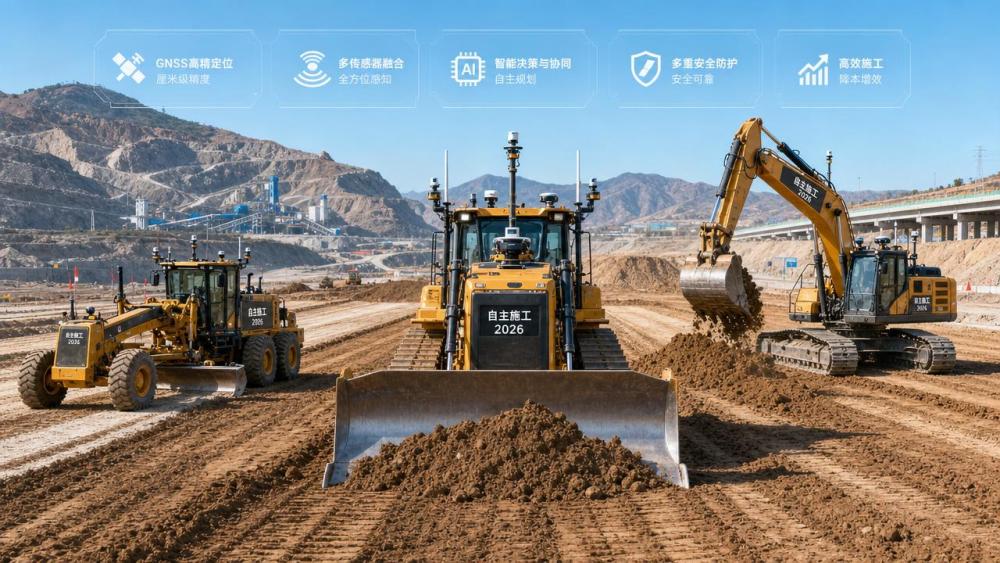
Autonomous construction does not mean every machine works alone with no human oversight.
In 2026, most deployments sit on a spectrum.
That spectrum includes operator assist, remote control, supervised autonomy, and limited fully autonomous task execution.
For crawler excavators, this may include automated dig cycles in defined zones.
For motor graders, it often means blade automation linked to GNSS, IMU, and 3D site models.
For bulldozers, autonomy is strongest in repetitive push patterns on controlled earthmoving pads.
For skid steer loaders, autonomy remains more constrained because urban environments are tighter and less predictable.
This distinction matters because unrealistic expectations cause poor investment decisions.
Autonomous construction is best understood as a layered operating model.
- Machine perception through cameras, radar, lidar, and positioning systems
- Control automation through electro-hydraulic and drive-by-wire systems
- Site intelligence through digital plans, geofencing, and task orchestration
- Human supervision through remote intervention and safety governance
When one layer is weak, autonomous construction performance drops quickly.
That is why polished demos often look stronger than field reality.
Where is autonomous construction already delivering real savings?
The strongest business case appears in structured, repetitive, high-hour environments.
Examples include quarry loading zones, mine haul support, mass grading, landfill operations, and large greenfield infrastructure sites.
In these settings, routes are predictable and work surfaces are easier to map.
Autonomous construction can improve utilization by reducing idle time, rework, and inconsistent cycle execution.
Savings usually come from four areas.
1. Lower rework and tighter grade accuracy
Precision grading systems reduce overcut, undercut, and excessive material movement.
Even small accuracy gains can create large cost reductions on long road or airport projects.
2. Better machine consistency
Autonomous construction does not get tired, distracted, or inconsistent across shifts.
That can stabilize fuel burn, cycle times, and component wear.
3. Safer operation in hazardous zones
Remote and autonomous systems reduce direct exposure near unstable slopes, blast areas, dust-heavy pits, and contaminated ground.
Safety value is not always booked as direct savings, but it reduces interruption risk.
4. Labor resilience
In regions with skilled operator shortages, autonomous construction supports output continuity.
That may matter more than headline labor reduction.
The best savings cases rarely come from replacing entire crews immediately.
They come from extending productive hours, reducing errors, and making expert supervision scalable across several machines.
What are the biggest risks behind the autonomous construction hype?
The hype around autonomous construction often ignores integration risk.
Machines do not operate in isolation.
They depend on digital terrain models, reliable positioning, communication coverage, maintenance discipline, and site traffic rules.
If these foundations are weak, autonomy can magnify confusion instead of removing it.
Common risks include:
- Poor sensor performance in dust, rain, glare, mud, or heavy vibration
- Connectivity gaps that interrupt remote supervision or fleet coordination
- Cybersecurity exposure across telematics, cloud platforms, and control interfaces
- Liability uncertainty after near misses or mixed-control incidents
- Unexpected retraining needs for technicians, planners, and field supervisors
Another risk is buying autonomy before digitizing the site.
Without accurate surface data, change management, and workflow discipline, autonomous construction cannot perform reliably.
There is also a branding trap.
Some systems marketed as autonomous are really advanced operator-assist packages.
That does not make them useless.
It means expected savings should be benchmarked against actual task automation, not marketing language.
Which projects and machine classes are the best fit?
Autonomous construction works best where variability is low and repeatability is high.
That favors large civil earthworks more than highly congested city-center jobs.
The fit also differs by machine type.
If a site includes dense pedestrian traffic, constant design changes, and uneven digital coverage, autonomous construction will face limits.
In those situations, semi-autonomous functions may offer a stronger return than full task autonomy.
How should organizations judge ROI, risk, and timing?
A good autonomous construction decision starts with task economics, not technology excitement.
Measure the task first.
Then test whether autonomy improves the weakest part of that workflow.
Useful evaluation questions include:
- Is the work repetitive enough for autonomous construction to learn stable patterns?
- Are grade models, survey updates, and machine guidance data already reliable?
- Can the site support communication uptime for supervision and intervention?
- Will the savings come from fuel, labor resilience, cycle speed, safety, or rework reduction?
- What happens when autonomy fails or hands control back to humans?
The timing question is equally important.
For many fleets, 2026 is the year to scale pilots with strict KPIs, not the year to automate everything.
Early wins often come from combining machine control, telematics, remote diagnostics, and limited autonomous construction modules.
That blended approach reduces risk while building internal competence.
What practical steps make autonomous construction more successful?
Success depends less on a single machine purchase and more on operating system maturity.
The following checklist is practical and realistic.
EMD’s monitoring of earthmoving technology suggests one consistent pattern.
Autonomous construction performs best when paired with disciplined hydraulic maintenance, software governance, and workflow mapping.
The machine matters, but the operating environment matters more.
So, is autonomous construction hype, risk, or real savings?
It is all three, depending on the task and the readiness of the site.
Autonomous construction is hype when sold as universal automation without process discipline.
It is risk when organizations underestimate data quality, safety governance, or control handover complexity.
It delivers real savings when used in repeatable, digitally managed, high-hour operations where precision and uptime matter.
For 2026, the strongest strategy is selective adoption.
Prioritize machine classes and jobs where autonomous construction solves a visible operational bottleneck.
Build from operator assist to supervised autonomy.
Track results through rework, fuel, uptime, safety exposure, and cycle stability.
The next step is simple.
Map one repetitive workflow, define measurable KPIs, and test autonomous construction where digital control is already strong.
That is where confidence, and real savings, usually begin.