
Related News
- 00
0000-00
How to size heavy-duty loaders for North American mining operations - 00
0000-00
How altitude affects mining excavator performance in Latin America - 00
0000-00
Caterpillar Launches New Cat 6060 and Upgraded Autonomous Mining System - 00
0000-00
When does eco-friendly construction equipment pay for itself? - 00
0000-00
Will a wheel loader quick coupler fit your existing attachments?
Heavy equipment maintenance costs can quickly erode margins, making every repair decision a financial strategy issue—not just an operational one. For budget owners and approval stakeholders, the real question is whether extending asset life delivers better value than investing in replacement. This article examines how to evaluate downtime, repair frequency, residual value, and total cost of ownership to support smarter capital decisions.
For finance approvers in earthmoving, mining support, roadbuilding, and infrastructure fleets, the repair-versus-replace decision is rarely about a single invoice. It is about cash flow timing, project continuity, utilization rates, emissions compliance, and how quickly an aging asset turns from productive equipment into a margin risk.
Whether the asset is a crawler excavator, wheel loader, motor grader, bulldozer, or skid steer loader, the same discipline applies: compare near-term repair spending with the remaining economic life of the machine, then test that result against replacement cost, financing conditions, and the operational value of higher uptime.
Why heavy equipment maintenance decisions matter at the budget level
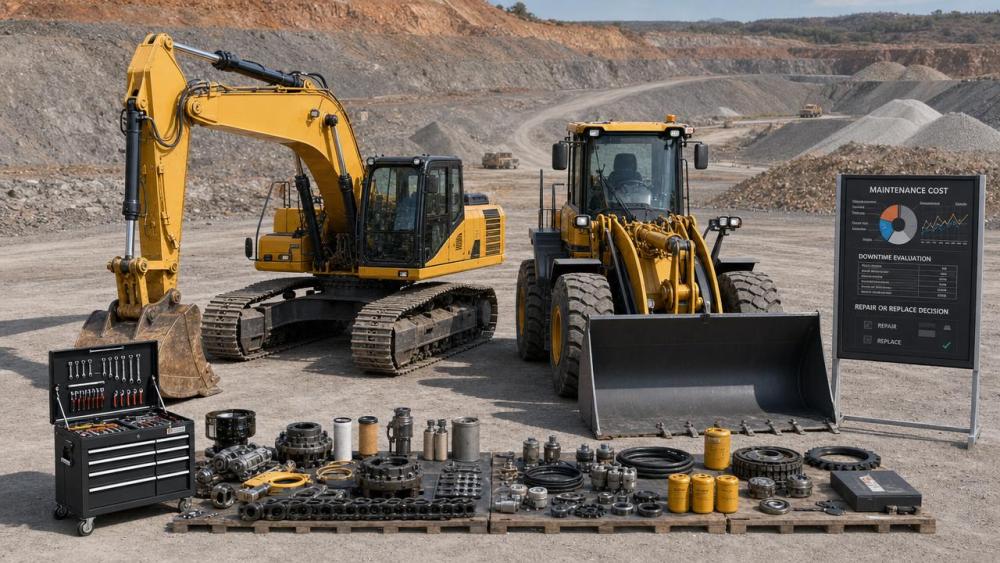
In capital-intensive fleets, heavy equipment maintenance is not a back-office line item. For a machine operating 1,200 to 2,000 hours per year, even a 3% to 5% increase in unplanned downtime can affect job schedules, fuel burn, subcontractor costs, and penalty exposure.
For finance teams, the first mistake is evaluating repair cost in isolation. A $25,000 hydraulic overhaul may look cheaper than a replacement cycle. But if that same machine loses 12 working days, requires rented backup equipment, and suffers lower resale value six months later, the apparent savings can disappear quickly.
The four cost layers behind every repair approval
- Direct repair expense: parts, labor, diagnostics, transport, and field service call-outs.
- Indirect downtime loss: idle crews, delayed milestones, and lower production output.
- Risk cost: repeat failure, safety incidents, and missed compliance upgrades.
- Opportunity cost: capital tied to an aging asset instead of a more efficient machine.
These cost layers are especially relevant in high-intensity applications. A crawler excavator in quarry work, a bulldozer on mass earthworks, or a grader on airport paving tolerates far less interruption than a lightly used support machine. The financial threshold for replacement therefore varies by duty cycle, not by equipment age alone.
Common financial signals that maintenance cost is becoming strategic
Approval teams should escalate review when any of the following conditions appear for 2 consecutive quarters: maintenance cost rising above 10% to 15% of current asset value, unscheduled downtime exceeding 8% of available operating hours, or repair frequency increasing from quarterly events to monthly interventions.
A second warning sign is concentration risk. If one aging excavator supports a critical trenching package, or one grader is essential for final surface tolerance within ±10 mm, a breakdown affects far more than one balance-sheet line. It disrupts project sequencing and can trigger expensive workflow bottlenecks.
How to compare repair and replacement using total cost of ownership
A reliable decision framework starts with total cost of ownership rather than sticker price. Finance approvers should compare the next 12 to 36 months under two scenarios: keep and repair the existing machine, or replace it with a newer asset through purchase, lease, or fleet rotation.
Key variables to model
- Expected annual operating hours, such as 800, 1,500, or 2,200 hours.
- Planned and unplanned maintenance cost per month or per 100 operating hours.
- Average downtime days per failure event and backup rental cost.
- Fuel efficiency gap between old and newer units, often 5% to 15% depending on duty cycle.
- Residual value now versus after another 12 to 24 months of use.
- Financing cost, depreciation treatment, and emissions compliance risk.
The table below gives a practical comparison model for budget reviews. It does not assume a specific brand or machine class, but it reflects common fleet evaluation logic used across earthmoving equipment categories.
The main conclusion is simple: low upfront repair spend does not automatically mean lower ownership cost. If replacement improves uptime, lowers operating friction, and protects resale timing, the higher acquisition cost can still deliver stronger financial performance within 18 to 36 months.
A practical threshold rule for approvers
Many fleet managers use a threshold test when evaluating heavy equipment maintenance decisions. If one major repair exceeds 50% of the machine’s current market value, or if cumulative annual repair spend exceeds 20% to 30% of replacement value, replacement should move from optional to active review.
This rule is not universal. A specialized bulldozer with a predictable undercarriage rebuild path may justify further investment. A heavily cycled skid steer with repeated hydraulic and drivetrain faults may not. The point is to compare spending against remaining productive life, not against emotional attachment to the asset.
Machine-specific triggers: when repair still makes sense and when it does not
Different machine classes age differently. A finance approval process works better when tied to component risk profiles rather than a single fleet-wide rule. The wear logic for a crawler excavator is not the same as for a motor grader or compact loader.
Crawler excavators and wheel loaders
Repair often remains justified when the structure is sound, service history is complete, and the issue is limited to one major system such as pumps, cylinders, or engine ancillaries. However, replacement becomes more compelling when boom wear, swing bearing looseness, frame fatigue, and repeated hydraulic contamination appear together within a 6- to 12-month period.
Typical review points
- Undercarriage or tire replacement cycle versus expected remaining machine life.
- Hydraulic system cleanliness after previous failures.
- Bucket, linkage, and pin wear affecting precision and productivity.
- Idle time percentage and fuel burn during loading or trenching cycles.
Motor graders and bulldozers
For graders, precision matters as much as power. If sensor integration, blade control response, or steering performance no longer supports tolerance-sensitive work, the machine may still run but no longer meet profitable job requirements. On bulldozers, undercarriage wear, transmission condition, and final drive health can reshape the economics quickly because these components carry high replacement cost.
Skid steer loaders in urban or compact sites
Compact machines usually have lower unit cost, but their utilization pattern is intense and attachment-related wear is often underestimated. If a skid steer sees daily attachment changes, repeated hose damage, and cooling system contamination, small repairs can accumulate into a disproportionate maintenance burden over 12 months.
The next table summarizes common decision triggers by equipment category. It can help approvers move from general impressions to a more structured review standard.
This matrix shows that the best heavy equipment maintenance decision depends on failure pattern, production role, and remaining structural value. The more failures spread across multiple systems, the less likely repair spending will generate a strong return.
A five-step approval process for finance teams
A disciplined approval process helps remove urgency-driven decisions. It also creates a repeatable standard across different project teams, regions, and machine classes. In most fleets, a five-step method is enough to improve decision quality without slowing operations.
Step 1: Verify utilization and role criticality
Confirm whether the machine runs 500 hours per year or 2,000. A lightly used backup loader should not be judged by the same rules as a primary excavator working two shifts. Also rank the asset as critical, support, or non-core based on project dependency.
Step 2: Separate one-time failure from recurring pattern
Approvers should ask whether the proposed repair resolves a contained event or follows 3 to 4 interventions in the same system over the last 12 months. Recurring faults usually indicate deeper lifecycle decline, contamination issues, operator mismatch, or unsuitable application conditions.
Step 3: Estimate all-in downtime cost
Downtime should be priced in full. Include crew idle hours, replacement rental, transport delays, and project sequencing losses. In some infrastructure packages, one lost machine day can trigger several downstream cost events, especially where grading, loading, and haul coordination are tightly linked.
Step 4: Check residual value timing
An often-missed point in heavy equipment maintenance planning is timing the exit. Selling or trading an asset before another major wear event may preserve more value than keeping it for 9 more months and then absorbing both the repair invoice and a lower resale outcome.
Step 5: Compare replacement pathways
Replacement does not always mean a full cash purchase. It may involve short-cycle leasing, a used-equipment upgrade, fleet standardization, or redeploying a lower-hour machine from another region. Approval quality improves when at least 2 to 3 replacement pathways are priced side by side.
Frequent mistakes that lead to poor repair-versus-replace decisions
Even experienced organizations can misjudge maintenance economics. Most errors come from measuring the visible invoice while ignoring hidden performance losses. For financial stakeholders, the goal is not to avoid spending. It is to spend where asset productivity remains defensible.
Mistake 1: Treating all repair dollars as equal
A planned $18,000 rebuild during a low-demand window is not equal to an emergency $18,000 repair that stops a contract-critical machine. The second event carries disruption, overtime, and often expedited parts costs that may raise the true impact by 25% or more.
Mistake 2: Ignoring technology and compliance gaps
Newer machines may offer telematics visibility, tighter hydraulic control, lower fuel use, and better alignment with non-road emissions rules. If an older unit cannot support data-driven fleet management or future site access requirements, continued repair may only delay a necessary transition.
Mistake 3: Delaying action until residual value collapses
When approval teams postpone decisions for too long, they often lose both ways: the machine consumes growing maintenance cost and then sells into the market after another visible failure. A 10% to 15% residual value drop can materially change lifecycle economics in a single year.
What finance approvers should ask before signing the next repair order
Before approving a major repair, request a short decision brief from operations or the fleet manager. This should fit on 1 to 2 pages and answer the commercial questions behind the technical recommendation.
Essential approval questions
- What are the last 12 months of maintenance events and total spend on this machine?
- How many downtime days did those events create?
- What revenue, production, or schedule role does this asset support?
- Will this repair extend useful life by 6 months, 12 months, or more than 24 months?
- What is the expected resale or trade value now compared with after the repair cycle?
- What are the 2 best replacement alternatives and their monthly cost impact?
These questions shift the conversation from workshop logic to investment logic. That is the right frame for finance-led approvals in heavy civil, mining support, site development, and municipal infrastructure fleets.
The strongest repair-versus-replace decisions come from combining maintenance records, utilization data, downtime economics, and residual value timing into one view. For finance approvers, heavy equipment maintenance should be judged by total business impact, not by invoice size alone. If your team is reviewing aging excavators, loaders, graders, bulldozers, or skid steers, now is the time to build a clearer lifecycle decision model. Contact us to discuss a tailored equipment evaluation framework, compare replacement pathways, and get more practical solutions for cost-controlled fleet performance.