
Related News
- 00
0000-00
How to size heavy-duty loaders for North American mining operations - 00
0000-00
How altitude affects mining excavator performance in Latin America - 00
0000-00
Caterpillar Launches New Cat 6060 and Upgraded Autonomous Mining System - 00
0000-00
When does eco-friendly construction equipment pay for itself? - 00
0000-00
Will a wheel loader quick coupler fit your existing attachments?
Choosing heavy construction equipment without a structured evaluation often creates hidden costs long before a machine reaches the jobsite.
Price, brand familiarity, and immediate availability matter, but none should drive the full decision alone.
The right heavy construction equipment must match ground conditions, production goals, emissions rules, maintenance capacity, and fleet strategy.
When those factors are ignored, utilization drops, fuel burn rises, downtime expands, and project schedules begin to slip.
This guide explains the most common selection mistakes to avoid and shows how to build smarter, lower-risk equipment decisions.
Understanding heavy construction equipment selection in operational context
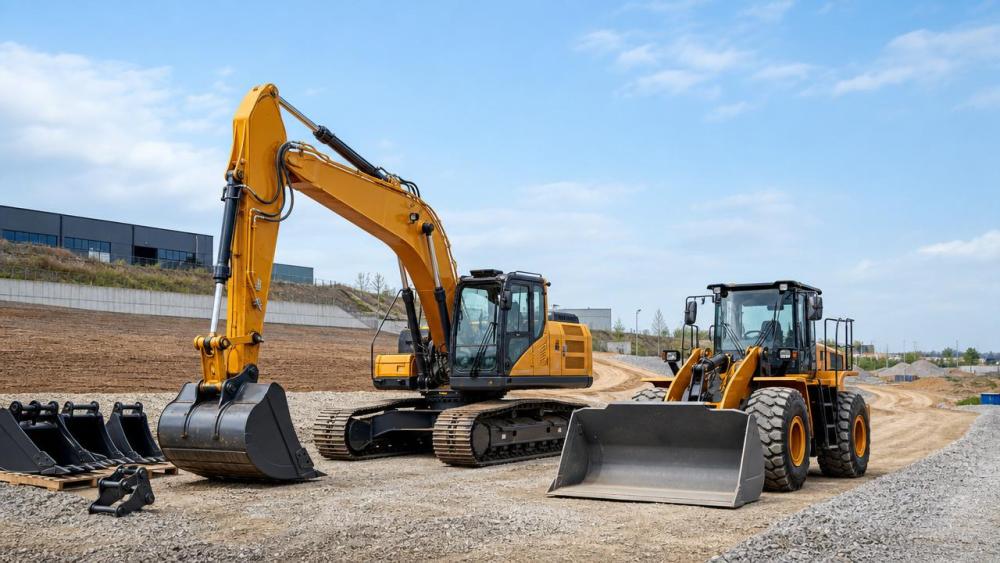
Heavy construction equipment includes excavators, wheel loaders, motor graders, bulldozers, and skid steer loaders used in earthmoving, site preparation, hauling support, and surface finishing.
Selection is not only about machine category. It is also about sizing, hydraulic capability, attachment compatibility, digital controls, transport limits, and service access.
In modern fleets, heavy construction equipment is expected to deliver more than raw power.
It must support fuel efficiency, low emissions, safety systems, uptime visibility, and consistent operator performance across mixed project environments.
That is why selection mistakes often start with narrow thinking.
A machine can look productive on paper yet perform poorly when haul distances, soil density, slope, weather, or support infrastructure are different from assumptions.
Current industry signals shaping equipment decisions
The market for heavy construction equipment is changing fast, especially as infrastructure spending, regulatory pressure, and digital fleet management become more important.
Several signals now influence equipment selection quality:
- Stricter emissions standards affect engine choices and aftertreatment requirements.
- Fuel volatility increases the value of lifecycle efficiency.
- Remote diagnostics reduce downtime when telematics are integrated correctly.
- Operator shortages raise the importance of intuitive controls and automation support.
- Mixed fleets demand stronger compatibility across attachments, software, and service processes.
These shifts mean that heavy construction equipment should be evaluated as a long-term operating asset, not just a short-term purchase item.
The most common heavy construction equipment selection mistakes
Choosing by purchase price alone
A lower sticker price can hide higher fuel consumption, shorter component life, lower resale value, and weaker dealer support.
Heavy construction equipment should be compared by total cost of ownership, not acquisition cost only.
Oversizing or undersizing the machine
Oversized equipment increases transport cost, fuel use, and idle waste.
Undersized equipment struggles with breakout force, bucket fill, grading precision, or cycle time under real production loads.
Ignoring site-specific conditions
Ground bearing pressure, slope stability, moisture content, haul route quality, and working space all affect which heavy construction equipment will perform safely and efficiently.
A machine suited for open quarry work may fail in urban utility corridors or soft subgrade environments.
Overlooking attachment and fleet compatibility
Hydraulic flow, coupler design, control software, and auxiliary lines must align with current attachments and support equipment.
Poor compatibility reduces flexibility and forces extra investment that should have been identified earlier.
Treating emissions and regulations as secondary
Heavy construction equipment that misses local emissions requirements may be impossible to deploy where needed.
Noise restrictions, transport permits, and jobsite safety rules can also reshape the correct machine choice.
Neglecting maintenance support
Even high-quality heavy construction equipment creates risk when parts lead times are long or field service coverage is weak.
Service intervals, filter access, common wear points, and diagnostic support should be reviewed before commitment.
Why better selection improves business performance
Avoiding these mistakes creates measurable value across the entire operating cycle of heavy construction equipment.
The benefit is not limited to one project or one machine class.
- Higher utilization through closer machine-to-task matching
- Lower fuel and maintenance cost over time
- Fewer delays caused by breakdowns or regulatory issues
- Better operator consistency with more suitable controls
- Stronger resale performance when specification matches market demand
For information-driven organizations, heavy construction equipment selection also supports broader goals such as decarbonization, standardization, and digital fleet visibility.
That alignment becomes more valuable as fleets expand across regions and project types.
Typical machine categories and mistake patterns
Practical evaluation steps before selecting heavy construction equipment
A disciplined process reduces bias and improves decision quality.
The following sequence works well across most heavy construction equipment categories:
- Define the main task, hourly production target, and expected duty cycle.
- Assess site variables, including soil, slope, weather, access, and transport constraints.
- Compare machine specifications against real operating needs, not brochure extremes.
- Review maintenance intervals, parts availability, and diagnostic support.
- Check compliance with emissions, safety, and local operating regulations.
- Model total cost of ownership, including fuel, wear parts, downtime, and resale.
- Validate compatibility with existing attachments, operators, and data systems.
Where possible, field demonstrations should be used to verify visibility, control responsiveness, and cycle performance under realistic loads.
A more strategic path forward
The best heavy construction equipment decisions come from connecting performance data, jobsite reality, and long-term fleet strategy.
That approach reduces avoidable cost and supports more reliable project execution.
For deeper market intelligence, EMD tracks equipment evolution across crawler excavators, wheel loaders, motor graders, bulldozers, and skid steer loaders.
Its coverage follows machine performance, regulatory change, hydraulic systems, autonomy trends, and infrastructure demand signals shaping the future of heavy construction equipment.
Use this framework as a working checklist before any new acquisition, rental comparison, or fleet renewal decision.
Smarter selection starts by avoiding predictable mistakes and evaluating every machine as a strategic operational asset.