
Related News
- 00
0000-00
How to size heavy-duty loaders for North American mining operations - 00
0000-00
How altitude affects mining excavator performance in Latin America - 00
0000-00
Caterpillar Launches New Cat 6060 and Upgraded Autonomous Mining System - 00
0000-00
When does eco-friendly construction equipment pay for itself? - 00
0000-00
Will a wheel loader quick coupler fit your existing attachments?
On 1 August 2026, India will begin enforcing a new compulsory BIS certification requirement for imported hydraulic attachments, covering products such as buckets, grapples, and pulverizers. For exporters, importers, distributors, and end users serving India’s infrastructure and mining markets, this is not just a documentation update: it directly affects whether shipments can clear port entry and whether delivery schedules can be maintained.
What the mandate now requires
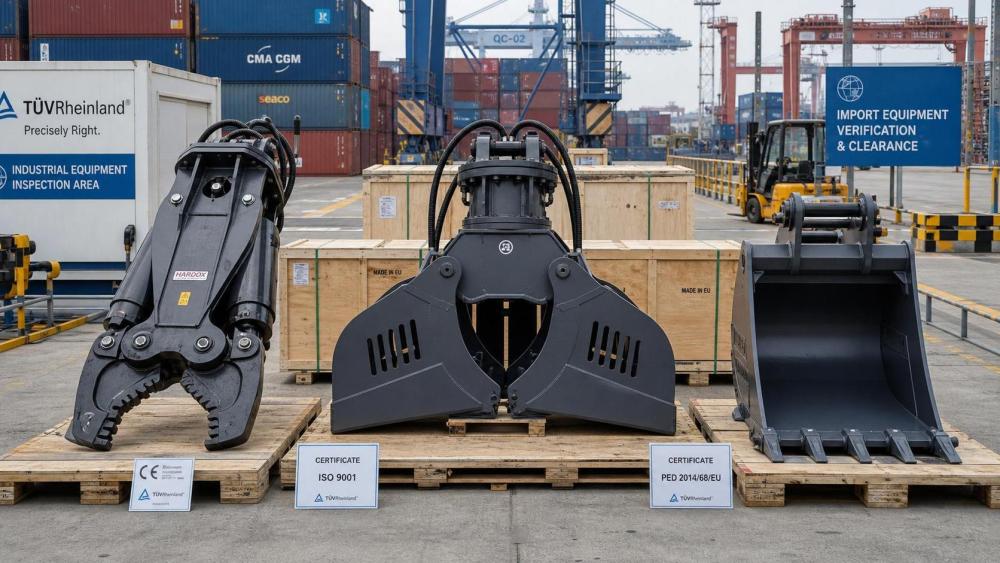
According to the provided information, the Bureau of Indian Standards (BIS) has made BIS IS 17742:2026 certification mandatory for all imported hydraulic attachments from 1 August 2026. The requirement applies to imported products including buckets, grapples, and pulverizers.
The certification process requires local third-party testing. The specified test areas include hydraulic burst pressure, hose abrasion resistance, and coupler interchangeability under ISO 16052.
The enforcement consequence is also clear in the provided information: consignments that do not comply will be rejected at Indian ports. The measure is stated to affect more than 70% of global hydraulic attachment exporters supplying India’s infrastructure and mining sectors.
Where disruption is most likely to appear
Export-oriented attachment suppliers face immediate compliance risk
From an industry perspective, exporters that ship hydraulic attachments into India are the first group exposed to direct disruption because the rule is tied to import acceptance. The main pressure point is no longer only product availability, but whether each shipment is backed by certification that satisfies the new BIS requirement and the required local third-party testing process.
What deserves closer attention is the operational impact on shipment timing, product release planning, and market continuity for suppliers that previously treated India as a standard export destination.
Importers and distributors must manage port-entry risk
Indian importers, channel partners, and distributors may be affected at the point where goods arrive and customs clearance depends on compliance status. Analysis shows that the risk here is concentrated in inbound logistics, inventory continuity, and customer delivery commitments.
For these businesses, the practical issue is whether non-compliant consignments could interrupt product supply for downstream customers in infrastructure and mining-related applications.
Infrastructure and mining buyers may feel the impact through delivery certainty
End users and procurement teams may not be directly responsible for certification, but they are exposed to the outcome if imported attachments are delayed or rejected. Observably, the key concern for buyers is not only product specification, but whether suppliers can continue delivering certified equipment into India without interruption.
This makes supplier qualification, order planning, and delivery communication more important in transactions tied to hydraulic attachments.
Testing and compliance service links become more important
The requirement for local third-party testing means compliance-related service providers are likely to become a more critical part of the import chain. Analysis shows that the affected business step is the conversion of a product standard into shipment-ready proof of conformity.
For companies involved in documentation, testing coordination, and shipment preparation, the main variable to watch is how consistently certification evidence aligns with the new BIS requirement before cargo reaches port.
What companies should watch now
Track whether official wording or implementation details evolve
The current confirmed facts establish the mandate, the effective date, the covered product examples, the required testing areas, and the consequence of non-compliance. What deserves closer attention is whether any further official clarification changes how companies interpret scope, documentation, or implementation steps in practice.
Review affected product lines rather than treating attachments as one category
Because the provided information explicitly names buckets, grapples, and pulverizers, companies should examine which imported hydraulic attachment lines are exposed first. Analysis shows that the practical task is product-by-product confirmation of whether a shipment falls within the certification requirement and whether supporting test evidence is aligned.
Separate policy language from shipment readiness
It is more appropriate to understand this mandate as both a regulatory requirement and a logistics gate. A company may understand the policy in principle, but actual business readiness depends on whether local third-party testing has been completed and whether the shipment can withstand port-level scrutiny.
Prepare customer and supplier communication around lead times and documents
For exporters, importers, and procurement teams, a near-term priority is communication discipline. The relevant focus points are supplier qualification, certification status, supporting documentation, delivery timing, and contingency planning for consignments that could face rejection if they are not compliant.
Why this matters beyond a single compliance update
Analysis shows that this development should not be read as a routine administrative change. The decisive element is that compliance is linked to port acceptance, which turns a standard requirement into an immediate trade and delivery issue. Because the measure is stated to affect over 70% of global hydraulic attachment exporters supplying India’s infrastructure and mining sectors, the scope of attention is broad even if the current confirmed facts remain narrowly defined.
At the same time, it would be premature to extend the conclusion beyond what has been provided. Observably, the most defensible reading for now is that the rule already creates a clear market-access condition, while its wider commercial effects still need to be watched through implementation.
How the market should read this development for now
The immediate meaning of this update is straightforward: imported hydraulic attachments entering India from 1 August 2026 face a hard compliance threshold under BIS IS 17742:2026, supported by local third-party testing and enforced through possible port rejection. From an industry perspective, this is best understood as a concrete short-term operational change and a broader compliance signal for companies tied to India-bound attachment trade.
It is more appropriate to understand this as an active market-access requirement that already has business consequences, while its longer-range effects on supply arrangements and procurement behavior still warrant continued observation.
Basis of this article and points for further verification
This article is based on the user-provided news title, event date, and event summary concerning India’s new BIS certification mandate for hydraulic attachments effective 1 August 2026. The analysis above distinguishes between confirmed facts and editorial observation.
For developments of this kind, relevant source types typically include official notices, standards documentation, company statements, industry association releases, authoritative media coverage, and standard-setting organization materials. No specific official source link was provided in the input, so the exact primary documentation should continue to be verified. Follow-up attention should remain on any further official clarification regarding implementation, scope, and compliance practice.