
Related News
- 00
0000-00
How to size heavy-duty loaders for North American mining operations - 00
0000-00
How altitude affects mining excavator performance in Latin America - 00
0000-00
Caterpillar Launches New Cat 6060 and Upgraded Autonomous Mining System - 00
0000-00
When does eco-friendly construction equipment pay for itself? - 00
0000-00
Will a wheel loader quick coupler fit your existing attachments?
Where Hydraulic Attachments Compatibility Starts to Matter
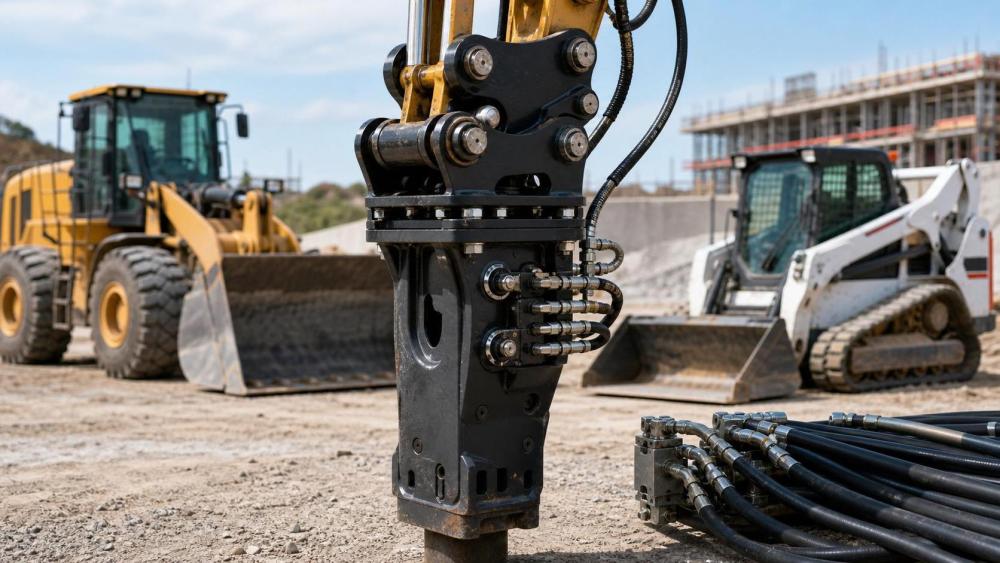
Hydraulic attachments compatibility is rarely a paperwork issue. It shows up on site, under load, when a breaker stalls, a mulcher overheats, or a quick coupler leaks after only a few shifts.
That is why fit and flow checks deserve attention before installation, troubleshooting, or fleet upgrades. In practical terms, hydraulic attachments compatibility protects uptime, seal life, hose integrity, and usable attachment performance.
Across excavators, skid steers, loaders, graders, and specialized support machines, the same attachment label can hide very different operating demands. A cold planer, grapple, tilt bucket, or hydraulic hammer may fit physically, yet still fail functionally.
EMD follows this issue closely because modern earthmoving fleets are becoming more mixed. Higher precision controls, lower-emission engines, electro-hydraulic systems, and remote monitoring all raise the consequences of a mismatch.
In actual field use, the better question is not whether an attachment can be mounted. The real question is whether machine hydraulics, controls, couplers, and duty cycle can support the attachment safely and consistently.
Why the Same Attachment Behaves Differently Across Jobsites
Different applications create different compatibility thresholds. A demolition breaker on a crawler excavator faces heat buildup, return pressure sensitivity, and continuous shock loading. A snow blower on a skid steer faces flow stability and seasonal cold-start behavior.
Even within one machine family, hydraulic attachments compatibility changes with auxiliary circuit design, pump capacity, relief pressure settings, case drain requirements, and software-controlled flow management.
More advanced fleets complicate this further. Precision grading equipment may use electro-hydraulic modulation that expects stable control signals. If an attachment valve block reacts differently, performance may feel erratic long before a hard failure appears.
The common mistake is assuming hydraulic power is a single number. In reality, compatibility depends on a package of conditions that must work together under the intended duty cycle, not just during a short test hookup.
The first judgement points are usually these
- Rated and peak auxiliary flow versus attachment operating window
- System pressure, relief settings, and return line restrictions
- Coupler interface, hose size, thread standard, and port orientation
- Control logic, proportional response, and electrical integration
- Heat rejection capacity during continuous or high-impact work
Excavation, Demolition, and Material Handling Need Different Checks
On crawler excavators, hydraulic attachments compatibility often gets judged by tool size first. That is understandable, but excavation, demolition, and material handling stress the hydraulic package in very different ways.
A hydraulic breaker needs stable pressure, acceptable back pressure, and correct carrier weight. Excess flow can be just as damaging as insufficient flow, especially when the attachment relies on internal sealing and impact timing.
A rotating grapple or shear changes the picture. Flow smoothness, spool response, and auxiliary line routing become more important, because frequent modulation and rotation cycles expose weak hose protection and inconsistent pilot behavior.
For tilt buckets and compaction plates, the risk is often hidden in control feel. A machine may technically drive the tool, yet poor metering makes precision trench shaping or slope finishing slower and less predictable.
In these scenarios, hydraulic attachments compatibility should be checked against the actual work pattern. Intermittent trench support, all-day demolition, and utility lifting place very different demands on the same base machine.
Compact Machines Create Fast Decisions but Tighter Margins
Skid steer loaders are often treated as universal carriers because they support many tools. In reality, hydraulic attachments compatibility is more sensitive here because compact platforms leave less room for hydraulic and thermal margin.
A standard-flow skid steer may lift and connect a trencher, brush cutter, or snow blower without issue. That does not mean it can sustain target rotor speed, acceptable oil temperature, or reliable motor life over a full shift.
High-flow packages improve capability, but they also require stricter checks on hose rating, case drain use, and coupler cleanliness. A compact machine working in dust or urban debris sees contamination risks much faster.
This is one reason EMD tracks attachment behavior in urban infrastructure and secondary urbanization projects. Tight spaces reward attachment versatility, but they also punish casual assumptions about flow class and return capacity.
Typical differences by application condition
When Fit Is Correct but Flow Still Fails
One of the most expensive errors is stopping the evaluation at physical fit. Coupler dimensions, pin spacing, and bracket geometry matter, but hydraulic attachments compatibility often breaks down in the circuit, not at the mount.
A mulcher may connect cleanly and still underperform because the machine cannot sustain required gallons per minute once oil heats up. A hammer may fire, yet internal wear accelerates because return pressure is outside tolerance.
Electrical controls create another blind spot. Attachments using solenoids, rotation functions, or variable speed logic may need harness matching, software parameter changes, or dedicated control modes. Without those, operators often describe the machine as weak or unstable.
In practical troubleshooting, hydraulic attachments compatibility should be confirmed under realistic oil temperature, realistic load, and realistic cycle duration. Short no-load checks miss most of the expensive problems.
Common Misjudgments That Distort Hydraulic Attachments Compatibility
Some misjudgments appear across nearly every fleet type. They usually begin with a correct observation, then fail because one operating condition was ignored.
- Treating similar machines as interchangeable, even when auxiliary circuits and software differ
- Using nominal flow numbers without checking pressure drop at working temperature
- Ignoring case drain needs on hydraulic motors
- Assuming quick couplers of similar size have identical internal flow characteristics
- Evaluating purchase price without calculating hose wear, downtime, and retuning effort
Another frequent issue is borrowing experience from one project and applying it unchanged to another. Quarry stripping, airport grading support, utility trenching, and hazardous demolition all place different stress on the same attachment family.
That is especially relevant as fleets move toward decarbonization and autonomy. New electro-hydraulic platforms may deliver better control efficiency, yet they can be less forgiving of mismatched auxiliary logic or unstable return conditions.
A Practical Way to Judge Compatibility Before Installation
The most useful approach is a staged compatibility review. It keeps hydraulic attachments compatibility tied to the intended application instead of a generic fit chart.
Start with machine and attachment data
Confirm operating flow range, maximum pressure, return requirements, hose size, coupler type, and any electrical control needs. Check actual machine configuration, not only model family literature.
Then compare against real job conditions
Look at duty cycle, ambient temperature, material density, expected shift length, and frequency of attachment changes. These factors often decide whether a setup survives daily use.
Finish with a short monitored trial
Measure oil temperature rise, cycle response, pressure stability, and visible leakage after the machine reaches working condition. That final step catches many hydraulic attachments compatibility problems early.
What a Reliable Compatibility Standard Should Include
A workable internal standard does not need to be complicated. It needs to be specific enough to compare one job, one machine, and one attachment combination against another.
At minimum, record approved flow and pressure windows, coupler and thread standards, case drain rules, acceptable return pressure, control harness notes, and warm-up or cooldown procedures.
For mixed fleets, add notes on which attachments are sensitive to electro-hydraulic tuning or software profiles. This matters more as machines support remote diagnostics, semi-autonomous grading, and tighter emissions-driven power management.
Seen this way, hydraulic attachments compatibility is not just a maintenance checkpoint. It is a reliability discipline that connects attachment output, machine protection, and asset utilization across the entire work cycle.
Before the next installation or fleet reshuffle, map each attachment to its real operating scene, confirm fit and flow data, and test under load. That sequence prevents avoidable mismatch costs far better than a nameplate match alone.