
Related News
- 00
0000-00
How to size heavy-duty loaders for North American mining operations - 00
0000-00
How altitude affects mining excavator performance in Latin America - 00
0000-00
Caterpillar Launches New Cat 6060 and Upgraded Autonomous Mining System - 00
0000-00
When does eco-friendly construction equipment pay for itself? - 00
0000-00
Will a wheel loader quick coupler fit your existing attachments?
Reliable model comparison begins with disciplined reading of technical data. In earthmoving fleets, one inconsistent specification can affect safety reviews, procurement logic, maintenance planning, and regulatory confidence.
That is why equipment specification analysis standards matter far beyond catalog accuracy. They create a common method for interpreting excavator, loader, grader, bulldozer, and skid steer data under real operating conditions.
For platforms such as EMD, where machine intelligence spans hydraulic force, grading precision, emissions change, and autonomy trends, standardized analysis helps convert scattered specifications into dependable operational judgment.
Why specification consistency now carries more weight
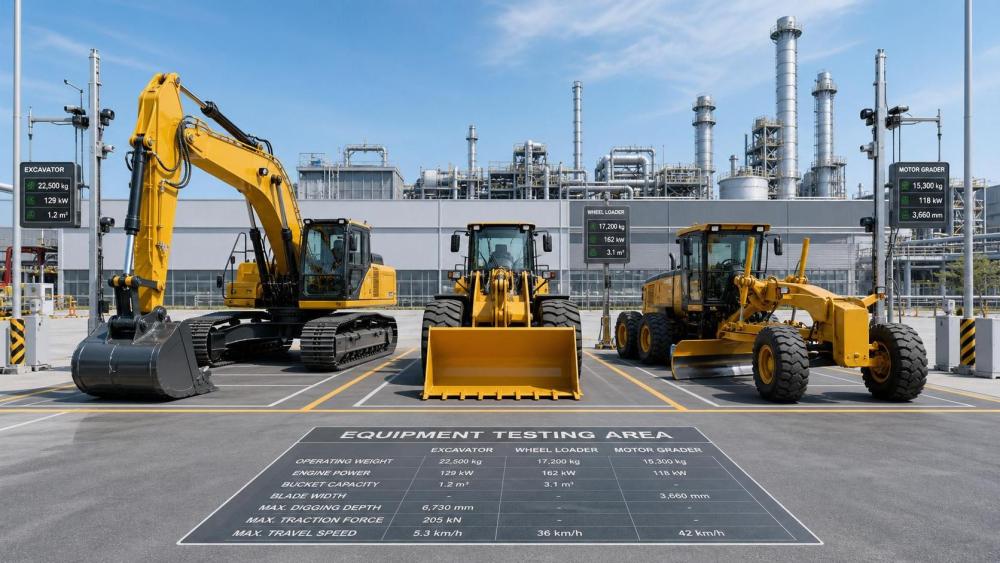
Construction machinery has become more complex. A crawler excavator is no longer compared only by operating weight and bucket size. Electronic controls, emissions systems, telematics, and assist functions now shape field performance.
The same applies to wheel loaders, motor graders, bulldozers, and skid steers. Published figures may look comparable, yet they may be measured under different standards, attachments, fuel assumptions, or software settings.
This is where equipment specification analysis standards become essential. They reduce false equivalence between models that appear similar on paper but behave differently in loading cycles, slope work, grading accuracy, or high-duty haul support.
The issue has become sharper as electrification and autonomy enter heavy equipment. Range calculations, charging windows, sensor coverage, control latency, and fail-safe behavior all require more disciplined comparison than legacy brochures ever needed.
What equipment specification analysis standards actually mean
At a practical level, equipment specification analysis standards are rules for reading, normalizing, and validating machine data before making any comparison or decision.
They are not limited to one test code. They combine measurement basis, terminology control, source verification, operating context, and acceptance thresholds.
A reliable review usually answers five questions:
- What exactly was measured?
- Under which test condition was it measured?
- Which attachment or configuration was included?
- Is the source manufacturer-declared, certified, or field-verified?
- Can the number be compared directly with another model?
Without those checks, model comparison often collapses into a price-versus-power shortcut. That shortcut is risky in safety-critical applications and usually expensive over the asset life cycle.
The parameters that deserve closer reading
Not every specification has equal decision value. Some figures are marketing-visible, while others determine whether the machine can work safely, repeatedly, and within compliance limits.
Performance numbers
Digging force, breakout force, rated operating capacity, blade pull, drawbar pull, lift capacity, and cycle time should always be read against machine configuration and test method.
An excavator with strong headline breakout force may deliver different usable performance once boom length, bucket profile, and hydraulic mode are aligned with the actual task.
Dimensional and stability data
Operating weight, ground pressure, transport width, turning radius, axle load, and center-of-gravity effects influence site access, haul permits, and rollover margins.
These figures are often underestimated during comparison, especially when attachments, counterweights, track options, or tire choices shift the machine’s effective working envelope.
Control and system data
Modern equipment also demands analysis of electro-hydraulic response, assist software, GNSS integration, laser support, remote-control architecture, and diagnostic coverage.
For motor graders and autonomous-ready platforms, software logic can be as important as steel and hydraulics. Equipment specification analysis standards should therefore include control-system descriptions, not just mechanical ratings.
Where model comparison usually goes wrong
Many comparison errors come from mixing nominal values with application values. A nominal engine power figure does not automatically predict tractive effort, fuel burn, or sustained output in demanding cycles.
Another common problem is ignoring regional regulation. Non-road emission rules, safety certifications, and local transport limits can make an otherwise attractive model unsuitable.
Specification sheets also vary in freshness. Software updates, revised emissions packages, and optional control kits can change performance or compliance status after the original publication date.
In EMD’s coverage areas, this matters especially for machines moving toward low-emission powertrains and remote operation. Legacy comparison habits rarely capture these transition risks well.
Typical mismatch points
A workable standard for daily evaluation
A useful review process does not need to be overly academic. It needs to be repeatable, documented, and resistant to ambiguous vendor language.
The strongest equipment specification analysis standards usually include the following checkpoints:
- Create a controlled parameter list for each equipment class.
- Record the source date, document version, and market region.
- Normalize units, test references, and attachment assumptions.
- Separate standard features from optional packages.
- Flag any value that lacks traceable methodology.
- Link each parameter to a safety, compliance, or operational outcome.
This approach makes comparison sheets far more useful. Instead of collecting numbers, it builds a decision record that can be reviewed later during audits, incident checks, or tender disputes.
How standards differ by machine category
A single comparison template rarely works across all equipment. The same equipment specification analysis standards need category-specific emphasis.
Crawler excavators and bulldozers
Priority usually falls on hydraulic force, undercarriage durability, slope stability, ground pressure, and control response in sustained heavy-duty work.
Wheel loaders and skid steers
Rated load interpretation, tipping thresholds, auxiliary hydraulic flow, visibility, and attachment interface consistency often drive the most important comparison outcomes.
Motor graders
Blade geometry, articulation behavior, GNSS compatibility, fine grading controls, and sensor integration deserve deeper analysis than raw engine ratings alone.
This category logic aligns with EMD’s broader market view. Machines are increasingly judged by how precisely they deliver work, not simply by how much power they advertise.
Reading specifications in the context of decarbonization and autonomy
Current comparison standards must also account for transition technologies. Decarbonization introduces battery capacity, charging compatibility, duty-cycle variability, and thermal management into the specification set.
Autonomy adds another layer. Sensor redundancy, remote intervention logic, communications latency, and fail-operational design all influence whether a machine is truly comparable to a conventional alternative.
In other words, equipment specification analysis standards should not freeze around legacy diesel-era parameters. They need to expand with the industry’s technical direction.
What to do next with the data
The next step is to convert specifications into a structured comparison file by machine class and intended task. Keep the data traceable, note all assumptions, and isolate any figure that cannot be verified.
Then compare models against operating realities: terrain, attachment mix, transport limits, emissions obligations, maintenance access, and control-system requirements. That is where equipment specification analysis standards show their full value.
A disciplined standard will not replace field trials or site validation. It does, however, ensure that every later judgment starts from cleaner evidence, fewer blind spots, and a more reliable basis for model selection.