
Related News
- 00
0000-00
How to size heavy-duty loaders for North American mining operations - 00
0000-00
How altitude affects mining excavator performance in Latin America - 00
0000-00
Caterpillar Launches New Cat 6060 and Upgraded Autonomous Mining System - 00
0000-00
When does eco-friendly construction equipment pay for itself? - 00
0000-00
Will a wheel loader quick coupler fit your existing attachments?
Choosing the wrong road construction machinery can raise total cost, slow delivery, and weaken surface quality before the first pass begins. Sound selection depends on matching equipment to terrain, material behavior, precision targets, utilization rates, and emissions rules, rather than chasing the lowest purchase price.
In modern infrastructure work, road construction machinery decisions also affect fuel burn, operator productivity, maintenance planning, and digital jobsite control. Avoiding common mistakes requires a scenario-based view that links machine capability with real project conditions and lifecycle value.
Why project context changes the right road construction machinery choice
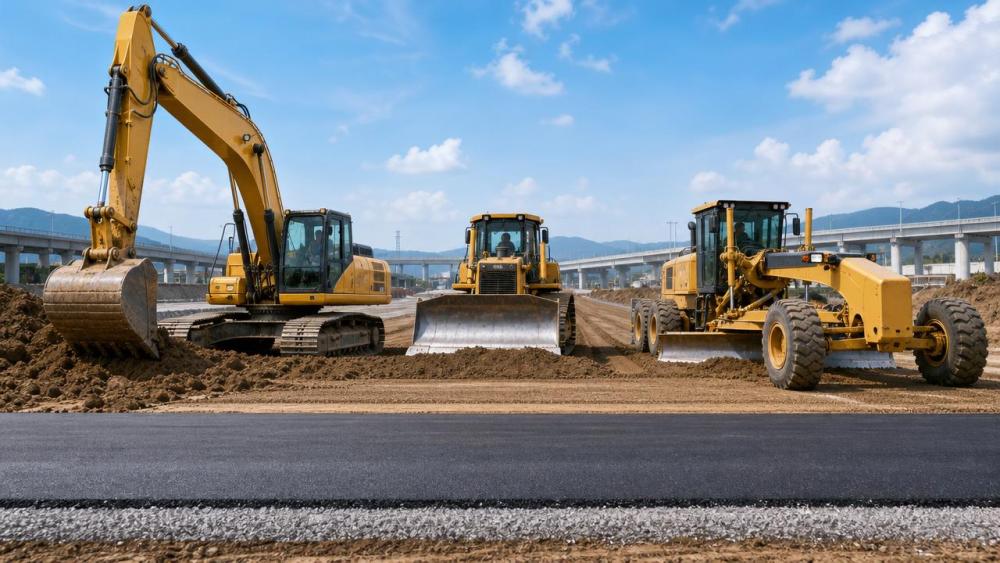
Not every road project demands the same equipment mix. A rural subgrade upgrade differs sharply from an urban resurfacing package or an airport access road build.
The biggest selection mistakes happen when road construction machinery is evaluated in isolation. Capacity, traction, grading accuracy, visibility, transport logistics, and attachment compatibility must be reviewed together.
EMD consistently tracks how crawler excavators, wheel loaders, motor graders, bulldozers, and compact support machines perform across changing infrastructure conditions. That broader equipment intelligence helps reveal where selection errors usually begin.
Scenario 1: New highway earthworks require balance, not maximum machine size
Large highway packages often trigger one repeated error: overestimating the value of sheer machine size. Bigger road construction machinery may appear safer for production, but oversizing can reduce efficiency.
If haul distance is short, material density varies, or cut-and-fill sequencing is tight, giant units may idle more than expected. Transport limits, turning space, and fuel use can quickly erode the assumed advantage.
Core checks for highway earthmoving
- Match excavator bucket size with truck cycle time.
- Confirm bulldozer tractive effort against soil class and moisture.
- Assess grader blade control for final formation accuracy.
- Review undercarriage wear expectations on abrasive ground.
- Calculate fuel and service intervals under sustained load.
A smarter approach compares production flow across the whole spread. The right road construction machinery lineup should minimize bottlenecks, not maximize isolated peak output.
Scenario 2: Urban road reconstruction punishes poor maneuverability assumptions
Urban jobs create different risks. Here, one common mistake is choosing road construction machinery designed for open space when the site is crowded, regulated, and interruption-sensitive.
Lane restrictions, buried utilities, nearby pedestrians, and frequent mobilization shifts favor compact dimensions, visibility, and flexible attachment use over raw breakout force alone.
What often gets overlooked in urban works
- Machine tail swing and turning radius near traffic barriers.
- Noise and non-road emission compliance requirements.
- Attachment change speed for milling support or trench repair.
- Transport weight for rapid relocation between work windows.
- Camera systems and sightlines in mixed public environments.
In this setting, road construction machinery with smaller footprints and better hydraulic versatility often delivers higher daily productivity than larger, less agile machines.
Scenario 3: Fine grading and airport-style surfaces expose precision gaps
Another costly mistake is treating precision grading as a secondary requirement. On roads with strict tolerances, poor machine control leads to rework, asphalt overuse, drainage failures, and slower handoff.
Motor graders, supported by GPS, laser, or 3D control systems, need stable hydraulics and repeatable blade response. Selecting road construction machinery without checking control integration can compromise the finish layer.
Precision-related selection points
- Sensor compatibility with current site software.
- Hydraulic smoothness at low-speed blade inputs.
- Calibration support and field service responsiveness.
- Operator interface clarity for automated grade functions.
Precision jobs reward road construction machinery that reduces correction passes. The savings appear in material control, compaction consistency, and schedule confidence.
How road construction machinery needs differ by scenario
This comparison shows why road construction machinery decisions should start with use case mapping. Similar machine categories can deliver very different outcomes across different road-building environments.
Practical selection guidance before committing to equipment
A reliable evaluation process converts broad machine specifications into practical fit. That prevents expensive assumptions from surviving into mobilization.
Recommended review steps
- Define site conditions, haul patterns, slopes, and material types.
- Set output targets by phase, not by machine brochure claims.
- Compare fuel, wear parts, and service support costs.
- Check digital control compatibility and training needs.
- Review transport permits, setup time, and redeployment ease.
- Validate local emission, safety, and noise compliance.
The best road construction machinery choice is often the one with fewer hidden constraints. Reliable uptime and fit-for-purpose performance usually outperform attractive headline power figures.
Frequent misjudgments that still damage road construction machinery ROI
Several mistakes continue to reduce asset value even when the base machine category seems correct. These issues usually appear after work starts, when correction is more expensive.
Misjudgment 1: Buying on price instead of lifecycle economics
Lower upfront cost can hide higher fuel consumption, weaker resale value, and more downtime. Road construction machinery should be compared on total ownership cost, not invoice price alone.
Misjudgment 2: Ignoring support network strength
Parts availability, field technicians, and software diagnostics directly affect utilization. A capable machine without responsive support can become the weakest asset on site.
Misjudgment 3: Underestimating operator-machine fit
Cab layout, control logic, visibility, and automation usability all matter. Poor ergonomic fit reduces the practical performance of otherwise strong road construction machinery.
Misjudgment 4: Forgetting decarbonization and future regulation
More projects now evaluate emissions, idle reduction, and alternative power readiness. Road construction machinery that cannot align with stricter standards may age faster in the market.
Next-step actions for better road construction machinery decisions
Start by building a simple selection matrix around three factors: jobsite scenario, performance requirement, and lifecycle constraint. This structure quickly reveals where a machine is strong, weak, or mismatched.
Then verify assumptions through field data, demo results, and service capability checks. For high-value fleets, road construction machinery decisions should also include digital integration and compliance planning.
EMD’s equipment intelligence approach supports this deeper review by linking machine physics, precision control, and infrastructure trends. Better road construction machinery selection begins with the right scenario questions, not the fastest quote.