
Related News
- 00
0000-00
How to size heavy-duty loaders for North American mining operations - 00
0000-00
How altitude affects mining excavator performance in Latin America - 00
0000-00
Caterpillar Launches New Cat 6060 and Upgraded Autonomous Mining System - 00
0000-00
When does eco-friendly construction equipment pay for itself? - 00
0000-00
Will a wheel loader quick coupler fit your existing attachments?
For procurement teams weighing fleet strategy, the real question is not just price but lifecycle value. In the debate over heavy equipment rental versus ownership, every decision affects cash flow, utilization, maintenance risk, and project flexibility. This guide explores how heavy equipment rental compares with buying, helping purchasers align equipment costs with uptime goals, bid competitiveness, and long-term operational efficiency.
What procurement teams really need to know before choosing rental or ownership
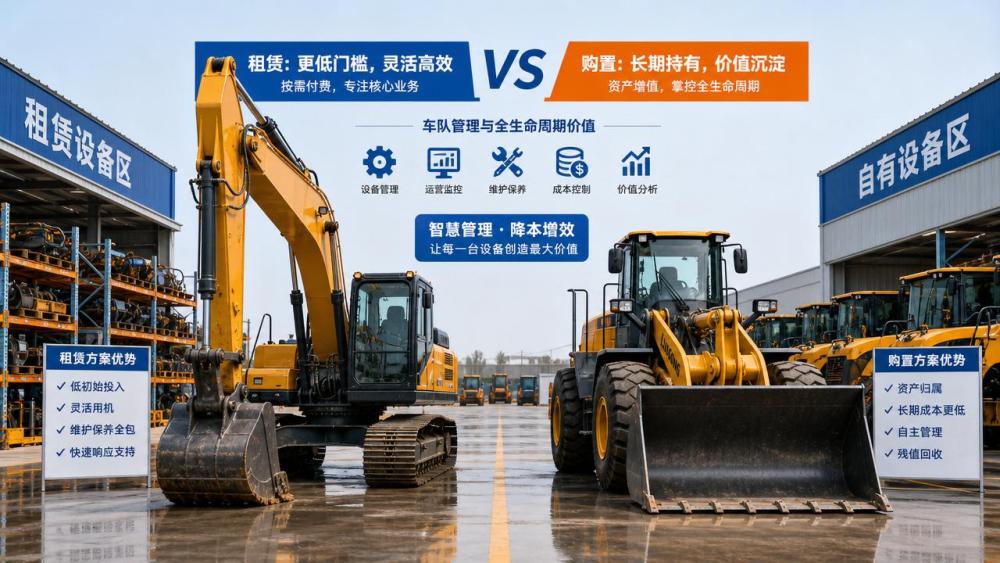
The core search intent behind heavy equipment rental versus ownership costs is practical comparison. Buyers want a clear framework for deciding which option lowers total cost and supports project delivery.
For procurement professionals, the most important concern is rarely the headline rate alone. The real issue is how each option affects utilization, downtime exposure, capital planning, and flexibility across changing workloads.
That leads to a useful starting conclusion. Heavy equipment rental is often the better choice for short-duration, variable, or specialized demand, while ownership usually pays off when utilization is high and predictable.
The decision becomes more important in sectors using crawler excavators, wheel loaders, bulldozers, graders, and skid steer loaders. These machines carry high acquisition costs, variable maintenance loads, and fast-changing technology profiles.
So the best article is not one that simply lists pros and cons. It should show how to compare lifecycle costs, identify usage thresholds, and assess operational risk with procurement discipline.
Why price alone gives procurement teams the wrong answer
Many equipment decisions begin with a simple comparison between rental rates and purchase price. That approach is easy, but it often hides the bigger cost drivers that shape long-term fleet performance.
If a machine is purchased, procurement must account for financing or capital cost, depreciation, insurance, taxes, maintenance, storage, transport, operator availability, and expected resale value at disposal.
If the same unit is rented, the team usually avoids major capital outlay and long-term maintenance obligations. However, rental pricing may include delivery fees, fuel policy exposure, damage liability, and premium rates in peak markets.
For that reason, the right comparison is not rent versus buy on day one. It is heavy equipment rental versus ownership across the full operating period that the asset is expected to support.
In practical procurement terms, the question is simple. Which option delivers the lowest cost per productive hour while protecting uptime, preserving cash, and supporting future project commitments?
The cost categories that matter most in heavy equipment rental analysis
Procurement teams need a structured model. Start by separating direct acquisition cost from operating cost, then add utilization assumptions and risk adjustments that reflect how the machine will actually be deployed.
For ownership, first calculate purchase price, interest expense or cost of capital, registration, insurance, and expected depreciation. Then estimate annual maintenance, component rebuilds, undercarriage wear, tire replacement, and workshop labor.
For rental, begin with daily, weekly, or monthly rate assumptions. Add freight, operator support if applicable, fuel responsibility, expected idle days, extension risk, and any penalties for excess wear or unplanned damage.
Next, compare utilization. A purchased excavator sitting idle still consumes capital and yard space. A rented bulldozer only costs money while under contract, though urgent availability can become a challenge later.
Finally, include hidden internal costs. Procurement time, service coordination, parts sourcing, compliance management, and remarketing effort all consume resources even when they do not appear in standard equipment ledgers.
When heavy equipment rental usually creates the strongest business case
Heavy equipment rental tends to outperform ownership when demand is temporary, project schedules are uncertain, or machine specifications vary significantly from one contract to the next.
That is common in infrastructure packages where one stage requires a high-capacity crawler excavator, the next calls for a motor grader with advanced controls, and later work shifts to compact urban loading equipment.
Rental also makes sense when utilization is low. If a machine is only needed for a few months each year, buying may lock capital into an asset that spends too much time unproductive.
Procurement teams also prefer rental when maintenance capacity is limited. For businesses without strong internal workshops, owning complex machines can expose operations to costly downtime and repair coordination problems.
Another major advantage is technology access. Rental fleets can provide newer units with better fuel efficiency, telematics, emissions compliance, and automation support without forcing a long ownership cycle.
This matters in segments where machine intelligence evolves quickly. GPS-enabled graders, low-emission engines, and advanced hydraulic controls can improve production, but ownership can leave fleets holding older and less competitive assets.
When ownership usually becomes the more economical choice
Ownership becomes attractive when machine demand is steady, predictable, and operationally critical. High utilization spreads fixed costs across more productive hours and improves the economics of capital investment.
A contractor using the same wheel loaders or bulldozers continuously across quarry, site preparation, or mine support operations may gain lower unit cost from ownership than from repeated rental contracts.
Ownership can also be superior when the business has strong maintenance systems. If in-house technicians, parts inventory, and preventive service routines are already established, lifecycle cost can be tightly controlled.
Another advantage is guaranteed availability. During infrastructure booms or regional equipment shortages, rental supply can tighten. Owned assets reduce dependency on market availability at the exact moment projects need to mobilize.
Procurement should also consider residual value. Well-managed equipment with documented maintenance history may retain meaningful resale value, lowering effective ownership cost over the asset life.
However, that benefit depends on timing, brand reputation, hours, market demand, and condition. Residual value should support the business case, not compensate for weak utilization assumptions.
How to calculate the break-even point between renting and buying
The most useful decision tool is the break-even utilization threshold. This shows how many operating hours or months are needed before ownership becomes less expensive than rental.
Start with annual ownership cost. Include depreciation, financing, insurance, taxes, planned maintenance, storage, and estimated major repairs. Then divide that total by expected annual productive hours.
Next, calculate the all-in rental cost per productive hour. Include rate, transport, fuel policy impact, standby charges, and any probable extension costs based on typical project slippage.
If the owned cost per hour is lower than the rental cost per hour at realistic utilization levels, ownership may be justified. If not, heavy equipment rental likely offers a more efficient cost structure.
Procurement should run at least three scenarios. Use conservative, expected, and high-utilization cases. This prevents a single optimistic forecast from driving a purchase that later turns underused.
It is also wise to model downtime impact. A lower nominal ownership cost can quickly disappear if maintenance delays cause lost production or force emergency short-term rentals at premium market rates.
Risk factors procurement teams should not overlook
Cost comparison is only half the decision. Procurement teams must also evaluate risk, because the cheapest option on paper may carry operational exposure that affects schedules, margin, and client commitments.
The first risk is utilization error. Buying equipment based on expected future demand can backfire if project awards slow down, funding shifts, or the scope mix changes away from that machine category.
The second risk is maintenance volatility. Major hydraulic failures, undercarriage wear, emissions-system issues, and electronic control problems can materially change ownership cost, especially on heavily loaded equipment.
The third risk is availability. Rental is flexible, but not always guaranteed. In high-demand regions, securing the correct excavator size, grader configuration, or attachment package may require earlier planning and stronger supplier relationships.
The fourth risk is compliance and technology obsolescence. Emissions regulations, remote diagnostics, safety systems, and semi-autonomous controls are evolving, which can shorten the practical competitiveness of owned units.
These risks explain why procurement should not ask only, “Which option is cheaper?” The better question is, “Which option is cheaper after adjusting for uncertainty and service continuity?”
A practical decision framework for buyers managing mixed fleets
In many organizations, the answer is not pure rental or pure ownership. The strongest strategy is often a blended fleet model based on utilization tiers and project criticality.
Own the machines that are core, heavily used, and required year-round. Rent the units that are seasonal, highly specialized, or linked to short-term peak demand and unusual jobsite requirements.
For example, a contractor may own standard excavators and skid steers that support everyday site operations, while renting extra bulldozers, long-reach excavators, or precision graders for specific project phases.
This blended approach improves capital efficiency while preserving flexibility. It also allows procurement teams to negotiate better terms by concentrating ownership where confidence is highest and rental where uncertainty is greatest.
To make this model work, procurement should maintain accurate fleet data. Track actual hours, idle time, repair frequency, rental spend by category, and project delay cost linked to equipment constraints.
Those data points create a more reliable decision cycle. Over time, categories with recurring high rental demand may justify purchase, while underused owned assets may be better replaced with rental access.
Questions procurement should ask suppliers before committing
Whether renting or buying, supplier evaluation affects the final economics. Commercial terms, service quality, parts support, and equipment condition can materially change cost outcomes.
For rental providers, ask about fleet age, guaranteed availability, replacement response times, transportation lead times, telematics access, damage policy, and pricing for extensions beyond the original contract period.
For purchase suppliers, ask about warranty coverage, service intervals, parts lead times, rebuild support, operator training, software updates, resale assistance, and expected residual performance in your region.
Procurement should also compare support depth by equipment type. A supplier strong in skid steer loaders may not provide the same uptime assurance for large crawler excavators or high-precision grading systems.
Strong supplier partnerships can reduce total equipment cost just as much as a lower initial rate. Fast service, transparent contract language, and dependable field support protect operating continuity.
Final takeaway: choose the option that matches utilization, risk, and strategic flexibility
There is no universal winner in the heavy equipment rental versus ownership debate. The right choice depends on utilization intensity, maintenance capability, project volatility, cash priorities, and equipment specialization.
Heavy equipment rental is usually the stronger answer for variable demand, shorter project cycles, limited workshop capacity, and rapid access to newer technology. Ownership is often superior for stable, high-hour, mission-critical use.
For procurement teams, the best path is a disciplined lifecycle comparison rather than a simple rate comparison. Build decisions around cost per productive hour, downtime exposure, and flexibility under changing project conditions.
In practice, the most resilient organizations use both models deliberately. They own core fleet where long-term value is clear and use rental to absorb peaks, manage uncertainty, and stay operationally agile.
That approach supports better capital allocation, stronger bid competitiveness, and more dependable equipment availability. In the end, the smartest equipment strategy is the one that keeps assets productive and projects moving.