
Related News
- 00
0000-00
How to size heavy-duty loaders for North American mining operations - 00
0000-00
How altitude affects mining excavator performance in Latin America - 00
0000-00
Caterpillar Launches New Cat 6060 and Upgraded Autonomous Mining System - 00
0000-00
When does eco-friendly construction equipment pay for itself? - 00
0000-00
Will a wheel loader quick coupler fit your existing attachments?
In 2026, heavy construction equipment costs are no longer shaped by purchase price alone. For financial decision-makers, total cost now depends on fuel efficiency, emissions compliance, labor availability, uptime, and technology readiness. This guide outlines the key cost drivers across excavators, loaders, graders, bulldozers, and skid steers, helping you evaluate capital allocation, forecast ownership expenses, and make more confident investment decisions in a rapidly changing infrastructure market.
Heavy Construction Equipment Costs in 2026: Core Definition and Cost Scope
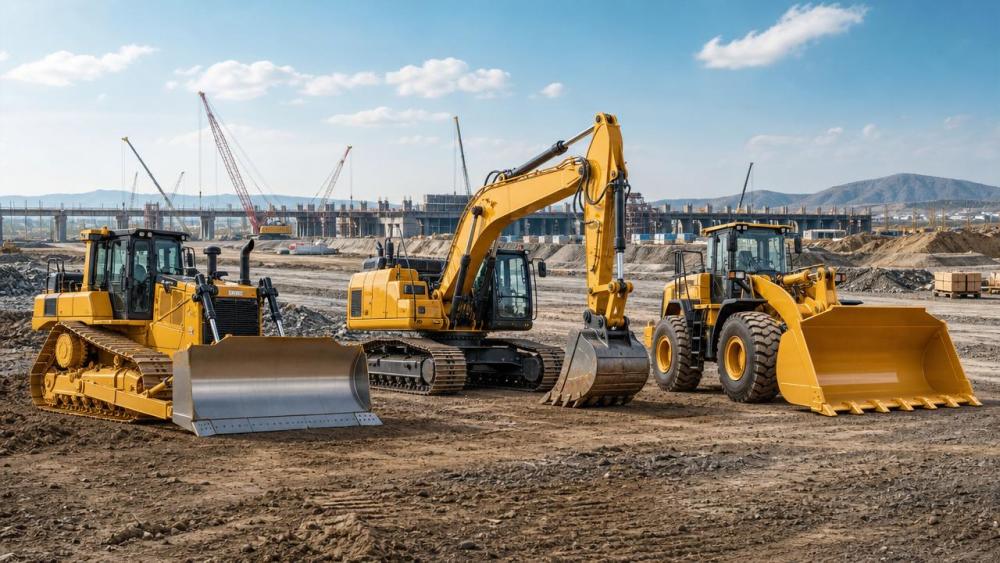
Heavy construction equipment costs include far more than the invoice price. In 2026, the category covers acquisition, financing, fuel, maintenance, repair, labor, insurance, software, and residual value.
For most fleets, total ownership cost is the most reliable benchmark. It measures what equipment truly consumes across its working life, not just what it costs on day one.
This matters across the broader infrastructure industry. Earthmoving assets now operate inside stricter environmental rules, tighter jobsite schedules, and rising expectations for digital visibility.
The heavy construction equipment market also reflects major technology shifts. Electrification, automation, telematics, and machine control are changing both cost structures and purchasing logic.
EMD tracks these shifts through crawler excavators, wheel loaders, motor graders, bulldozers, and skid steer loaders. Together, they form the operational backbone of global infrastructure construction.
Main cost layers in 2026
- Initial capital cost and financing terms
- Fuel, energy, and fluid consumption
- Preventive maintenance and unplanned repair
- Operator productivity and training requirements
- Compliance with emissions and safety regulations
- Software subscriptions, connectivity, and data tools
- Resale value, rebuild potential, and disposal timing
Industry Conditions Shaping Heavy Construction Equipment Costs
Several macro signals are pushing heavy construction equipment costs upward in 2026. Yet some digital tools are helping offset these increases through better planning and utilization.
Global infrastructure spending remains active. Road upgrades, energy projects, port expansion, mining support, and urban redevelopment are sustaining demand for productive earthmoving machinery.
At the same time, emission standards are becoming more complex. Compliance hardware raises machine prices and can increase maintenance sensitivity if duty cycles are poorly managed.
Labor shortages also influence cost. Newer machines often require fewer passes, better visibility, and easier controls, making productivity gains an important financial factor.
Why Heavy Construction Equipment Costs Now Depend on Asset Performance
In 2026, machine performance and cost are directly linked. A lower-priced unit may become more expensive if it burns more fuel, needs more service, or causes longer cycle times.
Productivity is therefore a cost variable. Faster loading, cleaner grading, stronger breakout force, or reduced track slip can improve cost per cubic meter or cost per completed section.
Telematics strengthens this analysis. It exposes idle hours, excessive fuel burn, harsh operating behavior, and maintenance gaps that silently inflate heavy construction equipment costs.
Machine uptime has equal importance. Every unplanned stop can trigger schedule disruption, labor inefficiency, subcontractor claims, and downstream material delays.
Performance factors with direct cost impact
- Cycle time and payload efficiency
- Hydraulic responsiveness and power matching
- Idle management and auto shutdown features
- Undercarriage wear or tire consumption
- Attachment compatibility and utilization rate
- Remote diagnostics and service access
Equipment Categories and Their Typical Cost Profiles
Different machine families carry different cost patterns. Understanding these patterns helps compare alternatives beyond nameplate horsepower or operating weight.
Crawler excavators often justify higher capital cost through broad attachment use and strong productivity. Bulldozers and graders usually show their value by limiting rework on mass earthworks and finish surfaces.
Practical Methods for Forecasting Heavy Construction Equipment Costs
Reliable forecasting starts with the job mix. Estimate annual hours, soil conditions, haul distance, attachment demands, and grade tolerance before comparing machine options.
Then convert specifications into operating assumptions. Fuel rate, wear parts, routine service intervals, and expected downtime should be modeled under realistic site conditions.
Residual value should not be ignored. In some cases, a machine with a stronger brand, cleaner service record, and better emissions support reduces lifetime cost significantly.
A workable forecasting checklist
- Define annual utilization in hours and operating intensity.
- Model fuel or energy use by application, not brochure averages.
- Include maintenance kits, fluids, tires, tracks, and wear components.
- Estimate downtime cost using schedule impact, not repair cost alone.
- Add software, connectivity, and machine control subscriptions.
- Stress-test financing assumptions and resale timing.
Implementation Considerations and Cost Control Priorities
The best response to rising heavy construction equipment costs is disciplined asset management. Standardized inspections and service planning remain the most effective control tools.
Telematics dashboards should be tied to action. Idle reduction, operator coaching, fault code review, and maintenance scheduling only create savings when tracked consistently.
Specification discipline also matters. Over-sized machines create hidden fuel and transport penalties, while under-sized units increase cycle counts and wear.
For advanced fleets, machine control and semi-autonomous functions can lower heavy construction equipment costs by improving repeatability, reducing overcut, and limiting material waste.
Priority actions for 2026
- Track cost per productive hour for each asset class
- Separate idle hours from working hours in all reports
- Use application-specific maintenance intervals
- Review emissions support and parts access before purchase
- Compare ownership, lease, rental, and mixed fleet strategies
Heavy construction equipment costs in 2026 demand a wider lens. The most resilient decisions balance capital price, operating efficiency, compliance readiness, uptime, and long-term asset value.
A practical next step is to build a category-by-category cost model for excavators, loaders, graders, bulldozers, and skid steers using actual utilization and site conditions.
With structured intelligence and disciplined forecasting, heavy construction equipment becomes easier to compare, easier to deploy, and far more predictable across the full infrastructure lifecycle.