
Related News
- 00
0000-00
How to size heavy-duty loaders for North American mining operations - 00
0000-00
How altitude affects mining excavator performance in Latin America - 00
0000-00
Caterpillar Launches New Cat 6060 and Upgraded Autonomous Mining System - 00
0000-00
When does eco-friendly construction equipment pay for itself? - 00
0000-00
Will a wheel loader quick coupler fit your existing attachments?
Heavy equipment maintenance is no longer just a service issue—it is a capital decision that directly affects uptime, cash flow, and long-term fleet value. For financial decision-makers, the real question is whether repairing aging machines still protects margins or whether replacement delivers better lifecycle returns. This article explores the cost logic behind both paths, helping you make smarter, data-driven equipment investment choices.
How should finance teams evaluate heavy equipment maintenance costs?
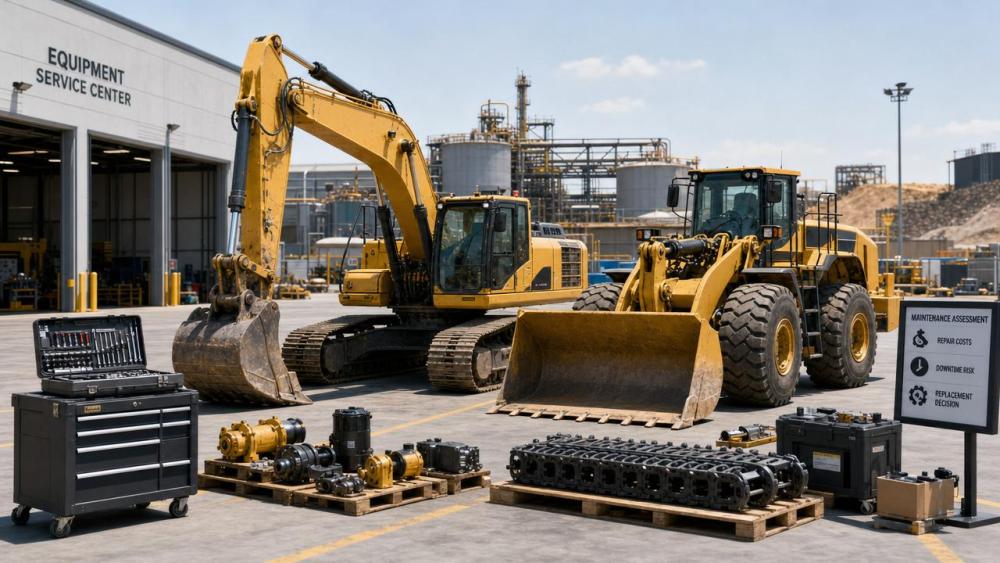
For finance approvers in construction, mining, roadbuilding, and municipal infrastructure, heavy equipment maintenance must be treated as an asset strategy, not a workshop expense. A crawler excavator, wheel loader, motor grader, bulldozer, or skid steer loader can remain productive for years, but only if repair spending still supports utilization, compliance, and project delivery.
The core question is simple: when does continued repair preserve value, and when does it trap budget in declining assets? The answer depends on cost frequency, downtime severity, emissions exposure, parts lead times, operator productivity, and residual value erosion.
At EMD, this issue is viewed through a full operating lens. Heavy equipment maintenance is influenced by hydraulic system reliability, electro-hydraulic control responsiveness, grading precision requirements, machine duty cycle, and the broader transition toward autonomy and decarbonization. That perspective matters because the accounting decision is only as good as the operating data behind it.
- Direct repair cost includes labor, parts, fluids, field service, transport, and diagnostic time.
- Indirect cost includes idle crews, delayed milestones, subcontractor disruption, and liquidated damages risk.
- Strategic cost includes fuel inefficiency, operator dissatisfaction, lower resale value, and difficulty meeting newer site or emissions requirements.
Why repair-versus-replace decisions often get delayed
Many organizations postpone replacement because repair invoices appear smaller than a new capital request. Yet this comparison can be misleading. A machine with repeated hydraulic leaks, undercarriage wear, sensor faults, or transmission instability may consume budget in small approvals while generating large losses through downtime and reduced output.
Finance teams also face incomplete reporting. Maintenance records may show parts replaced, but not production losses per hour. Without that linkage, heavy equipment maintenance looks manageable even when lifecycle economics have already turned negative.
What costs should be included before approving another major repair?
Before approving a high-value engine overhaul, pump replacement, or undercarriage rebuild, finance teams should evaluate the machine as a cash-generating asset. The table below organizes the most practical heavy equipment maintenance cost dimensions for approval workflows.
This framework helps prevent a common error: approving a repair based only on workshop cost. In many fleets, the hidden cost of downtime and lower production capacity exceeds the invoice value of the failed component.
A practical approval threshold
A useful internal rule is to compare major repair cost against the machine’s current market value, expected remaining service life, and expected downtime after repair. If the repair absorbs a large share of market value and does not materially improve reliability, replacement deserves immediate review.
- If one repair restores predictable operation for multiple seasons, repair may be justified.
- If several systems are aging at the same time, one successful repair may simply expose the next failure point.
- If parts availability is uncertain, finance should treat lead-time risk as a real cost, not a technical footnote.
Repair now or replace later: which option creates better lifecycle returns?
The decision becomes clearer when heavy equipment maintenance is compared with replacement across cost, risk, and operational impact. The next table highlights how finance teams can judge both paths without reducing the issue to purchase price alone.
Aging equipment is not automatically a replacement case. Many machines still justify targeted heavy equipment maintenance when the frame, drivetrain, and structural systems remain sound. However, once reliability uncertainty spreads across multiple high-value systems, replacement often improves total return despite the higher initial spend.
Where this matters most by machine type
The repair-versus-replace threshold differs by application. Excavators with strong structures may support selective rebuilds. Loaders working in abrasive bulk material may face accelerated wear. Graders depend heavily on precision control performance, so declining sensor or blade control accuracy can damage output quality before a machine is technically “down.”
Bulldozers used in hard pushing applications often show cost stress in undercarriage, hydrostatic systems, and track-related wear. Skid steers in urban applications may remain viable longer, but attachment compatibility and hydraulic flow performance still affect replacement timing.
Which warning signs show that heavy equipment maintenance is no longer enough?
Finance approvers need a disciplined trigger list. Waiting for catastrophic failure is rarely the best policy because emergency decisions usually cost more. The signs below indicate that maintenance spending may be preserving operation without preserving value.
- The same subsystem fails more than once within a short operating interval, especially pumps, injectors, cooling systems, electronic controls, or undercarriage components.
- The machine misses project-critical availability windows, forcing rentals or crew rescheduling.
- Fuel consumption rises while production per hour falls, even after standard service actions.
- The equipment cannot easily support newer site expectations such as digital monitoring, precision grading integration, or emissions-sensitive project environments.
- Parts sourcing becomes irregular, extending downtime and increasing dependence on salvage or unpredictable channels.
These triggers are especially relevant in fleets exposed to tough operating cycles, such as mining haul support, airport grading, bulk earthmoving, and confined urban infrastructure work. In such environments, even a small decline in machine responsiveness can compound across labor, fuel, and schedule performance.
How can procurement and finance build a better approval model?
A stronger approval model links heavy equipment maintenance decisions to measurable fleet economics. EMD’s industry perspective is valuable here because asset decisions should reflect technical behavior, market timing, and regulatory trends together.
Recommended decision workflow
- Start with machine role classification: revenue-critical, support-critical, or non-critical. A production excavator should be judged differently from a backup support unit.
- Calculate cost per productive hour, not just service cost per hour. The distinction matters when idle time and performance loss are significant.
- Review upcoming compliance and project requirements. A machine that meets today’s need may not fit tomorrow’s tender conditions.
- Compare repair lead time with replacement lead time and interim rental cost. Cash preservation can fail if schedule risk is ignored.
- Use scenario modeling: repair and run for 12 months, repair and dispose, or replace now with updated productivity assumptions.
The table below can support approval committees that need a repeatable scoring method for maintenance, overhaul, and replacement decisions.
A structured model improves consistency between operations, maintenance, procurement, and finance. It also reduces the bias toward the cheapest immediate action, which is often the most expensive annual outcome.
What compliance and market trends should influence replacement timing?
Heavy equipment maintenance decisions are increasingly shaped by external conditions. Non-road emission regulations are tightening in many markets. Project owners are asking for better fuel performance, lower carbon exposure, cleaner jobsite operation, and more digital reporting. These requirements affect fleet value even before a machine physically fails.
EMD’s strategic intelligence approach is useful because it connects machine-level cost with sector-level change. For example, greater adoption of electro-hydraulic systems, precision grading technologies, and remote-capable control architectures changes the economic baseline. Older assets may still run, but they can become less competitive in tenders that reward precision, traceability, or emissions performance.
- If your market is moving toward stricter non-road emissions expectations, replacement timing should be reviewed earlier.
- If your projects rely on GPS, laser, or 3D machine control, degraded sensor and control response can create hidden cost long before outright failure.
- If autonomy or remote-assist workflows are becoming relevant, newer platforms may deliver better upgrade paths than extended maintenance of legacy systems.
FAQ: common heavy equipment maintenance questions from finance approvers
How do I know if a major repair is financially justified?
Look beyond the quoted repair amount. Check current machine value, expected remaining life after repair, downtime during repair, and whether the repair resolves a single defect or a wider reliability pattern. If the machine will remain unpredictable, the approval case weakens quickly.
Is heavy equipment maintenance cheaper than replacement in most cases?
Not always. Maintenance is often cheaper only in the short term. If recurring failures, poor fuel efficiency, and project delays are included, total annual cost can exceed the economics of replacement. This is especially true for high-utilization machines that directly drive site output.
Which machines usually deserve closer repair-versus-replace analysis?
Production excavators, wheel loaders in abrasive handling, precision motor graders, and bulldozers in severe pushing applications deserve close review because downtime and performance loss can have immediate margin impact. Even compact skid steers should be reviewed when attachment utilization and hydraulic flow performance affect task flexibility.
What is the biggest mistake finance teams make?
The most common mistake is approving repairs from an expense perspective only. Heavy equipment maintenance should be tied to production value, compliance risk, and the machine’s role in contract execution. A lower invoice does not automatically mean a lower business cost.
Why choose us for heavy equipment maintenance intelligence and fleet decision support?
EMD helps financial decision-makers evaluate heavy equipment maintenance with more than repair history. Our perspective spans crawler excavators, wheel loaders, motor graders, bulldozers, and skid steer loaders, along with the market, technical, and regulatory signals that shape replacement timing.
If you are comparing repair budgets with fleet renewal options, we can support discussions around operating profiles, equipment role classification, maintenance risk interpretation, emissions-related planning, and technology-fit review for precision or autonomous workflows.
- Consult on repair-versus-replace evaluation logic for excavators, loaders, graders, bulldozers, and skid steers.
- Review cost drivers such as hydraulic system wear, control-system aging, fuel inefficiency, and downtime sensitivity.
- Discuss selection pathways for newer equipment aligned with project output, compliance expectations, and delivery planning.
- Explore practical topics including parameter confirmation, equipment selection, delivery cycle expectations, custom planning, certification considerations, and quote-stage comparison support.
When heavy equipment maintenance starts to compete with capital planning, a faster answer is not enough. You need a better one. Contact EMD to build a more defensible approval case based on lifecycle cost, uptime exposure, and future fleet fit.