
Related News
- 00
0000-00
How to size heavy-duty loaders for North American mining operations - 00
0000-00
How altitude affects mining excavator performance in Latin America - 00
0000-00
Caterpillar Launches New Cat 6060 and Upgraded Autonomous Mining System - 00
0000-00
When does eco-friendly construction equipment pay for itself? - 00
0000-00
Will a wheel loader quick coupler fit your existing attachments?
As mixed terrain job sites become more complex, off-road machinery safety is becoming a defining operational issue across infrastructure, mining, utilities, and site development.
Unstable ground, changing weather, blind spots, and delayed machine response now create risk chains that are harder to predict with traditional controls alone.
For organizations tracking earthmoving performance, safety is no longer separate from productivity, uptime, or project quality.
This shift matters for crawler excavators, wheel loaders, bulldozers, motor graders, and skid steer loaders operating across mixed surfaces.
Understanding where off-road machinery risks are rising helps teams reduce incidents while protecting cycle times, asset value, and schedule reliability.
Mixed terrain is changing the off-road machinery risk profile
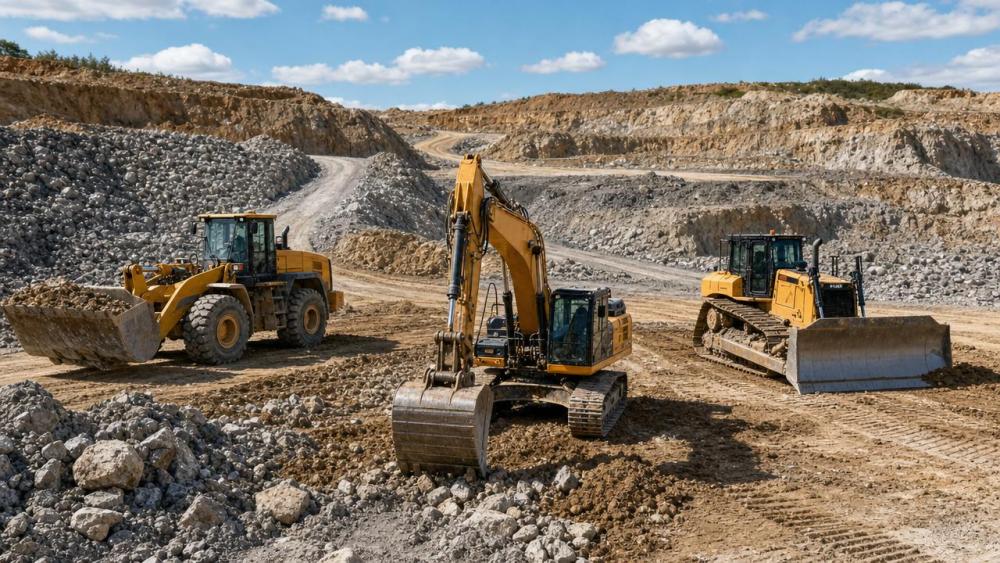
The modern job site rarely offers one consistent surface condition from start to finish.
Machines now move between mud, gravel, broken rock, compacted soil, steep grades, and partially stabilized working zones within the same shift.
That variability increases stress on traction, braking, hydraulic control, steering precision, and operator judgment.
Off-road machinery safety concerns grow further when projects combine heavy traffic, temporary routes, subcontracted activity, and tighter environmental restrictions.
In many regions, faster project timelines also reduce the margin for route preparation and hazard isolation.
As a result, small terrain changes can trigger larger operational failures, especially when machines operate near people, structures, or edges.
Several trend signals show off-road machinery hazards are intensifying
A clear signal is the growing overlap between heavy equipment tasks and dynamic site logistics.
Machines are expected to work in narrower corridors while maintaining higher throughput and stricter precision standards.
Another signal is the wider use of attachments, remote functions, and sensor-assisted control systems.
These technologies can improve safety, but they also introduce new failure points, calibration needs, and training demands.
A third signal is the expansion of work into weather-sensitive environments where terrain behavior changes quickly.
Rain, freeze-thaw cycles, dust buildup, and poor drainage can undermine assumptions made during pre-shift planning.
For off-road machinery, the danger often lies in the interaction of several minor issues rather than one dramatic defect.
The main forces behind rising off-road machinery safety risks
The following factors explain why safety exposure is increasing across mixed terrain operations.
Equipment complexity is part of the story
Today’s off-road machinery often blends mechanical systems, digital controls, automation features, and telematics.
That creates more opportunities for better control, yet it also raises the importance of software settings, interface design, and alert quality.
When alarms are unclear or sensor feedback is poorly trusted, operators may hesitate at the wrong moment.
Risk patterns differ across major machine categories
Not all off-road machinery faces identical safety pressure on mixed terrain.
- Crawler excavators face edge collapse, swing radius conflicts, and unstable lifting positions on uneven ground.
- Wheel loaders face traction loss, braking variation, and visibility issues when reversing near stockpiles.
- Motor graders face precision challenges on cross slopes and partially compacted surfaces.
- Bulldozers face rollover exposure on side slopes and hidden ground failures under pushing loads.
- Skid steer loaders face abrupt stability shifts when using heavy attachments in confined areas.
This equipment diversity means safety programs must be site-specific and machine-specific, not generic.
The impact extends beyond incidents and into business performance
Rising off-road machinery risk affects more than injury rates.
It also influences rework, equipment downtime, fuel waste, schedule disruption, and insurance pressure.
A near miss on mixed terrain often reveals hidden weaknesses in route design, machine allocation, or supervision routines.
When left unresolved, those weaknesses lower confidence in production forecasts and asset deployment plans.
For intelligence-driven operations, the strongest safety gains usually come from combining field discipline with machine data.
Why quality and safety outcomes are closely linked
Poor ground assessment can cause both a safety event and a quality defect.
An unstable grader pass may create surface inconsistency, just as a slipping loader may damage haul route integrity.
That is why off-road machinery safety should be integrated into quality checkpoints, not treated as a separate audit topic.
The most important areas now deserve closer attention
The following priorities have become essential in mixed terrain control plans.
- Daily terrain mapping, including soft zones, slope transitions, and drainage changes.
- Route separation between off-road machinery, service vehicles, and foot traffic.
- Visibility enhancement through cameras, lighting, mirror checks, and spotter protocols.
- Hydraulic and braking performance verification before high-load or downhill tasks.
- Attachment compatibility checks for weight, balance, pressure, and control response.
- Short-interval operator feedback to capture changing terrain conditions quickly.
- Telematics review focused on harsh braking, excessive slip, idle spikes, and abnormal motion patterns.
A practical response starts with layered prevention
No single intervention can solve mixed terrain exposure for off-road machinery.
The strongest approach combines planning, machine readiness, operator support, and fast site adjustments.
Future judgment should focus on adaptability, not only compliance
Compliance remains essential, but mixed terrain conditions are changing faster than many static procedures.
The next step for off-road machinery safety is adaptive control.
That means using field observations, equipment data, and repeatable review cycles to revise risk assumptions in real time.
Organizations that treat every terrain change as operational intelligence will be better prepared for autonomy, electrification, and advanced machine control.
This perspective aligns closely with the broader evolution of earthmoving systems studied by EMD, where reliability and insight drive long-term performance.
The next move is to audit risk where off-road machinery actually works
Start with a mixed terrain safety review covering routes, slope changes, surface consistency, visibility barriers, and machine-specific control limits.
Then compare those findings with maintenance records, operator feedback, and telematics patterns.
The goal is simple: identify where off-road machinery risk is increasing before it becomes an incident, a delay, or a costly quality failure.
In mixed terrain operations, safer decisions are often the same decisions that protect uptime, precision, and project confidence.