
Related News
- 00
0000-00
How to size heavy-duty loaders for North American mining operations - 00
0000-00
How altitude affects mining excavator performance in Latin America - 00
0000-00
Caterpillar Launches New Cat 6060 and Upgraded Autonomous Mining System - 00
0000-00
When does eco-friendly construction equipment pay for itself? - 00
0000-00
Will a wheel loader quick coupler fit your existing attachments?
In heavy equipment operations, overlooking small defects in heavy machinery parts can trigger major safety incidents, costly downtime, and failed inspections.
Quality risk detection is becoming more important as fleets grow smarter, projects grow faster, and compliance pressure becomes stricter across global construction and mining environments.
For EMD readers tracking excavators, loaders, graders, bulldozers, and skid steers, the issue is no longer only part replacement.
It is about spotting hidden quality risks in heavy machinery parts before they damage hydraulic systems, reduce breakout force, distort grading accuracy, or interrupt project schedules.
Why quality risks in heavy machinery parts are rising faster now
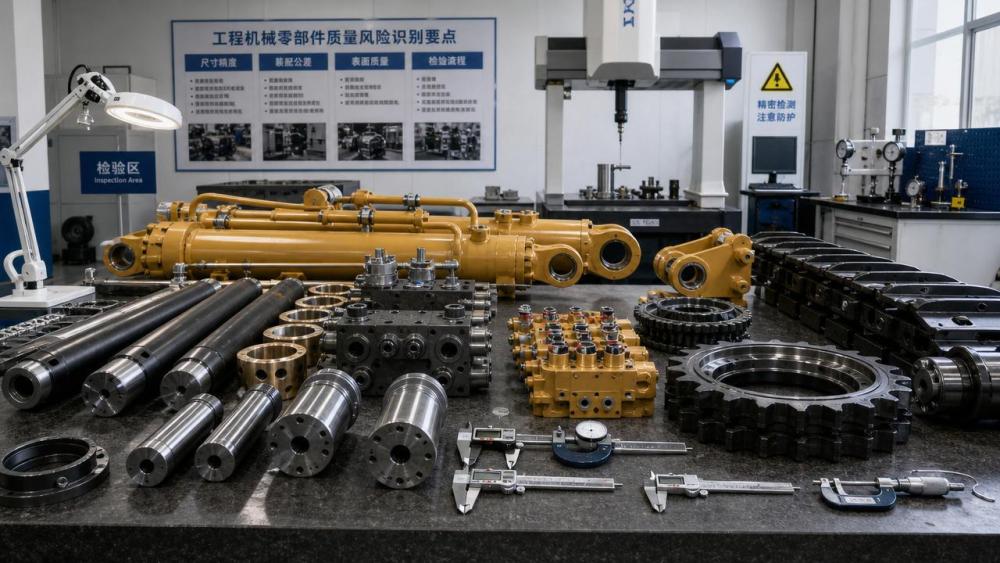
The market for heavy machinery parts is changing rapidly.
Supply chains are wider, machine uptime expectations are higher, and equipment is more dependent on precise hydraulic, electronic, and structural integration.
That shift increases exposure to inconsistent castings, weak seals, poor machining tolerance, coating failures, and incompatible aftermarket components.
In crawler excavators, a small defect in pins, bushings, cylinders, or control valves can spread into swing instability or arm drift.
In graders, poor blade linkage components can compromise surface precision.
In bulldozers and loaders, underperforming drivetrain or undercarriage parts can cut tractive efficiency and accelerate wear across adjacent systems.
The strongest warning signals are becoming easier to recognize
Many quality failures in heavy machinery parts announce themselves early.
The challenge is building discipline to interpret weak signals before breakdown occurs.
Visual irregularities often reveal deeper manufacturing issues
- Uneven surface finish may indicate unstable machining or poor final processing.
- Porosity, cracks, or pits may suggest casting defects or material contamination.
- Flaking paint or coating may hide corrosion or improper pre-treatment.
- Rough edges can signal poor deburring and weak process control.
- Color inconsistency may reveal mixed batches or uncontrolled heat treatment.
Fit problems are one of the clearest risk indicators
Quality heavy machinery parts should install smoothly within design tolerance.
If a part needs forceful alignment, extra shimming, rework, or repeated fastening, risk is already present.
Bad fit can cause leakage, vibration, preload imbalance, seal failure, or premature fatigue.
Performance drift matters as much as visible damage
A component may look acceptable and still perform poorly.
Watch for abnormal temperature rise, inconsistent pressure retention, unstable cycle times, unusual noise, or unexpected wear patterns after short service intervals.
Several industry forces are driving these heavy machinery parts risks
The rise in quality concerns is not random.
It is shaped by technical, commercial, and regulatory pressures across the machinery ecosystem.
Risk impact spreads across more business and operating links than expected
The impact of poor heavy machinery parts is rarely isolated to one failed item.
It usually moves through maintenance planning, operator confidence, jobsite productivity, compliance records, and total asset life.
In infrastructure work, one unreliable component may delay grading tolerance acceptance, interrupt concrete preparation, or reduce fleet coordination efficiency.
In mining or harsh earthmoving, the same issue can increase safety exposure because recovery access is limited and operating loads stay high for long periods.
- Unexpected downtime raises labor and standby costs.
- Secondary damage expands repair scope beyond the original part.
- Inspection failures can slow project handover or contract milestones.
- Inconsistent part quality weakens confidence in maintenance data.
The most effective checks combine material, dimensional, and operating evidence
Spotting quality risks in heavy machinery parts works best when checks are layered.
Single-point inspection is not enough for modern equipment systems.
Start with traceability and documentation
- Verify part numbers, batch identifiers, and material certificates.
- Check whether hardness, coating, and heat-treatment records are available.
- Confirm compatibility with machine model, revision, and application duty.
Measure critical dimensions, not just general appearance
Use calipers, gauges, or coordinate measurement where needed.
Focus on bore diameter, pin clearance, sealing faces, thread quality, and mounting flatness.
For hydraulic heavy machinery parts, surface finish on sealing interfaces is especially important.
Compare operating behavior after installation
Track vibration, noise, temperature, and cycle consistency against known baselines.
Even small deviations may reveal a hidden quality issue before full failure develops.
Priority watchpoints differ by equipment category and duty cycle
Not all heavy machinery parts fail in the same way.
Risk identification improves when inspection focus matches application conditions.
The strongest response is a repeatable risk-screening routine
A reliable process reduces dependence on individual judgment alone.
It also creates consistent evidence for maintenance, audit, and warranty review.
- Define critical heavy machinery parts by safety, load, and downtime impact.
- Set incoming inspection points for visual, dimensional, and documentation checks.
- Record first-use operating data after installation.
- Flag repeat failures by batch, source, machine type, and application.
- Escalate abnormal trends before the next purchase or overhaul cycle.
What deserves closer attention in the next stage of equipment reliability
As machinery becomes more automated and efficiency-driven, tolerance sensitivity will keep increasing.
That means quality risks in heavy machinery parts will appear sooner in performance data, not only during physical failure.
Condition monitoring, digital maintenance records, and better parts traceability will become practical tools for earlier detection.
For operations tied to uptime, precision, and compliance, the next smart move is clear.
Review the heavy machinery parts that create the highest consequence if they fail, tighten inspection standards, and compare field performance against expected service behavior.
When quality screening becomes systematic, equipment reliability improves, safety exposure drops, and project continuity becomes far easier to protect.