
Related News
- 00
0000-00
How to size heavy-duty loaders for North American mining operations - 00
0000-00
How altitude affects mining excavator performance in Latin America - 00
0000-00
Caterpillar Launches New Cat 6060 and Upgraded Autonomous Mining System - 00
0000-00
When does eco-friendly construction equipment pay for itself? - 00
0000-00
Will a wheel loader quick coupler fit your existing attachments?
Construction machinery components rarely fail without warning, and the earliest clues often appear during ordinary operation. In heavy equipment environments, small abnormalities can escalate fast.
For excavators, wheel loaders, motor graders, bulldozers, and skid steer loaders, early diagnosis supports uptime, safety, fuel efficiency, and lower repair costs.
Within the broader intelligence focus of EMD, reliable maintenance begins with understanding how construction machinery components behave under stress, contamination, heat, vibration, and cyclic loading.
Understanding Failure Progression in Construction Machinery Components
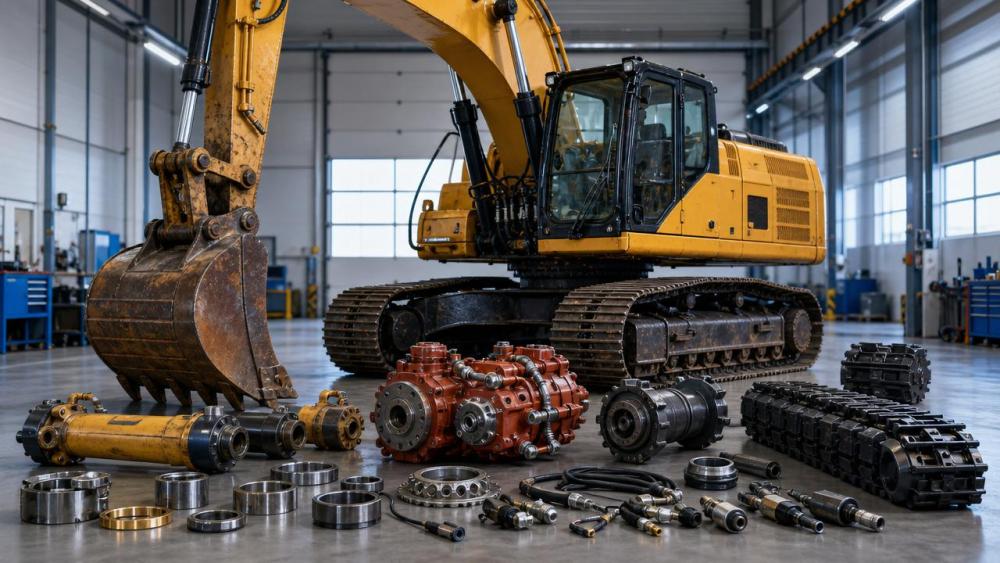
Most construction machinery components do not move from healthy to broken in a single step. Failure usually develops through gradual wear, reduced tolerance, unstable performance, and final breakdown.
This pattern is common across hydraulic systems, undercarriage parts, structural joints, pins, bushings, bearings, sensors, electrical harnesses, and cooling assemblies.
Early failure signs often include heat, noise, leakage, vibration, slow response, uneven movement, contaminated fluids, and visible surface damage.
In modern fleets, these signs matter even more because machine utilization is high, duty cycles are aggressive, and emissions-compliant systems operate with tighter tolerances.
For EMD’s focus sectors, reliable interpretation of these warning signals supports both operational continuity and long-term asset planning.
Why the earliest signs are easy to miss
Warning symptoms often appear intermittently. A machine may still complete a shift while internal wear is already accelerating.
Dust, mud, heavy loads, and operator variability can also mask the real condition of construction machinery components.
Key Industry Attention Points and First Warning Signals
Across the global earthmoving sector, maintenance teams increasingly track a set of recurring indicators. These help identify early-stage component risk before secondary failures appear.
These indicators are especially relevant as construction machinery components become more integrated with electro-hydraulic controls, telematics, and precision grading systems.
Environmental stress factors
- Abrasive dust accelerates seal, bearing, and bushing wear.
- Heat cycles weaken hoses, insulation, and elastomer materials.
- Shock loads drive cracks in frames, blades, buckets, and weld zones.
- Moisture contamination degrades fluid quality and electrical reliability.
Business Value of Early Detection
Spotting failing construction machinery components early creates measurable operational value. The first benefit is avoiding unplanned downtime during production-critical shifts.
The second benefit is controlling repair scope. A worn pin is cheaper than a damaged linkage. A weak seal is cheaper than a ruined hydraulic cylinder.
The third benefit is safety. Unstable steering, slow braking response, boom drift, or undercarriage failure can create severe site hazards.
There is also a strategic advantage. Reliable monitoring improves service planning, parts stocking, and replacement timing across mixed equipment fleets.
For intelligence-led maintenance programs, trend analysis around construction machinery components supports stronger lifecycle decisions, especially where utilization rates are high.
Typical Failure Signs by Equipment Category
Different machine types express component stress differently. Recognizing those patterns helps narrow root causes quickly.
Crawler excavators
- Bucket curl weakness may indicate pump wear or relief valve instability.
- Boom or arm drift often points to cylinder seal leakage.
- Track noise and uneven travel can signal sprocket or roller wear.
Wheel loaders
- Slow lift cycles can suggest hydraulic inefficiency or fluid contamination.
- Articulation joint play may reveal bushing wear and poor lubrication.
- Transmission hesitation deserves immediate condition review.
Motor graders
- Inconsistent blade control can reflect valve response issues.
- Sensor offset may reduce grading precision before any visible hardware damage appears.
- Circle drive wear often begins with subtle vibration and backlash.
Bulldozers and skid steer loaders
- Track frame stress cracks may emerge near high-load welded areas.
- Hydraulic attachment instability can indicate coupler or hose problems.
- Overheating in compact machines often develops from restricted airflow.
Practical Inspection Methods for Construction Machinery Components
A strong inspection routine combines observation, measurement, and trend comparison. It should be simple enough for daily use and detailed enough for escalating faults.
- Listen for new sounds during startup, travel, digging, lifting, and steering.
- Check fluid color, odor, metal particles, and water contamination.
- Measure temperature differences across pumps, motors, bearings, and coolers.
- Inspect welds, mounting points, and guards for fresh cracks or movement marks.
- Review fault codes together with operator-reported behavior changes.
- Compare current cycle times with machine baseline performance.
The best results come from documenting repeat observations. One isolated symptom may mislead, but a pattern usually exposes the real issue in construction machinery components.
Signs that require immediate escalation
- Rapid temperature rise after a short operating period.
- Visible metal debris in filters or drained fluid.
- Loss of control response in braking, steering, or boom functions.
- Growing structural cracks near load-bearing sections.
Implementation Priorities and Next Steps
An effective program for monitoring construction machinery components does not need to start with complex digital transformation. It starts with discipline, records, and consistent thresholds.
Build a checklist for hydraulic, structural, drivetrain, cooling, and electrical systems. Link each symptom to a likely cause and a defined inspection response.
Then create simple trend logs for pressure, temperature, leakage, wear measurements, and recurring fault codes. Small datasets often reveal major reliability opportunities.
Where available, combine manual checks with telematics, oil analysis, and condition-based service intervals. This hybrid approach improves visibility across critical construction machinery components.
For organizations following EMD’s infrastructure intelligence perspective, early failure recognition is more than maintenance practice. It is a foundation for uptime, safety, and equipment lifecycle resilience.
The next practical step is clear: review recent recurring faults, identify the first missed warning sign, and standardize how that signal is captured from now on.