
Related News
- 00
0000-00
How to size heavy-duty loaders for North American mining operations - 00
0000-00
How altitude affects mining excavator performance in Latin America - 00
0000-00
Caterpillar Launches New Cat 6060 and Upgraded Autonomous Mining System - 00
0000-00
When does eco-friendly construction equipment pay for itself? - 00
0000-00
Will a wheel loader quick coupler fit your existing attachments?
Industrial Machinery Trends That Could Change Equipment ROI
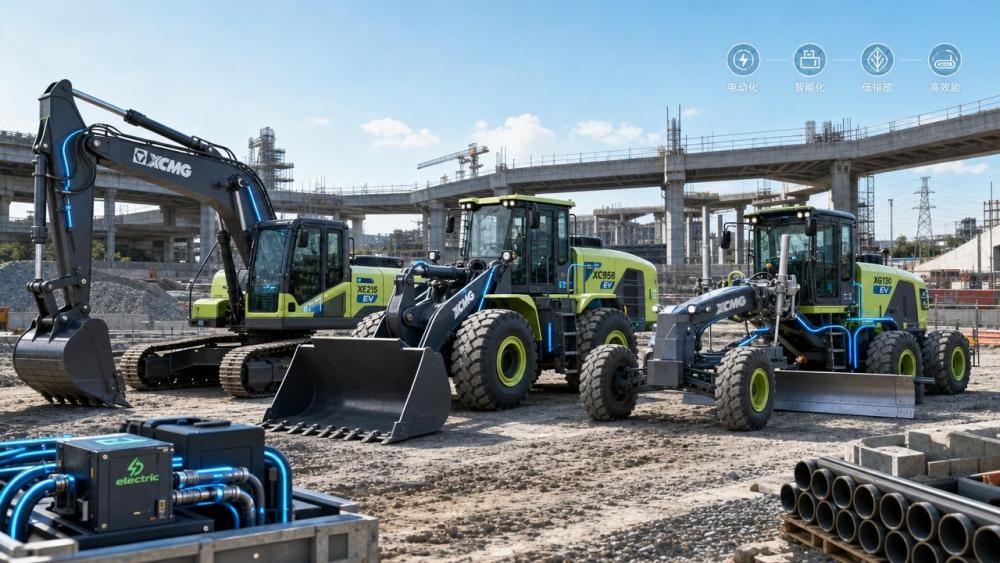
Equipment ROI is no longer shaped only by purchase price, fuel burn, or maintenance intervals.
The next wave of industrial machinery trends is redefining how heavy assets create value across infrastructure projects.
Electrified powertrains, autonomous grading, connected hydraulics, predictive intelligence, and tighter emissions rules now influence every utilization calculation.
For crawler excavators, wheel loaders, bulldozers, motor graders, and skid steers, these shifts affect productivity, uptime, resale value, and operating risk.
Understanding industrial machinery trends early helps fleets align investment cycles with smarter asset performance and stronger competitive resilience.
Core Definition of Industrial Machinery Trends
Industrial machinery trends describe the technical, regulatory, economic, and operational changes shaping heavy equipment performance and ownership value.
They include machine design, hydraulic efficiency, digital control, emissions compliance, automation, connectivity, financing behavior, and lifecycle service models.
In earthmoving, these trends become visible through faster digging cycles, smoother blade control, lower idle time, and better fleet coordination.
The most important industrial machinery trends share one feature: they convert machine intelligence into measurable financial advantage.
A crawler excavator with optimized electro-hydraulic response can reduce wasted motion and improve fuel-to-production ratios.
A motor grader guided by GNSS, laser, and 3D design files can reduce rework while preserving tight elevation tolerances.
A wheel loader linked to payload data can balance cycle speed with tire wear, fuel usage, and material movement targets.
These examples show why industrial machinery trends should be evaluated through total lifecycle economics, not headline specifications alone.
Industry Background and Current Signals
Global infrastructure programs are becoming more complex, more transparent, and more constrained by environmental performance expectations.
Urban renewal, mining expansion, airport construction, renewable energy corridors, and logistics hubs demand reliable machinery with predictable output.
At the same time, non-road emissions rules continue to influence engine architecture, aftertreatment systems, and fleet replacement timing.
Industrial machinery trends now connect regulation, jobsite safety, digital supervision, and carbon reporting into one investment conversation.
These signals do not affect every fleet equally, but they increasingly define procurement logic and long-term asset strategy.
The strongest industrial machinery trends are those that reduce uncertainty across productivity, compliance, safety, and maintenance planning.
Electrification and Energy Strategy
Electrification is one of the most visible industrial machinery trends, especially in compact and urban equipment segments.
Battery-electric skid steers, compact excavators, and small loaders can reduce noise, ventilation needs, and local emissions.
Their ROI depends on duty cycle, charging access, electricity pricing, utilization rate, and battery warranty structure.
For heavy crawler excavators and large wheel loaders, hybrid architectures may appear before full battery adoption at scale.
Hydraulic systems also matter because energy recovery and smart pump control can lower consumption without changing the power source.
Energy strategy should therefore compare diesel efficiency, hybrid assistance, electric operation, idle reduction, and charging infrastructure together.
Among industrial machinery trends, electrification delivers best results when matched to repeatable routes, predictable loads, and managed shift schedules.
Automation, Autonomy, and Precision Control
Automation is moving from premium option to practical productivity tool across earthmoving and grading applications.
Machine control systems can guide blades, buckets, and attachments according to digital terrain models and positioning data.
Motor graders benefit strongly because precision grading rewards consistency, smooth pass planning, and millimeter-level surface control.
Bulldozers gain value from automatic blade control, traction management, and reduced overcut in demanding push operations.
Crawler excavators increasingly use 2D and 3D guidance to improve trench depth, slope accuracy, and operator confidence.
These industrial machinery trends can reduce survey dependency, limit rework, and shorten project schedules when site data is reliable.
Autonomy will not replace every manual task quickly, especially in mixed, congested, or unpredictable sites.
However, semi-autonomous functions already influence ROI by stabilizing quality and reducing fatigue-related productivity losses.
Connected Hydraulics and Predictive Intelligence
Connected hydraulics are among the most important industrial machinery trends for high-intensity loading and digging equipment.
Sensors can monitor pressure, temperature, flow behavior, valve response, contamination risk, and component stress patterns.
When this data feeds predictive models, maintenance can shift from calendar intervals to condition-based intervention.
For wheel loaders, payload and cycle analytics reveal whether trucks, stockpiles, or operator habits limit productivity.
For excavators, electro-hydraulic proportional control can improve breakout force delivery while smoothing boom, arm, and bucket coordination.
For bulldozers, drivetrain and hydraulic health monitoring reduces the risk of expensive downtime during heavy pushing campaigns.
The ROI advantage appears when alerts are translated into work orders, parts planning, and dispatch decisions.
Without operational discipline, connected industrial machinery trends can become dashboards that produce visibility but little economic change.
Equipment Categories and ROI Pathways
Different machines respond to industrial machinery trends through different value pathways.
The right ROI model should reflect each machine’s dominant work pattern, environment, and replacement horizon.
This category view prevents technology decisions from becoming generic.
It also clarifies which industrial machinery trends deserve priority in specific operating environments.
Business Value Beyond Purchase Cost
Modern ROI analysis should include more than invoice price and expected maintenance spend.
Industrial machinery trends affect capital planning, bid competitiveness, insurance exposure, operator training, and carbon reporting.
A machine with higher acquisition cost may outperform cheaper alternatives if it raises utilization and protects uptime.
Reliable telematics can improve rental readiness, resale documentation, and warranty discussions with service partners.
Precision systems can strengthen tender performance when projects require documented grade quality or material accountability.
Low-emission machines can protect access to urban, indoor, tunnel, and regulated infrastructure zones.
The practical value of industrial machinery trends lies in turning technical capability into repeatable commercial advantage.
Practical Evaluation Guidelines
Evaluating industrial machinery trends requires a disciplined framework that avoids both hype and outdated assumptions.
The following checks help connect technical upgrades with measurable ROI outcomes.
- Map each machine to its highest-value duty cycle before selecting new technology.
- Compare fuel, energy, labor, maintenance, downtime, and residual value together.
- Confirm whether digital systems integrate with existing dispatch and maintenance workflows.
- Test precision control systems under real soil, slope, visibility, and signal conditions.
- Review emissions rules across current and future project regions.
- Measure utilization before and after upgrades, not only during demonstrations.
A phased approach often works better than full fleet replacement.
Pilot programs can validate industrial machinery trends in actual production conditions before wider capital commitment.
Implementation Risks and Attention Points
Every technology shift introduces risk if machines, people, data, and jobsite processes are misaligned.
Electric equipment may underperform if charging logistics are treated as an afterthought.
Autonomous features may disappoint when digital terrain models are inaccurate or poorly updated.
Predictive maintenance may fail if sensor alerts do not trigger timely service action.
Connected machines also require cybersecurity discipline, data ownership clarity, and consistent software update practices.
Industrial machinery trends should therefore be managed as operational transformation, not as isolated equipment features.
Training is another critical factor because advanced controls only improve ROI when used consistently and correctly.
Strategic Outlook for Heavy Equipment ROI
The most durable industrial machinery trends point toward cleaner power, smarter hydraulics, autonomous assistance, and verified production data.
These developments will not eliminate the importance of rugged frames, reliable undercarriages, and proven drivetrains.
Instead, they will add a new layer of intelligence above traditional mechanical strength.
Heavy equipment ROI will increasingly depend on how well machines communicate, adapt, document, and protect uptime.
Crawler excavators will be judged by controllable breakout force and precision excavation data.
Wheel loaders will be judged by payload consistency, fuel-per-ton results, and loading system balance.
Motor graders will be judged by surface accuracy, fewer passes, and digital quality records.
Bulldozers will be judged by traction efficiency, blade intelligence, and severe-duty reliability.
Skid steers will be judged by attachment productivity, maneuverability, and utilization across fragmented urban tasks.
Next Steps for Applying Industrial Machinery Trends
A practical next step is to build an ROI baseline for each core equipment category.
Track hours, idle time, fuel or energy use, downtime, rework, payload, grade accuracy, and maintenance events.
Then compare that baseline with the industrial machinery trends most relevant to each machine family.
Prioritize upgrades that improve measurable production outcomes within existing project constraints.
The strongest investment path combines mechanical durability, digital intelligence, emissions readiness, and disciplined operational execution.
By treating industrial machinery trends as strategic signals, fleets can protect asset value and improve long-term infrastructure performance.