
Related News
- 00
0000-00
CBP Sets UL 62841-3-11 Filing Rule for Electric Excavators - 00
0000-00
How to Use Operating Weight for Better Equipment Selection - 00
0000-00
EU Requires EN IEC 63254-2 for Imported Electric Excavators - 00
0000-00
Construction Equipment Emissions Compliance: Key Standards, Costs, and Buying Risks - 00
0000-00
CBP Sets Fire-Test Filing Rule for Electric Excavators
Industrial Machinery Trends That Affect Maintenance Planning
For aftermarket maintenance teams, understanding industrial machinery trends is essential to building smarter service schedules, reducing unplanned downtime, and extending equipment life.
From electrification and automation to stricter emissions systems and predictive diagnostics, today’s changes are reshaping how excavators, loaders, graders, and dozers should be maintained.
In real operating conditions, these industrial machinery trends are not abstract market signals. They directly affect parts planning, technician training, service intervals, and field response priorities.
Why Industrial Machinery Trends Matter More Than Ever
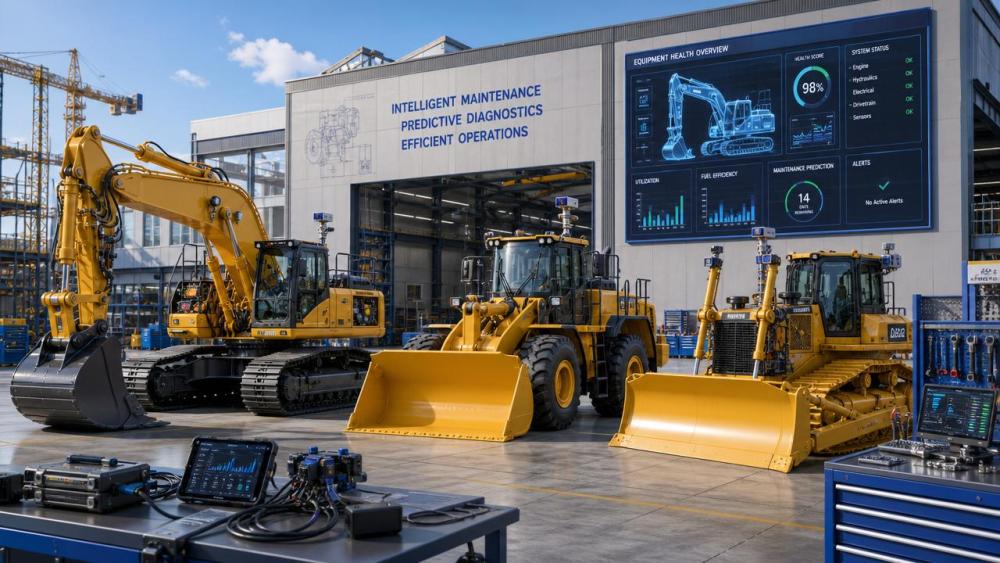
Maintenance planning used to focus on hours, wear, and visible damage. That still matters, but the equipment itself is changing much faster than before.
Crawler excavators now combine hydraulic muscle with software logic. Wheel loaders balance fuel efficiency with higher payload pressure. Motor graders depend heavily on sensors and control calibration.
Bulldozers and skid steer loaders are also becoming more connected, more emissions-sensitive, and more dependent on clean electrical performance.
That means maintenance planning must shift from reactive repair to condition-based support. The strongest teams now read industrial machinery trends as early warning signals.
At EMD, this shift is especially visible across heavy earthmoving fleets working under higher utilization, tighter emissions pressure, and growing expectations around uptime.
Trend 1: Electrification Changes Core Service Logic
Electrification is one of the clearest industrial machinery trends affecting maintenance planning. Even when fleets are not fully electric, hybrid and electrified subsystems are increasing.
This changes the service model in several ways. Fewer traditional engine tasks may reduce some routine work, but battery health and power electronics introduce new risks.
- Thermal management becomes a maintenance priority.
- High-voltage safety procedures require retraining.
- Connector cleanliness and insulation checks become critical.
- Charging behavior starts affecting machine availability.
In practice, electrification shifts attention from combustion wear patterns to energy flow stability. A weak cooling loop can now create uptime losses as serious as a hydraulic leak.
Maintenance planning should include battery inspection windows, electrical fault response playbooks, and spare part strategies for controllers, harnesses, and cooling components.
Trend 2: Smarter Machines Need Smarter Diagnostics
Another major industrial machinery trend is the rise of automation, telematics, and software-managed machine behavior.
Excavators increasingly rely on electro-hydraulic proportional control. Graders use GPS and laser systems. Remote or semi-autonomous functions are expanding in quarries, mines, and hazard zones.
As a result, maintenance planning can no longer treat electronics as secondary. Sensor drift, firmware mismatch, and communication faults now influence machine reliability every day.
A machine may look mechanically sound while still losing productivity because a calibration offset is forcing inefficient movements or false fault protection.
This is where predictive diagnostics starts paying off. Telematics data can reveal abnormal temperatures, unstable hydraulic response, repeated fault codes, or idle-heavy work cycles.
Useful actions include:
- Reviewing fault code frequency instead of isolated alarms.
- Comparing asset behavior across similar machine models.
- Scheduling calibration checks before peak workloads.
- Updating software controls during planned downtime.
Among current industrial machinery trends, this one has a simple message: if diagnostics capability lags behind machine intelligence, downtime will rise even when maintenance hours look disciplined.
Trend 3: Emissions Systems Raise Maintenance Sensitivity
Stricter non-road emissions rules continue shaping global equipment design. This is one of the most practical industrial machinery trends for field service planning.
Modern engines often depend on EGR, DPF, SCR, sensors, and control logic working together. A problem in one area can trigger reduced power, regeneration trouble, or shutdown risks.
What makes this harder is that many failures are usage-related. Long idle time, poor fuel quality, light load cycles, and delayed filter service all increase system stress.
That means maintenance planning should account for application profile, not just service hours. A loader in stop-start yard work may age differently from one in sustained quarry loading.
From a market perspective, industrial machinery trends linked to emissions will keep pushing maintenance toward cleaner operating discipline and better operator-service coordination.
Trend 4: Hydraulic Performance Is Becoming More Data-Driven
Hydraulics remain the heart of earthmoving productivity. Yet one of the more important industrial machinery trends is how hydraulic performance is now interpreted through data, not feel alone.
For excavators, breakout force and smooth control response depend on pressure stability, valve behavior, fluid condition, and software tuning.
For bulldozers and loaders, transmission efficiency and hydraulic load matching affect both fuel burn and wear progression.
This means old habits, like waiting for obvious lag or noise, are less effective. By then, efficiency loss may already be expensive.
Better planning focuses on trend indicators such as:
- Slow rise in operating temperature
- Recurring micro-fluctuations in response time
- Contamination findings from oil analysis
- Seal wear patterns tied to duty intensity
Among all industrial machinery trends, data-backed hydraulic maintenance is one of the fastest ways to reduce hidden productivity loss without waiting for visible failure.
Trend 5: Parts Planning Must Follow Global Supply Reality
Recent industrial machinery trends also reflect supply chain volatility. Lead times for sensors, control modules, harnesses, and specialized hydraulic parts can be unpredictable.
That changes maintenance planning in a very practical way. Service teams cannot rely only on fast replenishment after failure.
Instead, they need a risk-ranked parts strategy. Fast-moving wear items are still important, but low-volume electronic components now deserve more attention.
A grader stopped by one failed positioning sensor can be just as disruptive as a machine waiting for a major hydraulic repair kit.
A stronger planning model usually includes:
- Critical spares lists by machine family
- Failure history matched to lead time risk
- Seasonal stocking around project peaks
- OEM and supplier communication on upgrades
This is where industrial machinery trends connect directly with uptime economics. Better forecasting often saves more than emergency repair speed alone.
How to Turn Industrial Machinery Trends Into a Better Maintenance Plan
The most effective response is not to chase every new technology. It is to translate industrial machinery trends into a maintenance system that is specific, measurable, and flexible.
A practical approach starts with machine segmentation. Separate older mechanical assets from newer connected units, then build different inspection logic for each group.
Next, adjust service intervals by duty cycle, environment, and emissions behavior. A one-size schedule rarely fits mixed fleets anymore.
It also helps to combine workshop records with telematics and fluid analysis. That mix creates a far more useful picture than hour-based logs alone.
Priority actions are usually clear:
- Train around electrical and software diagnostics
- Review emissions-related work patterns monthly
- Use trend data to trigger early intervention
- Stock spares based on downtime impact
The broader message from industrial machinery trends is straightforward. Machines are becoming more precise, more connected, and less forgiving of inconsistent maintenance habits.
Teams that adapt early will protect asset life, improve jobsite availability, and support stronger lifecycle value across excavators, loaders, graders, dozers, and compact equipment.
For organizations tracking the future of earthmoving equipment, EMD continues to monitor the industrial machinery trends shaping service strategy, reliability expectations, and long-term fleet planning.
The next smart move is simple: review current maintenance plans against these trend signals, identify the biggest mismatch, and fix that gap before it becomes downtime.