
Related News
- 00
0000-00
How an earthmoving equipment portal helps vet factory capabilities - 00
0000-00
How to assess equipment specifications against applicable standards - 00
0000-00
How Middle East climate conditions should shape heavy equipment selection - 00
0000-00
Can an industrial equipment sourcing supplier directory improve vendor selection? - 00
0000-00
How earthmoving equipment is applied in canal construction
Construction Equipment Emissions Compliance: Key Standards, Costs, and Buying Risks
For procurement teams, construction equipment emissions compliance is no longer just a regulatory checkbox. It can decide whether a machine clears customs, whether it can work on a public project, how much it will cost to maintain, and how much value it keeps when you sell it later. That is why construction equipment emissions compliance needs to be checked before you compare price sheets, not after.
If you are sourcing excavators, wheel loaders, graders, bulldozers, or skid steers across multiple markets, the practical question is simple: does this unit match the emissions rules of the country, city, and jobsite where it will actually run? A machine can be technically sound and still be the wrong buy.
Start with the market, not the machine
This is the first filter, and it removes a lot of bad options early.
In the U.S., buyers usually look at EPA Tier 4 Final for many nonroad diesel machines. In the EU, Stage V is the main reference point for new non-road mobile machinery. Other markets may accept older standards, local equivalents, or transitional rules, but that is exactly where procurement mistakes happen. “Acceptable in one country” does not mean importable, registrable, or bid-eligible in another.
Before you ask for quotations, pin down these points in writing:
- Country of import
- Final operating region or city
- Whether the machine will work on public infrastructure, mining, rental fleets, or private sites only
- Whether the project owner or EPC contractor imposes a stricter emissions rule than national law
- Whether low-emission zones or clean construction requirements apply
A lot of buyers stop at national regulation. That is not enough. Some tenders, municipal jobs, and large industrial sites set their own equipment eligibility rules. If your machine misses that mark, the discount you won on purchase price disappears fast.
Do not rely on the seller saying “compliant”
This is one of the most common buying risks in cross-border equipment sourcing. “Tier 4,” “Stage V ready,” or “export version” can mean very different things depending on who is speaking.
Ask for the actual evidence pack. At minimum, review:
- Engine make, model, and family designation
- Emissions label photos on the engine and machine
- Declaration or certificate relevant to the target market
- Serial number match between machine documents and physical unit
- Aftertreatment configuration: DOC, DPF, SCR, EGR, or a combination
- Operator and service manuals showing maintenance requirements for the emissions system
If the supplier cannot produce this cleanly, assume you are buying risk along with the machine.
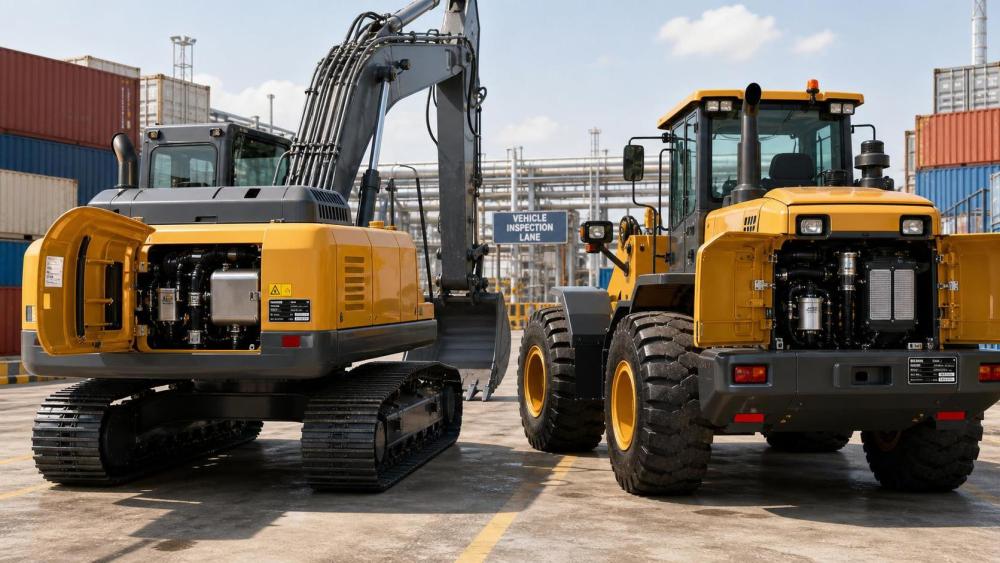
Know what standard changes the machine actually brings
From a procurement angle, emissions standards are not just paperwork. They affect hardware, operating habits, service intervals, and field reliability.
Tier 4 Final and Stage V machines often rely on advanced aftertreatment systems to reduce particulate matter and NOx. Depending on engine size and design, that may include diesel particulate filters and selective catalytic reduction systems using DEF or AdBlue. The result is cleaner exhaust, but also more things to inspect before purchase:
- Can your site support the required fuel and fluid quality?
- Will operators understand regeneration behavior and warning codes?
- Is dealer diagnostic support available in your region?
- Are sensors, filters, dosing parts, and software support locally available?
On paper, two machines may both be compliant. In practice, one may fit your jobsite far better because the support network is stronger and the operators already know the system.
Budget for compliance costs beyond purchase price
This is where cost analysis often goes soft. Buyers compare base machine price, shipping, and duty, but emissions compliance changes the full ownership model.
The main cost buckets usually include certification-related documentation, aftertreatment maintenance, DEF or AdBlue consumption where applicable, technician training, downtime linked to neglected regeneration cycles, and the possibility of replacing emissions components outside warranty. Actual amounts vary too much by brand, duty cycle, and market to generalize safely, so treat any blanket cost claim with caution unless the source is documented.
Retrofitting deserves special care. Some buyers assume an older excavator or loader can always be upgraded later. Sometimes it can. Sometimes it cannot. Even where retrofit solutions exist, legality, certification status, local approval, and performance impact need separate verification. A technically installed kit is not automatically a regulator-accepted solution. Mark this as 【待核实】 until local authorities, the engine supplier, or an accredited compliance source confirm it.
Used equipment is where the hidden trouble usually sits
The used market can make sense, especially for fleets balancing capex and utilization. But emissions-related risk is higher there than many first-time international buyers expect.
Watch for these warning signs:
- Missing or damaged emissions labels
- Evidence that DPF, SCR, or sensors were removed, bypassed, or altered
- Machine history from a region with different regulatory requirements
- No service records showing aftertreatment maintenance
- Unclear engine swap history
- Low price that only makes sense if the machine cannot legally enter your market
One detail many teams miss: a machine can be mechanically productive and still fail a procurement review because the documentation trail is broken. If you cannot defend the compliance status to customs, a client auditor, or a financing partner, ownership becomes messy.
A quick comparison table for procurement screening
Match the machine to the duty cycle, not just the regulation
A compliant machine that spends long periods idling, running light loads, or cycling irregularly may create more aftertreatment headaches than a unit working under steadier heavy load. That matters for excavators in urban utility work, skid steers doing stop-start attachments, and machines in dusty or low-speed applications.
Ask the supplier how the engine and aftertreatment package behaves in your actual application, not in generic brochure language. Quarry loading, airport grading, trenching, demolition, and mine support all stress equipment differently. A procurement team that ignores duty cycle often hands operations a machine that is compliant but frustrating.
Check tender and financing consequences early
Some contractors only discover the emissions issue when submitting for a public works package or arranging lease financing. By then, you are negotiating from a weak position.
Before issuing a purchase order, confirm whether your lenders, insurers, rental customers, or project owners ask for specific compliance documentation. Their screening can be stricter than customs review. This matters especially for fleet buyers who plan to redeploy machines between regions or resell into regulated markets later.
What experienced buyers put on the final pre-purchase checklist
- Target market and jobsite emissions requirement confirmed in writing
- Engine and machine compliance documents reviewed before deposit
- Physical labels and serial numbers matched to paperwork
- Aftertreatment hardware visually inspected, especially on used units
- Dealer parts and diagnostic support checked in the operating region
- Operator training needs included in cost calculation
- Any retrofit claim marked 【待核实】 until accepted by relevant authority or documented compliance source
- Tender, financing, and resale implications reviewed before final approval
That is the practical shape of construction equipment emissions compliance in procurement. It is part legal screening, part technical due diligence, and part cost control. The teams that get it right usually do one thing differently: they treat emissions status as an asset-use decision, not just an engine spec. That keeps bad inventory out of the fleet and avoids the expensive surprise of owning a machine that cannot go where the work is.