
Related News
- 00
0000-00
How an earthmoving equipment portal helps vet factory capabilities - 00
0000-00
How to assess equipment specifications against applicable standards - 00
0000-00
How Middle East climate conditions should shape heavy equipment selection - 00
0000-00
Can an industrial equipment sourcing supplier directory improve vendor selection? - 00
0000-00
How earthmoving equipment is applied in canal construction
Operating Weight Is Not a Shortcut Number
In equipment evaluation, operating weight is often treated as a quick filter: 20-ton excavator, 6-ton loader, 14-ton dozer. That is useful, but incomplete. The reason equipment selection by operating weight matters is not that weight alone tells you what a machine can do. It matters because operating weight sits at the intersection of structural stability, undercarriage loading, transport planning, ground pressure, attachment compatibility, and cycle efficiency. When evaluators use it well, they reduce the risk of choosing a machine that looks right on paper but performs poorly once it reaches the site.
The most common mistake is to read operating weight as a direct proxy for productivity. A heavier machine may offer better breakout force, stronger lift stability, and more robust frame durability, but that does not automatically make it the better choice. In confined urban work, soft underfoot conditions, bridge deck access, or jobs with frequent relocation, too much machine weight can create more constraints than value. The number is meaningful only when tied back to the task, the surface, the haul route, and the work tool package.
What Operating Weight Usually Includes
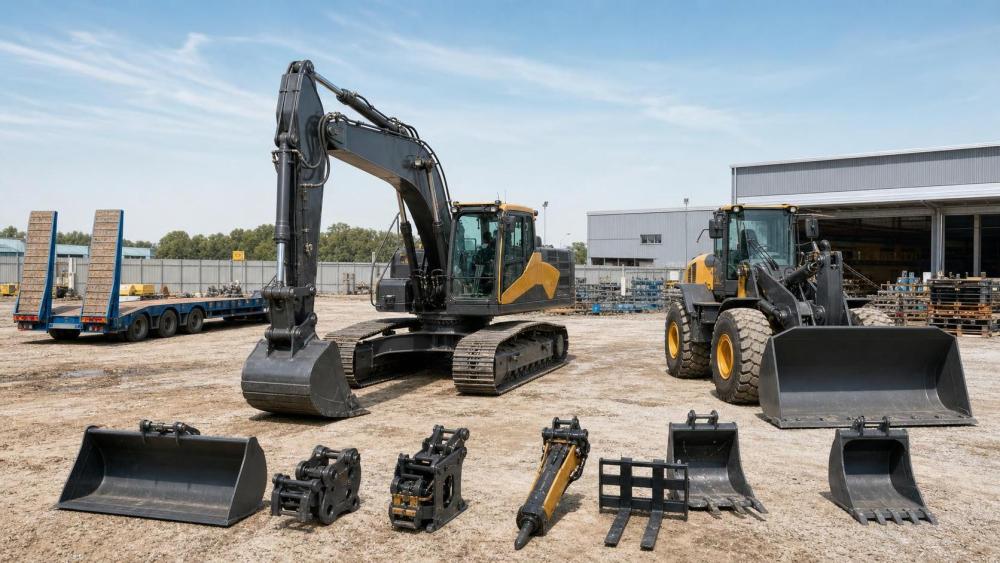
In most manufacturer literature, operating weight refers to the machine in a working-ready condition. That often means standard configuration, fluids, and a defined attachment or work tool. The problem is that “working-ready” is not always described the same way across categories or brands. An excavator’s published operating weight may reflect a standard boom, arm, bucket, and cab configuration. A wheel loader may include a standard bucket and full fuel, while optional counterweights, tire choices, quick couplers, guarding packages, or larger attachments can shift the actual field weight materially.
That is why experienced evaluators do not compare published weights in isolation. They check the configuration basis behind the number. If one machine is listed with a heavy-duty undercarriage, larger bucket, and additional guarding, while another is published in a lighter standard trim, the headline comparison is already distorted. For fleets working in quarry, demolition, forestry, or high-abrasion earthmoving, optional protection and attachment mass are not side notes. They are part of the real operating condition.
Why Weight Matters Differently Across Machine Types
The industry talks about weight as if it behaves the same way everywhere. It does not. On crawler excavators, operating weight strongly influences stability during lifting, digging reach behavior, tail balance, and transport class. On bulldozers, it is closely tied to available tractive effort and blade load management, but track design and powertrain characteristics still shape real pushing performance. On wheel loaders, weight interacts with tipping load, tire loading, axle durability, and bucket fill strategy. On motor graders, weight distribution can matter as much as total machine weight because fine grading depends on controllability, frame geometry, and how the machine carries the moldboard under changing surface resistance.
Skid steer loaders make the point even more clearly. A heavier skid steer may accept a wider attachment range and feel more planted under demanding hydraulic work, yet if the site includes fragile pavement, narrow gates, or frequent trailer moves between scattered urban jobs, extra weight can reduce dispatch flexibility. The operating weight number remains relevant, but the decision logic changes with the machine family.
Where Technical Evaluators Actually Use the Number
The practical value of operating weight shows up in a few recurring decisions.
- Matching machine class to duty severity. Heavy excavation in compacted soil, rock handling, or sustained blade work usually pushes buyers toward higher operating weight classes because the machine must resist shock, maintain footing, and carry larger structural loads over time.
- Checking access and logistics. Transport permits, low-bed trailer selection, axle loading, and route restrictions can eliminate an otherwise attractive machine before the first shift starts.
- Assessing surface impact. Ground pressure is not the same as total weight, but operating weight is one of the first signals for whether a machine may struggle on soft subgrades, reclaimed land, wet utility corridors, or finished surfaces.
- Evaluating attachment realism. A machine may technically accept a hammer, compactor, tiltrotator, larger bucket, or grading system, yet once that package is fitted, working stability and transport mass can move into a different category.
- Estimating fleet balance. In mixed fleets, a poor step between machine classes creates inefficiency. A loader that is too small for the truck pass count, or an excavator too heavy for the support fleet’s hauling and mobilization method, adds cost without needing a dramatic performance failure to prove it.
The Number Only Works with Context
A useful evaluation starts by asking what the machine must resist, not just what it must move. Resistance may come from dense material, uneven bench conditions, repeated lifting, long reach work, steep grades, or continuous attachment loading. In those cases, operating weight helps signal how much machine mass is available to stabilize the work cycle. That is especially relevant when the job rewards consistency more than peak output. A slightly heavier platform may finish faster over a month because it spends less time correcting instability, recovering traction, or operating below attachment capacity.
But context cuts the other way too. There are many jobs where lower operating weight is an advantage rather than a compromise. Urban utility trenching, landscape construction, airport maintenance windows, warehouse redevelopment, and secondary road shoulder work often reward compactness, easier mobilization, and lower surface damage. Technical teams that focus too heavily on upper-end capability can overspecify the machine and inherit unnecessary cost in transport, fuel burn, undercarriage wear, or access limitations.
Common Misreadings That Distort Selection
One persistent misunderstanding is assuming that close operating weights mean comparable machines. They may not be. Two excavators in the same nominal tonnage band can differ meaningfully in hydraulic tuning, lift chart behavior, counterweight design, track gauge, engine power, and work tool support. The same is true for loaders and dozers. Weight places the machine in a neighborhood; it does not describe the house.
Another mistake is to separate operating weight from dimensions. A machine can fall into the right weight class and still be wrong for the site because swing radius, transport width, blade width, overall height, or bucket envelope creates a physical conflict. Evaluators dealing with tunnels, urban barricades, under-bridge work, or lane-restricted corridors know this well. Weight may narrow the shortlist, but dimensional fit decides whether the shortlist survives.
A third issue appears when buyers compare standard published weight against actual field configurations. Extra guarding, longer arms, wider shoes, heavy buckets, couplers, grade control hardware, or high-flow auxiliary packages can move the real operating condition away from the brochure baseline. That gap matters most in applications where stability margins, transport thresholds, or surface loading are already tight.
A Better Way to Use Operating Weight in Selection
For equipment selection by operating weight, the more reliable method is comparative rather than absolute. Start with the target job and define the limiting conditions: material density, required reach, slope, lift requirement, surface bearing condition, transport route, and attachment package. Then compare candidate machines within a realistic configuration, not just a brochure headline. This changes the conversation from “Is 22 tons enough?” to “With this bucket, this coupler, and this transport route, what class gives stable production without creating access or logistics penalties?” That is a much better question.
A compact review table can help during early screening:
What This Means for Evolving Fleets
The topic is becoming more important as fleets add automation packages, electrified platforms, and precision control systems. Sensors, onboard computing, battery systems, protective structures, and advanced attachment interfaces can all influence the real working mass of the machine or change how that mass is distributed. For evaluators tracking decarbonization and autonomy, operating weight remains a foundational parameter, but it has to be read alongside energy storage layout, payload effect, and chassis behavior under digitally controlled work cycles.
This is where disciplined technical review pays off. Earthmoving fleets are no longer selecting only for brute force or nominal class. They are selecting for fit: fit with transport corridors, fit with emissions pathways, fit with grade control workflows, fit with operator behavior, and fit with the commercial rhythm of the project. Operating weight is still one of the fastest ways to orient that decision, but it only becomes a good decision tool when paired with the rest of the machine’s working reality.
The Useful Question to End With
When reviewing a machine, do not ask whether its operating weight is high or low in isolation. Ask whether that weight is buying something the job actually needs: better lift confidence, stronger footing, attachment stability, or more durable production under severe duty. If the answer is yes, the number is earning its place in the specification. If not, it may just be carrying cost, transport complexity, and access restrictions into a job that would have been better served by a different class.
That is the practical value of equipment selection by operating weight. It is not a shorthand for machine quality. It is a disciplined starting point for understanding how the machine will behave once the brochure is gone and the work begins.