
Related News
- 00
0000-00
How to size heavy-duty loaders for North American mining operations - 00
0000-00
How altitude affects mining excavator performance in Latin America - 00
0000-00
Caterpillar Launches New Cat 6060 and Upgraded Autonomous Mining System - 00
0000-00
When does eco-friendly construction equipment pay for itself? - 00
0000-00
Will a wheel loader quick coupler fit your existing attachments?
As 2026 approaches, heavy construction equipment is entering a decisive era shaped by electrification, autonomous control, stricter emissions standards, and data-driven fleet optimization.
These shifts are changing how fleets are specified, financed, operated, and serviced across infrastructure, quarrying, mining, and urban development projects worldwide.
For organizations tracking heavy construction equipment, the priority is no longer simple machine ownership. The focus is lifecycle productivity, compliance resilience, energy efficiency, and measurable uptime.
This article reviews the most important heavy construction equipment trends shaping 2026 and explains their practical value across excavators, wheel loaders, motor graders, bulldozers, and skid steer loaders.
Heavy Construction Equipment in 2026: A Practical Definition
Heavy construction equipment includes high-capacity machines designed for excavation, loading, grading, pushing, site preparation, and material movement under demanding operating conditions.
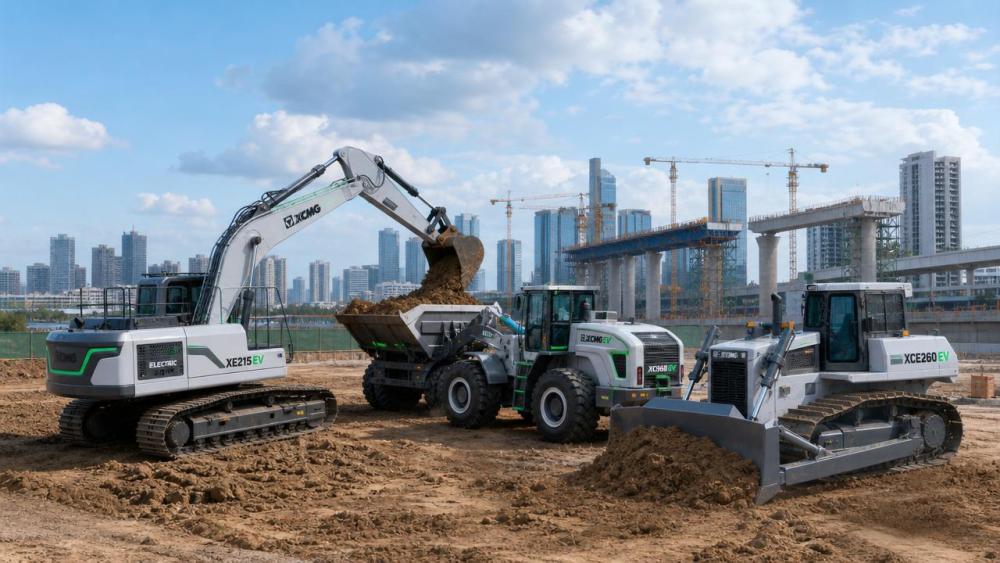
In 2026, the category is no longer defined only by horsepower, breakout force, and payload. Software, connectivity, emissions performance, and automation now shape competitive value.
The modern heavy construction equipment market combines iron, hydraulics, sensors, telematics, power electronics, and digital control systems into integrated production assets.
This evolution is especially visible in crawler excavators, wheel loaders, motor graders, bulldozers, and compact yet highly versatile skid steer platforms.
Core performance dimensions
- Fuel or energy efficiency per operating hour
- Hydraulic responsiveness and controllability
- Machine uptime and service interval stability
- Digital visibility across mixed fleets
- Compliance with regional emissions and safety standards
- Adaptability to semi-autonomous and remote operation
Industry Signals Reshaping Heavy Construction Equipment Demand
Several market forces are redefining heavy construction equipment purchasing criteria and replacement cycles as 2026 planning becomes more disciplined.
These signals matter because heavy construction equipment is increasingly judged by cost per moved ton, cost per cubic meter, and schedule certainty.
The Most Important Heavy Construction Equipment Trends for 2026
1. Electrification moves from niche to selective mainstream
Electric heavy construction equipment will not replace diesel everywhere in 2026, but adoption will expand in urban, indoor, tunneling, and regulated environments.
Compact and mid-sized machines are leading first, especially where noise limits, air quality targets, and repetitive duty cycles justify battery investment.
Hybrid systems will remain important for larger heavy construction equipment, offering lower fuel burn without full charging dependency.
2. Electro-hydraulic intelligence improves precision
Advanced electro-hydraulic controls are making machines smoother, faster, and more predictable under variable load conditions.
This is especially important for crawler excavators and motor graders, where precision directly affects rework, fuel use, and finishing quality.
3. Autonomous functions become economically relevant
The biggest gains will come from assistive autonomy rather than fully driverless deployment across all sites.
Features such as grade control, payload monitoring, obstacle alerts, dig assistance, and remote operation will deliver near-term value.
For hazardous mines and isolated project zones, remote heavy construction equipment operation will continue gaining strategic importance.
4. Data-driven maintenance becomes a margin lever
Predictive maintenance is evolving from dashboard visibility into workflow control for parts planning, downtime reduction, and service scheduling.
High-value heavy construction equipment increasingly justifies condition-based maintenance using pressure trends, thermal data, and utilization patterns.
5. Fleet standardization gains importance
Mixed fleets remain common, but standardizing controls, attachments, diagnostics, and data formats reduces training burden and service complexity.
This trend will influence new heavy construction equipment procurement decisions as organizations seek simpler lifecycle management.
Business Value Across Equipment Categories
Not every trend affects every machine type equally. The practical value of heavy construction equipment innovation depends on the duty cycle and work environment.
For many fleets, the best heavy construction equipment investment is not the most advanced machine. It is the one with the strongest utilization profile and service support.
Typical Application Scenarios in 2026
Heavy construction equipment trends become easier to evaluate when mapped to real operating scenarios.
- Urban redevelopment: electric or low-emission compact equipment supports low-noise, low-visibility work windows.
- Highway expansion: graders and dozers benefit from integrated machine control and digital site models.
- Mining and quarrying: loaders and excavators gain from payload analytics, remote operation, and uptime-centered maintenance.
- Airport and logistics infrastructure: precision grading and schedule reliability become more valuable than peak machine output alone.
- Hazardous or remote zones: remote heavy construction equipment operation improves safety and staffing flexibility.
Practical Considerations Before Investing
The 2026 market rewards disciplined evaluation. Heavy construction equipment decisions should reflect site conditions, utilization rates, and infrastructure readiness.
Key checkpoints
- Measure total cost of ownership, not only acquisition price.
- Verify dealer support, parts access, and software update pathways.
- Match electrification plans to charging, grid, or energy storage capability.
- Assess telematics compatibility across all heavy construction equipment brands.
- Prioritize features that improve real production, not showroom complexity.
- Build training plans for operators, technicians, and digital workflow users.
Another important consideration is residual value. Machines aligned with future emissions, safety, and data standards are more likely to hold value longer.
This is especially relevant where heavy construction equipment fleets face cross-border deployment or resale into multiple regulatory markets.
Strategic Outlook for the Next Planning Cycle
The heavy construction equipment sector in 2026 will favor organizations that combine machine performance with information discipline.
The strongest results will come from balancing proven diesel platforms, selective electrification, assistive autonomy, and tighter maintenance intelligence.
For sectors linked to infrastructure, mining, logistics, and urban development, heavy construction equipment is becoming a smarter and more strategic capital asset.
A practical next step is to review fleet age, duty cycles, idle time, emissions exposure, and digital readiness before the 2026 replacement window closes.
With clear benchmarking and informed specification, heavy construction equipment investments can deliver stronger productivity, better compliance resilience, and more durable long-term value.