
Related News
- 00
0000-00
How to size heavy-duty loaders for North American mining operations - 00
0000-00
How altitude affects mining excavator performance in Latin America - 00
0000-00
Caterpillar Launches New Cat 6060 and Upgraded Autonomous Mining System - 00
0000-00
When does eco-friendly construction equipment pay for itself? - 00
0000-00
Will a wheel loader quick coupler fit your existing attachments?
In 2026, autonomous construction is no longer defined by trade-show demos or isolated pilots. It is proving itself in tightly managed work zones where repeatable cycles, digital site models, and controlled traffic make autonomy practical. The strongest results are appearing in earthmoving, grading, quarry haul support, and hazardous-zone operations, where the technology can improve safety, machine utilization, surface accuracy, and fuel burn without demanding full jobsite autonomy from day one.
That distinction matters. The most useful question is not whether machines can drive themselves everywhere. It is whether a specific task, machine, and site workflow can support dependable semi-autonomous or autonomous performance at scale. Across the broader infrastructure and heavy equipment sector, adoption is working best where operational complexity is reduced and digital control is already part of the job.
Why autonomous construction needs a checklist, not a headline
The gap between marketing and deployment remains wide. Many systems can automate a single motion, but far fewer can maintain performance across weather changes, operator shifts, mixed fleets, and unstable ground conditions. A checklist-based view helps separate real operating readiness from feature claims.
For heavy equipment intelligence platforms such as EMD, the clearest pattern is this: autonomous construction succeeds when three layers align. The machine must have mature controls, the site must support high-quality positioning data, and the workflow must tolerate predictable repetition. When one of those layers fails, adoption slows quickly.
Core checklist: where autonomous construction is actually working
Use the following execution checklist to evaluate whether a project is a realistic fit for autonomous construction in 2026.
- Prioritize repeatable cycles such as truck loading, slot dozing, haul-route support, and finish grading, where machine behavior can be standardized across shifts.
- Verify positioning integrity through GNSS, base stations, IMUs, lidar, or local correction networks before expecting stable autonomous machine control.
- Map geofenced work zones with clear exclusion areas, controlled access points, and limited pedestrian interaction to reduce exception handling.
- Select machine categories with proven electro-hydraulic precision, because autonomy performs better where actuation and feedback loops are already mature.
- Measure value by production consistency, rework reduction, idle time, and fuel efficiency, not by novelty or percentage of hands-free operation.
- Integrate autonomy into dispatch, grade-control, maintenance, and fleet data systems so the machine becomes part of the operating process.
- Start with supervised autonomy or remote oversight instead of full removal of personnel from the loop during early deployment phases.
- Confirm mixed-fleet compatibility, since many projects depend on excavators, dozers, loaders, and graders from more than one OEM.
Machine categories advancing fastest
Motor graders and precision grading systems
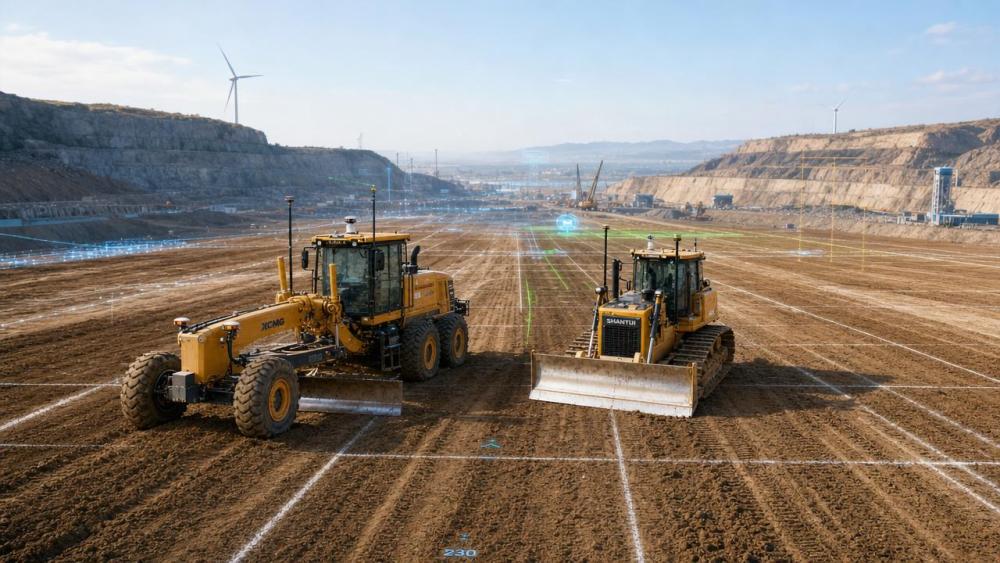
Grading is one of the strongest use cases for autonomous construction. The work depends on digital terrain models, repeatable blade movements, and measurable tolerances. Modern graders already rely on GNSS, inertial sensing, and machine control software, so autonomy builds on an existing digital foundation.
In airports, highways, logistics parks, and large industrial pads, autonomous or semi-autonomous grading can reduce overcut, shorten survey feedback loops, and improve first-pass accuracy. The highest gains appear where site geometry is stable and material conditions are well characterized.
Bulldozers in production earthmoving
Dozers are advancing quickly because many tasks involve predictable push patterns inside geofenced areas. Slot dozing, bench shaping, stockpile management, and mass excavation support autonomous workflows better than open, highly variable urban jobsites.
The economics are attractive. Fuel use, track slip, idle time, and blade pass efficiency can all be tracked. When autonomy stabilizes operator variability, production planning becomes easier and surface outcomes become more consistent.
Crawler excavators in controlled dig zones
Excavators remain more complex because digging conditions change constantly. Still, autonomous construction is working in trenching, repetitive loading, and hazardous material zones where bucket path planning can be bounded by digital models and exclusion rules.
Semi-autonomous digging functions are often more valuable than full machine autonomy. Automated swing limits, dig-depth control, bucket trajectory assistance, and remote intervention can deliver practical gains without overpromising total independence.
Wheel loaders and quarry support operations
Wheel loaders are seeing meaningful progress in quarries, yards, and tightly managed bulk-material sites. These environments feature defined travel paths, repetitive load-and-carry cycles, and fewer unpredictable interactions than open construction sites.
Autonomous loader functions can improve cycle consistency and reduce tire abuse, fuel spikes, and unnecessary braking. However, success still depends on stockpile variability, visibility conditions, and coordination with trucks or crushers.
Where adoption is strongest by scenario
Large greenfield infrastructure
Greenfield highway, airport, and industrial projects are highly favorable for autonomous construction. They usually begin with strong survey control, centralized planning, and broad work zones. That makes geofencing, digital terrain management, and machine routing much easier to govern.
Adoption works best during early earthworks, subgrade shaping, and long-run grading, not during late-stage finishing where subcontractor density and site interaction rise sharply.
Mining-adjacent and hazardous environments
Remote-controlled and autonomous equipment performs well near unstable slopes, contaminated ground, blast zones, and other high-risk areas. In these cases, safety value can justify deployment even before labor productivity reaches its maximum.
Low-latency communications and strong fallback logic are essential here. If connectivity is weak, the site must support safe degraded modes rather than assuming perfect uptime.
Urban and mixed-access projects
Urban adoption is real, but narrower. Dense traffic, changing access, pedestrians, utilities, and subcontractor overlap create frequent exceptions. In these environments, assisted autonomy usually beats full autonomy.
Grade control, collision avoidance, swing restriction, and remote operation support can still generate strong returns, especially for compact equipment and utility trenching tasks.
Common blind spots that slow autonomous construction
Overestimating site readiness. A machine may be autonomy-ready while the site remains data-poor. Weak survey control, missing correction coverage, or inconsistent digital models can undermine performance fast.
Ignoring change management. Autonomy changes dispatch logic, handoff rules, maintenance timing, and safety procedures. Without workflow redesign, advanced machines behave like isolated tools instead of integrated assets.
Confusing autonomy with labor elimination. Most successful deployments still rely on supervisors, remote operators, survey technicians, and fleet coordinators. The gain comes from role redesign and higher consistency.
Skipping OEM and interface validation. Mixed fleets remain standard across construction and quarrying. If machine data, attachments, and control layers do not communicate cleanly, rollout costs rise.
Using the wrong success metric. The better KPI set includes rework, pass count, unplanned stops, fuel per moved cubic meter, and safety exposure reduction.
Practical execution steps for 2026 deployment
- Choose one machine class and one bounded task before expanding to broader autonomous construction workflows.
- Build a site-readiness audit covering positioning, connectivity, digital models, traffic separation, and fallback procedures.
- Run supervised production trials long enough to capture weather variation, shift changes, and material inconsistency.
- Tie every autonomy event to operational KPIs, including fuel, cycle time, grade accuracy, utilization, and safety incidents.
- Scale only after proving repeatability across crews, not after a single high-performing demonstration week.
Conclusion: focus on controlled value, not total automation
The 2026 reality is clear. Autonomous construction is working where the machine task is repeatable, the site is digitally controlled, and the safety case is meaningful. Motor graders, bulldozers, crawler excavators, and wheel loaders are all advancing, but not at the same pace or under the same site conditions.
The next step is straightforward: identify one workflow with strong survey control, measurable production outcomes, and limited interaction complexity. Test there first. In heavy equipment operations, scalable autonomy begins with disciplined scope, not broad promises.