
Related News
- 00
0000-00
How to size heavy-duty loaders for North American mining operations - 00
0000-00
How altitude affects mining excavator performance in Latin America - 00
0000-00
Caterpillar Launches New Cat 6060 and Upgraded Autonomous Mining System - 00
0000-00
When does eco-friendly construction equipment pay for itself? - 00
0000-00
Will a wheel loader quick coupler fit your existing attachments?
In 2026, earthmoving technology is moving from incremental machine upgrades to a strategic productivity lever for contractors, OEMs, fleet owners, and infrastructure investors.
Electrified drivetrains, autonomous grading, AI-enabled fleet intelligence, and low-latency remote operation are redefining jobsite cost, precision, safety, and utilization.
The question is no longer whether advanced systems will reshape operations, but how quickly they can be integrated to protect margins.
Earthmoving Technology Is Becoming the Productivity Core of 2026 Jobsites
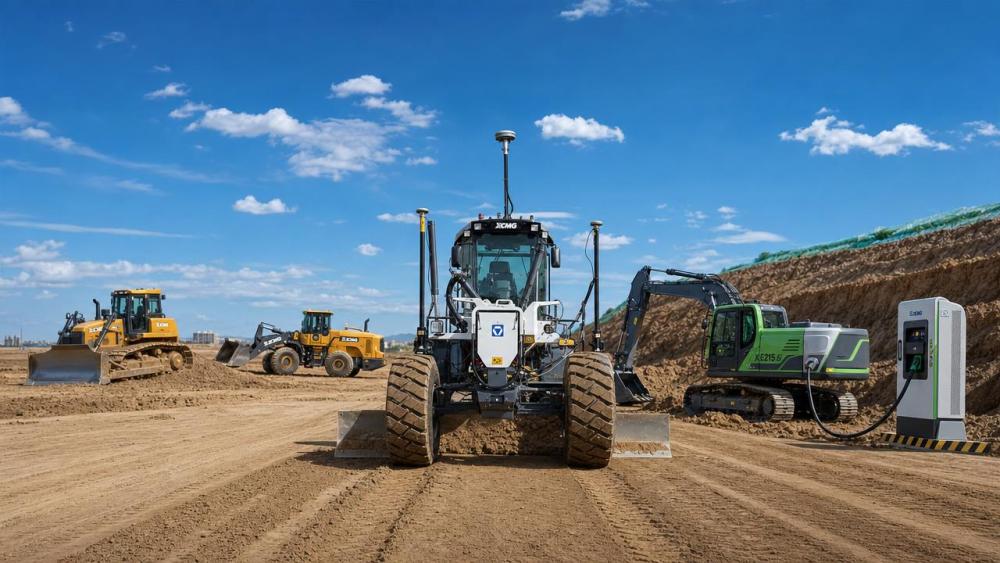
For decades, productivity gains came from larger buckets, stronger hydraulic breakout force, and improved operator comfort.
In 2026, earthmoving technology is shifting the advantage toward connected control, data-guided execution, and intelligent machine coordination.
Crawler excavators, wheel loaders, motor graders, bulldozers, and skid steer loaders are becoming nodes in a digital production system.
This transition matters because earthmoving remains one of the most cost-sensitive stages in infrastructure delivery.
Fuel, rework, idle time, underused assets, and survey delays can quietly erode the economics of major projects.
Modern earthmoving technology addresses those losses by improving visibility, repeatability, and decision speed across the jobsite.
The Market Signals Point to Faster Technology Adoption
Several signals show that 2026 will reward organizations that treat earthmoving technology as operational infrastructure.
Infrastructure funding is rising in many regions, yet skilled operator availability remains constrained.
Emission rules for non-road equipment are also becoming stricter, especially around urban and public-sector projects.
At the same time, competitive bidding increasingly favors predictable production, transparent reporting, and measurable carbon reduction.
These forces are accelerating demand for electric machines, telematics, 3D grading, autonomy, and remote operation platforms.
The result is a new productivity equation: stronger machines still matter, but smarter execution matters more.
Key Drivers Behind the Shift
Electrified Drivetrains Are Moving Beyond Sustainability Messaging
Electric machines are no longer limited to pilot projects or compact urban applications.
Battery-electric mini excavators, compact loaders, and emerging mid-size platforms are entering practical daily deployment.
This earthmoving technology trend is driven by noise limits, emission restrictions, and improved battery management systems.
Electric equipment also changes maintenance economics because drivetrains contain fewer high-wear mechanical components.
The strongest near-term opportunities remain in urban construction, indoor demolition, tunnels, landscaping, and municipal work.
However, heavy earthmoving will not electrify uniformly across all applications.
Large bulldozers, mining loaders, and high-duty excavators require careful analysis of charging logistics and operating cycles.
The winning strategy is not simply buying electric equipment.
It is matching electrified earthmoving technology to duty cycle, charging window, utilization pattern, and project location.
Autonomous Grading and Machine Control Are Reducing Rework
Precision grading is one of the clearest examples of earthmoving technology converting data into measurable productivity.
Motor graders, dozers, excavators, and compact loaders now combine GNSS, laser sensing, IMU systems, and 3D design files.
These systems help operators cut closer to grade with fewer passes and less staking.
For airports, highways, ports, rail corridors, and industrial pads, millimeter-level surface control has direct financial value.
Autonomous blade control also supports workforce resilience by helping less experienced operators achieve consistent results.
The next step is semi-autonomous task execution, where machines follow approved design surfaces with limited human correction.
This earthmoving technology will not remove human judgment from jobsites.
Instead, it will shift judgment toward planning, exception management, quality verification, and safety oversight.
AI Fleet Intelligence Is Turning Equipment Data Into Decisions
Telematics has been available for years, but 2026 adoption is becoming more decision-oriented.
The value of earthmoving technology now depends on converting machine data into action before cost overruns appear.
AI-enabled fleet platforms can compare utilization, idle time, fuel burn, cycle counts, location, fault codes, and maintenance history.
This enables better allocation of excavators, loaders, graders, dozers, and attachments across active projects.
Predictive maintenance is especially important for high-intensity loading machinery and hydraulic equipment.
Unexpected downtime during mass excavation or mine stripping can disrupt haulage balance and contract schedules.
Advanced earthmoving technology helps identify pressure anomalies, overheating patterns, contamination risks, and abnormal cycle behavior.
When insights reach field teams quickly, maintenance becomes preventive instead of reactive.
Practical Metrics Worth Tracking
- Idle ratio by machine class and jobsite zone.
- Fuel or energy consumption per production unit.
- Hydraulic temperature and pressure trend deviations.
- Bucket cycles, pass counts, and loading consistency.
- Grade conformance compared with digital design models.
- Attachment utilization across skid steer and compact fleets.
Remote Operation Is Becoming a Safety and Continuity Tool
Remote-controlled earthmoving equipment is gaining relevance in mines, quarries, disaster response, and hazardous demolition.
The enabling factor is low-latency communication combined with improved cameras, sensors, and machine response logic.
This earthmoving technology reduces exposure to rockfall, dust, unstable ground, explosives, contaminated sites, and extreme heat.
Remote operation also supports continuity when access restrictions or workforce shortages affect physical site attendance.
Its adoption depends on communication reliability, operator interface quality, cybersecurity, and emergency fallback design.
A remote excavator or dozer is not just a machine with cameras.
It is part of a controlled operating architecture with procedures, training, and digital risk management.
The Impact Extends Across Machines, Projects, and Business Models
The influence of earthmoving technology is not limited to machine performance.
It changes estimating, bidding, scheduling, training, maintenance planning, and lifecycle asset management.
For project delivery, digital grading and fleet analytics reduce uncertainty before it becomes field conflict.
For equipment ownership, connected systems support higher utilization and better residual value documentation.
For OEM ecosystems, software, sensors, batteries, hydraulic control, and service platforms are becoming competitive differentiators.
For infrastructure investors, earthmoving technology provides stronger visibility into progress, cost risk, and decarbonization performance.
Where the Effects Will Be Most Visible
- Mass excavation projects requiring stable daily production rates.
- Urban jobsites with strict noise and emission requirements.
- Road and airport works demanding precise surface tolerances.
- Mining and quarry operations with hazardous operating zones.
- Rental fleets needing transparent utilization and maintenance data.
What to Prioritize Before Investing in New Systems
Adopting earthmoving technology should begin with operational bottlenecks, not vendor claims.
The first question should identify where productivity, accuracy, safety, or equipment availability is being lost.
The second question should test whether data, automation, electrification, or remote control can remove that constraint.
Integration is often the hardest part because machines, design files, operators, and reporting systems must work together.
A phased roadmap reduces risk while building internal confidence.
Core Points to Watch
- Confirm machine compatibility with existing digital design workflows.
- Evaluate energy infrastructure before scaling electric fleets.
- Standardize telematics data definitions across mixed equipment brands.
- Train operators on assisted control, not only manual technique.
- Protect connected earthmoving technology with cybersecurity policies.
- Measure productivity gains against baseline field data.
A 2026 Response Framework for Smarter Jobsites
The Next Advantage Will Come From Connected Execution
The future of earthmoving technology is not one machine, one sensor, or one software platform.
It is the connection between hydraulic power, spatial intelligence, operator skill, clean energy, and fleet-level decision making.
In 2026, the most resilient jobsites will combine mechanical strength with digital precision.
They will use excavators, loaders, graders, dozers, and skid steers as coordinated production assets.
They will also treat data quality as seriously as fuel quality or hydraulic reliability.
To move forward, start with a field-level productivity audit and identify the highest-value constraint.
Then match the right earthmoving technology to that constraint, test it, measure it, and scale only after results are proven.
This practical sequence can turn technology adoption from a capital expense into a durable competitive advantage.