
Related News
- 00
0000-00
How to size heavy-duty loaders for North American mining operations - 00
0000-00
How altitude affects mining excavator performance in Latin America - 00
0000-00
Caterpillar Launches New Cat 6060 and Upgraded Autonomous Mining System - 00
0000-00
When does eco-friendly construction equipment pay for itself? - 00
0000-00
Will a wheel loader quick coupler fit your existing attachments?
2026 Construction Equipment Trends That Could Reshape Fleet Planning
As infrastructure pipelines, emissions rules, and jobsite automation accelerate worldwide, 2026 may become a turning point for how fleets are sized, financed, and deployed.
Understanding construction equipment trends is no longer a procurement exercise. It affects utilization, carbon compliance, bidding power, maintenance risk, and long-term asset resilience.
Across excavators, loaders, graders, dozers, and skid steers, the strongest decisions will come from matching equipment strategy to operating scenarios.
Scenario Background: Why 2026 Fleet Planning Needs Sharper Judgment
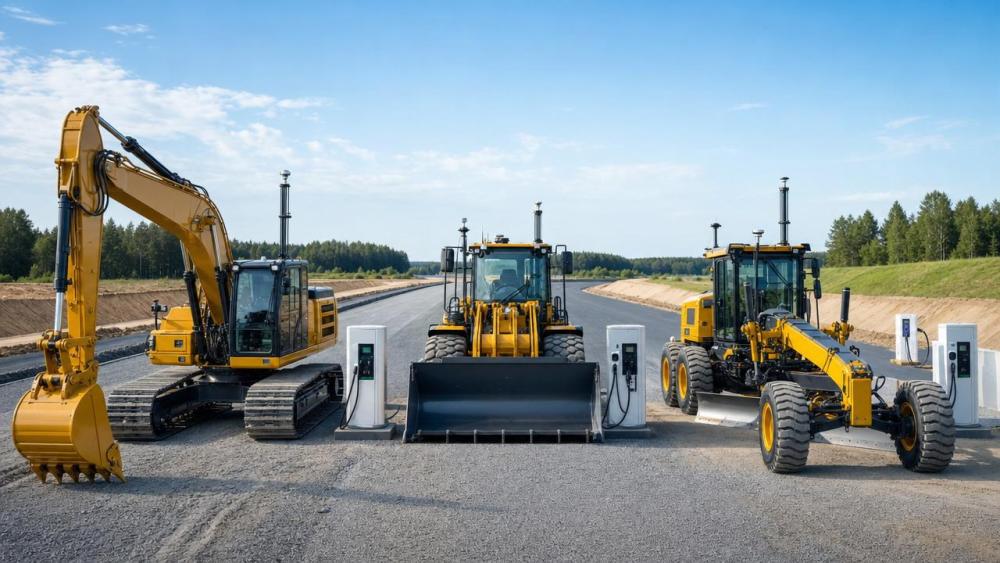
The next wave of construction equipment trends will not affect every jobsite equally. A mining haul road, an urban trench, and an airport runway demand different fleet logic.
Regulation is one driver. Non-road emissions standards are tightening, while low-emission procurement rules increasingly shape public infrastructure tenders.
Productivity is another driver. Machine control, telematics, and autonomous functions can reduce rework, idle time, and operator fatigue.
Capital discipline also matters. Higher interest rates and uncertain project cycles push fleets toward modular ownership, rentals, and utilization-based decisions.
For Global Earth-Mover Dynamics, these construction equipment trends reveal one core question: which machines deserve ownership, and which should remain flexible capacity?
Urban Infrastructure: Compact Power Becomes a Planning Priority
Dense urban work will place compact equipment at the center of 2026 construction equipment trends. Space limits often matter as much as breakout force.
Mini excavators, compact wheel loaders, and skid steer loaders are becoming essential for utility repair, fiber installation, drainage upgrades, and infill construction.
The core judgment point is maneuverability versus attachment versatility. Zero-radius turning and quick couplers can increase task coverage within short project windows.
Electric compact machines may gain momentum where noise limits, indoor work, or low-emission zones restrict diesel equipment.
However, charging access and duty-cycle predictability must be verified before replacing diesel units. Not every compact fleet benefits from full electrification immediately.
Heavy Earthmoving: Hydraulic Strength Still Defines Fleet Value
Large infrastructure, quarrying, and mine stripping will remain tied to traditional performance metrics. Breakout force, tractive effort, payload, and uptime still dominate.
In this scenario, construction equipment trends should be filtered through productivity per fuel unit, not technology appeal alone.
Crawler excavators must deliver stable digging power, responsive electro-hydraulic control, and strong thermal management under long-cycle loading.
Wheel loaders need optimized bucket fill, driveline efficiency, and durable axle systems for repetitive bulk material transfer.
Bulldozers require undercarriage endurance, blade control, and transmission efficiency to maintain pushing power in harsh soil and rock conditions.
The practical recommendation is clear. Keep high-utilization heavy assets in ownership when maintenance control and residual value justify the capital burden.
Precision Grading: Automation Moves From Premium Feature to Bid Advantage
Roads, airports, logistics parks, and drainage projects are especially exposed to construction equipment trends in precision control.
Motor graders with GPS, laser sensing, and 3D grade control can reduce staking, rework, and material waste.
The key scenario judgment is tolerance sensitivity. Millimeter-level surface accuracy can change project economics when pavement quality or drainage performance is critical.
Autonomous blade control also supports less experienced operators. That matters in regions facing skilled labor shortages.
Still, digital workflows must be ready. Machine control only delivers value when survey models, site data, and field execution stay synchronized.
Hazardous and Remote Sites: Remote Operation Becomes a Safety Strategy
Mines, demolition zones, landslide areas, and contaminated sites will accelerate construction equipment trends around remote control and autonomy.
In these environments, the main value is not only labor efficiency. It is risk reduction and operating continuity.
Low-latency communication, obstacle detection, remote diagnostics, and fail-safe machine control will become essential evaluation criteria.
Remote-controlled excavators and dozers can work where human exposure is costly, dangerous, or operationally unacceptable.
The planning challenge is infrastructure readiness. Connectivity, cybersecurity, camera coverage, and emergency protocols must be budgeted with the machine.
Different Scenario Needs: Matching Trends to Fleet Decisions
A useful fleet plan converts construction equipment trends into scenario-specific choices. The same innovation can be urgent, optional, or irrelevant depending on use.
This comparison shows why construction equipment trends should not be adopted as a single fleet formula.
Electrification: Where Battery Equipment Fits Best in 2026
Electrification is one of the most visible construction equipment trends, but its value depends heavily on jobsite rhythm.
Battery excavators and compact loaders fit predictable shifts, indoor demolition, municipal projects, and low-emission urban zones.
They may reduce local emissions, noise, and maintenance complexity. They can also improve access to carbon-sensitive contracts.
Yet heavy, remote, and continuous-duty projects still face charging, battery weight, and energy availability constraints.
A balanced approach is safer. Electrify compact and predictable use cases first, while tracking hybrid and alternative-fuel options for heavy equipment.
Telematics and Utilization: Data Turns Fleet Size Into a Measurable Decision
Telematics will shape construction equipment trends by exposing idle time, overload patterns, fuel burn, fault codes, and operator behavior.
The strongest fleet plans will use data before buying. Utilization evidence can reveal machines that should be redeployed, rented, or retired.
Condition monitoring also improves maintenance timing. Predictive service can reduce catastrophic failures and support better parts planning.
For mixed fleets, interoperable data matters. Closed systems can limit comparison across brands, regions, and equipment categories.
Before selecting platforms, confirm data ownership, API availability, reporting frequency, and integration with work-order systems.
Scenario Adaptation Recommendations for 2026 Fleet Plans
The following actions convert construction equipment trends into practical fleet decisions without overcommitting capital too early.
- Segment machines by scenario, not only by equipment category or purchase age.
- Separate core assets from flexible capacity, especially for seasonal or uncertain project pipelines.
- Pilot electric machines in predictable duty cycles before broad fleet conversion.
- Prioritize machine control where tolerance, rework, and material costs are high.
- Evaluate remote operation only with connectivity, safety, and cybersecurity requirements included.
- Use telematics to validate replacement timing and rental-versus-ownership decisions.
These recommendations keep construction equipment trends tied to measurable business outcomes rather than technology speculation.
Common Misjudgments That Can Weaken Fleet Planning
One common mistake is treating electrification as an immediate replacement strategy for every equipment class.
Battery machines can perform strongly, but the charging plan must match shift duration, site movement, and local grid capacity.
Another misjudgment is buying advanced automation without preparing digital site workflows.
Grade control depends on accurate models, trained field teams, and consistent data handoff between survey and production.
A third error is ignoring residual value. Some construction equipment trends may change resale demand faster than expected.
Machines with poor emissions compliance, weak telematics, or limited parts support may face steeper depreciation.
Finally, fleet plans often underestimate attachment strategy. Attachments can unlock utilization faster than buying another dedicated machine.
Action Guide: Turning Construction Equipment Trends Into Next-Step Decisions
Start by mapping the next 24 months of projects by environment, duty cycle, emissions exposure, and precision requirements.
Then rank each machine by utilization, maintenance cost, fuel efficiency, downtime risk, and regulatory vulnerability.
Create three fleet groups: strategic ownership, flexible rental capacity, and retirement or remarketing candidates.
For ownership candidates, compare lifecycle cost, not only purchase price. Include energy, maintenance, software, training, and residual value.
For rental candidates, use them to test construction equipment trends before committing to long-term capital deployment.
For retirement candidates, prioritize machines with weak compliance, recurring failures, or low compatibility with digital workflows.
The strongest 2026 fleet plans will not chase every innovation. They will select the right technology for the right ground condition.
That is where EMD’s intelligence lens becomes valuable: linking hydraulic force, spatial precision, decarbonization, and autonomy into practical fleet strategy.
As construction equipment trends evolve, resilient fleets will be those designed around scenarios, verified by data, and flexible enough to adapt.