
Related News
- 00
0000-00
How to size heavy-duty loaders for North American mining operations - 00
0000-00
How altitude affects mining excavator performance in Latin America - 00
0000-00
Caterpillar Launches New Cat 6060 and Upgraded Autonomous Mining System - 00
0000-00
When does eco-friendly construction equipment pay for itself? - 00
0000-00
Will a wheel loader quick coupler fit your existing attachments?
Autonomous Construction in 2026: Where It Delivers Real Jobsite Value
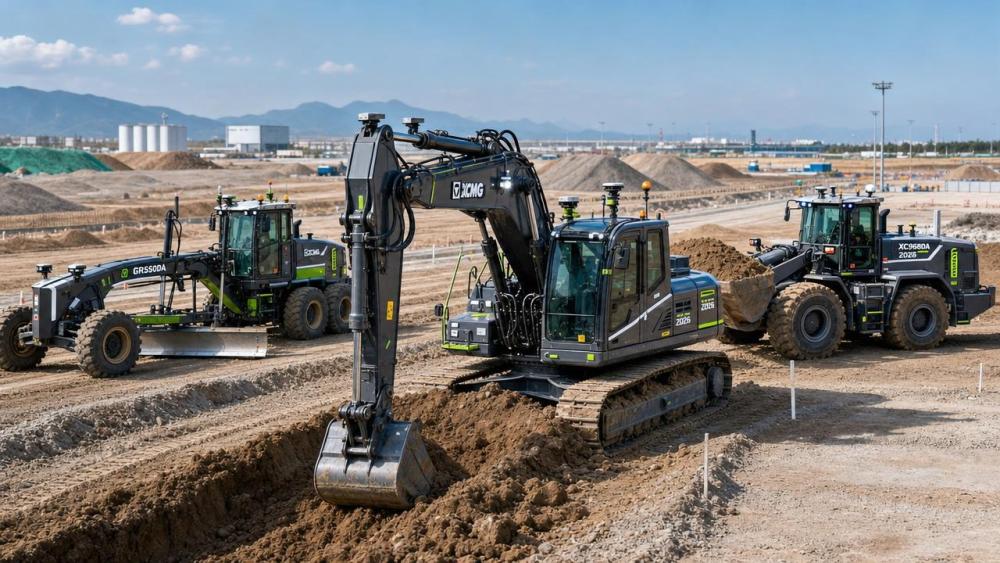
Autonomous construction is moving from pilot projects to measurable jobsite value in 2026, reshaping productivity, safety, and fleet utilization.
The question is no longer whether autonomy works. The real issue is where autonomous construction delivers the strongest return.
Excavation, grading, loading, dozing, and hazardous-site operations now show different adoption speeds, technical demands, and investment thresholds.
Why Scene-Based Judgment Matters in Autonomous Construction
Autonomous construction is not a single technology package. It is a jobsite operating model shaped by task repeatability and risk.
A quarry loading cycle differs from urban trenching. Airport grading differs from remote mine dozing.
Each scene has distinct constraints, including positioning accuracy, communication latency, ground variation, attachment control, and human-machine coordination.
In 2026, high-value deployment depends on matching autonomy level with operational pain points.
Global Earth-Mover Dynamics tracks this shift across crawler excavators, wheel loaders, graders, bulldozers, and compact machines.
The strongest autonomous construction cases usually combine labor pressure, repetitive cycles, harsh environments, and measurable production targets.
Scene One: Excavation Where Precision and Safety Define Value
Autonomous construction gains traction in excavation when digging geometry is predictable and safety risks are persistent.
Crawler excavators benefit from electro-hydraulic control, 3D machine guidance, and digital terrain models.
The best applications include trenching, foundation excavation, slope shaping, drainage channels, and repetitive bulk earth removal.
The key judgment point is not bucket automation alone. It is the consistency of ground data and dig-plan updates.
Autonomous construction creates value when operators avoid over-digging, rework, spotter exposure, and unstable edge conditions.
Hybrid approaches remain practical. One skilled operator may supervise several assisted machines during repetitive production phases.
Scene Two: Precision Grading Where Millimeters Become Margin
Motor graders are among the clearest beneficiaries of autonomous construction in infrastructure work.
Road bases, airport aprons, logistics yards, and industrial platforms require repeatable surface quality.
GNSS, laser receivers, IMU packages, and blade-control algorithms reduce dependence on manual correction.
The value is direct. Fewer passes reduce fuel, tire wear, labor hours, and project schedule risk.
Autonomous construction works best when design files are accurate and survey control is disciplined.
Poor data governance can erase the benefit, even when the machine control system is advanced.
Scene Three: Loading Cycles Where Throughput Drives the Business Case
Wheel loaders show strong autonomous construction potential in quarries, cement plants, ports, and material yards.
These environments often have stable routes, repeated stockpile interaction, and predictable dump points.
Autonomy improves cycle consistency, bucket fill factor, payload tracking, and fuel performance.
The core judgment point is traffic complexity. Mixed human vehicles increase perception and control demands.
Autonomous construction delivers better value in controlled zones with clear berms, geofencing, and digital dispatching.
For high-intensity loading machinery, integration with scales, fleet management, and production dashboards is essential.
Scene Four: Dozing Where Repetition Meets Extreme Traction
Bulldozers create autonomous construction value in ripping, pushing, spreading, landfill work, and mine support tasks.
Their advantage is traction. Their challenge is unpredictable material resistance and changing underfoot conditions.
Autonomous dozing is strongest when tasks follow planned corridors, push paths, or elevation targets.
Blade automation can maintain target grades while reducing operator fatigue during long repetitive shifts.
Autonomous construction also improves safety near unstable piles, waste faces, and remote overburden zones.
The decision should consider track wear, undercarriage cost, pass optimization, and production variability.
Scene Five: Hazardous Sites Where Distance Is the Main Value
Hazardous operations often justify autonomous construction before standard jobsites do.
Mines, demolition zones, contaminated areas, tunnels, and unstable slopes create urgent safety incentives.
Here, remote control, supervised autonomy, and low-latency communication may deliver immediate value.
The target is not always full autonomy. Removing personnel from danger can be enough.
Autonomous construction requires strong network planning, fail-safe behavior, obstacle detection, and clear emergency-stop procedures.
These projects should be evaluated through risk reduction, uptime protection, and insurance exposure, not only productivity.
How Requirements Differ Across Autonomous Construction Scenes
This comparison shows why autonomous construction strategy must begin with scene selection, not technology enthusiasm.
The same machine intelligence can produce different returns under different traffic, terrain, and data conditions.
Technology Foundations That Decide Real Jobsite Value
Successful autonomous construction depends on several foundations working together, not isolated sensors.
- Perception systems must detect people, machines, edges, piles, and temporary obstacles.
- Positioning must remain reliable despite dust, vibration, multipath signals, and weather.
- Hydraulic control must translate digital commands into smooth, predictable tool motion.
- Connectivity must support remote supervision, diagnostics, updates, and emergency intervention.
- Fleet software must connect machines, production targets, maintenance, and jobsite schedules.
Autonomous construction in heavy earthmoving also needs rugged validation under heat, shock, mud, and long duty cycles.
A system proven only on clean demonstration grounds may fail under production pressure.
Scene Fit Recommendations for 2026 Investment Decisions
Autonomous construction projects should start with operational bottlenecks and measurable baselines.
- Select one repeatable scene with clear production metrics.
- Map current cycle time, idle time, rework, incidents, and fuel use.
- Confirm digital design quality, survey control, and machine data availability.
- Define safe operating zones, traffic rules, and manual override procedures.
- Run phased deployment before expanding across fleets or sites.
For grading, start where tolerance failure is costly. For loading, start where routes stay stable.
For excavation, start where dig plans repeat. For hazardous work, start where human exposure is unacceptable.
Autonomous construction should be treated as an operating upgrade, not only a machine purchase.
Common Misjudgments That Reduce Autonomous Construction ROI
The first misjudgment is assuming full autonomy is always the best target.
Assisted control, remote operation, or supervised autonomy may deliver faster payback in many scenes.
The second misjudgment is ignoring jobsite data discipline.
Autonomous construction depends on accurate maps, clean design files, updated terrain models, and consistent production reporting.
The third misjudgment is underestimating change management.
Supervisors, mechanics, survey teams, operators, and safety teams need shared procedures for autonomous zones.
The fourth misjudgment is overlooking maintenance readiness.
Sensors, wiring, calibration, software updates, and hydraulic response checks must become part of routine uptime management.
What to Watch as Autonomous Construction Matures
The strongest market signals in 2026 will come from measurable production data.
Watch for documented improvements in pass count, bucket fill, truck exchange time, idle reduction, and safety exposure.
Also watch OEM partnerships around electrification, autonomy, telematics, and site-energy planning.
Autonomous construction will increasingly connect with decarbonization strategies through optimized routes and reduced unnecessary movements.
The winners will link mechanical strength, hydraulic precision, digital intelligence, and practical field support.
Action Guide: Turning Autonomy Interest into Jobsite Results
Begin with one question: which scene creates the most pain when people, machines, or data perform inconsistently?
Then select the autonomous construction level that directly addresses that pain.
Build the case around measurable outcomes, including safety exposure, rework reduction, asset utilization, fuel efficiency, and schedule reliability.
EMD’s perspective is clear: autonomy delivers value where earthmoving dynamics are understood at scene level.
In 2026, autonomous construction will reward disciplined deployment more than bold slogans.
The practical next step is to audit one high-value scene, define success metrics, and test autonomy under real production conditions.
That is where autonomous construction moves from future promise to jobsite advantage.