
Related News
- 00
0000-00
How to size heavy-duty loaders for North American mining operations - 00
0000-00
How altitude affects mining excavator performance in Latin America - 00
0000-00
Caterpillar Launches New Cat 6060 and Upgraded Autonomous Mining System - 00
0000-00
When does eco-friendly construction equipment pay for itself? - 00
0000-00
Will a wheel loader quick coupler fit your existing attachments?
Construction equipment trends are reshaping how project managers and site leaders evaluate fleet investments, from fuel efficiency and uptime to automation and emissions compliance. As project complexity rises and margins tighten, understanding these shifts is essential for choosing machines that improve productivity, reduce lifecycle costs, and keep infrastructure programs on schedule.
For project managers searching for guidance on construction equipment trends, the core intent is practical decision support. They want to know which market and technology shifts should influence fleet purchases, rentals, replacement cycles, and jobsite deployment strategies right now.
Their biggest concerns are usually straightforward: how to increase uptime, control total cost of ownership, meet project deadlines, handle labor shortages, satisfy emissions rules, and avoid buying equipment that becomes outdated too quickly.
The most useful content, therefore, is not a broad industry overview. It is a decision-focused analysis of which trends are materially changing fleet strategy, where the business value is strongest, and how different machine categories fit different project risks.
In this article, the emphasis is on actionable trends, investment logic, and equipment selection criteria. Generic commentary about innovation, sustainability, or digital transformation is kept secondary unless it directly affects productivity, cost, compliance, or asset utilization.
Why construction equipment trends now have a direct impact on fleet decisions
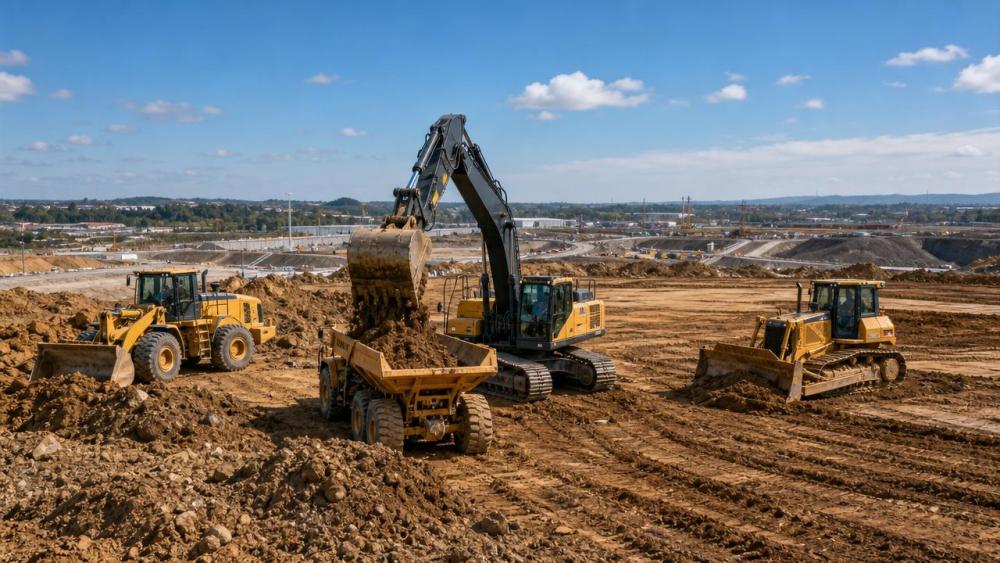
For years, fleet decisions were driven mainly by purchase price, brand preference, and operator familiarity. That model is no longer enough. Today, construction equipment trends are altering the economics of ownership at every stage of the asset lifecycle.
Fuel costs remain volatile, project schedules are tighter, and clients increasingly expect documented performance, safety, and environmental compliance. A machine that looked competitive on upfront price alone may become expensive when downtime, idle time, maintenance, and reporting obligations are added.
At the same time, OEMs are redesigning crawler excavators, wheel loaders, motor graders, bulldozers, and skid steer loaders around data visibility, operator assistance, and lower-emission power systems. This means project leaders are not just buying iron anymore. They are buying capability, software, and support ecosystems.
That shift is especially important for infrastructure programs and large earthmoving packages. When one underperforming machine delays haul balance, grading precision, or material movement, the cost multiplies across crews, subcontractors, and critical path activities.
The best fleet decisions now come from asking a different set of questions. Instead of “What does this machine cost?” managers need to ask “What does this machine prevent, enable, and optimize across the project timeline?”
Trend one: total cost of ownership is replacing purchase price as the primary filter
One of the most important construction equipment trends is the move from capital-cost thinking to lifecycle-cost thinking. This is especially relevant for project managers responsible for bid margins, resource planning, and schedule reliability.
Total cost of ownership includes fuel burn, maintenance intervals, wear parts, operator efficiency, telematics subscriptions, training needs, resale value, and the cost of unplanned downtime. In many cases, these factors outweigh the initial difference between competing models.
For example, a crawler excavator with better hydraulic efficiency may reduce fuel use over thousands of operating hours. A wheel loader with easier service access may shorten maintenance windows. A motor grader with better machine control integration may reduce rework and surveying dependencies.
These benefits matter because construction profitability often depends on consistent output rather than theoretical peak performance. A lower-priced machine that creates more idle labor, more service calls, or less predictable production can quietly erode project returns.
Project leaders should build fleet comparisons around operating hours, average load cycles, expected maintenance events, utilization targets, and site conditions. This approach makes construction equipment trends relevant to real procurement decisions, not just industry headlines.
Trend two: telematics and machine data are becoming essential management tools
Another major driver behind changing fleet decisions is the rapid rise of machine connectivity. Telematics is no longer a premium add-on for large contractors alone. It is becoming a standard requirement for effective fleet control.
Connected machines can provide visibility into idle time, fuel consumption, location, fault codes, service intervals, operator behavior, and utilization by project or region. For project managers, this turns equipment planning from reactive guesswork into measurable operational control.
The value is immediate in mixed fleets. If a skid steer loader is underutilized on one urban site while another crew needs attachment-ready compact equipment, telematics supports better reallocation. If a bulldozer shows repeated overheating alerts, maintenance can intervene before failure affects production.
Data also improves vendor discussions. Instead of relying only on sales claims, contractors can compare machine classes and brands based on verified jobsite performance. Over time, this leads to more accurate replacement timing and better alignment between fleet composition and project type.
The caution is that data only matters if teams use it. Site leaders should prioritize dashboards tied to decisions: fuel exceptions, idle thresholds, service forecasting, and production variance. Too much reporting with no action path creates noise rather than value.
Trend three: automation and operator-assist features are solving labor and precision challenges
Labor shortages are one of the most practical reasons construction equipment trends are changing fleet decisions. Many contractors cannot rely on deep operator benches, especially for precision grading, utility work, and high-output earthmoving.
As a result, operator-assist systems are moving from optional features to strategic productivity tools. Grade control, payload weighing, return-to-dig functions, blade automation, and semi-autonomous cycle support can help less experienced operators deliver more consistent results.
For motor graders, integrated GPS and laser-based controls can reduce the number of passes needed to reach specification. For excavators, 2D and 3D guidance improves trenching depth accuracy and reduces over-excavation. For wheel loaders, onboard weighing helps prevent inefficiencies in truck loading.
These capabilities do not eliminate the need for skilled operators. However, they reduce variability, accelerate onboarding, and improve repeatability across shifts and sites. That is highly valuable when project schedules cannot absorb quality corrections or slow production ramps.
When evaluating automation, project managers should focus on whether the feature solves a bottleneck. If grade accuracy delays paving, machine control may justify itself quickly. If the problem is simply low annual utilization, the investment case may be weaker.
Trend four: emissions compliance and decarbonization are influencing machine selection earlier
Sustainability messaging can sometimes sound abstract, but emissions compliance is a practical fleet issue. One of the strongest construction equipment trends is the growing effect of environmental regulation and customer reporting requirements on equipment planning.
In many markets, contractors must operate under stricter non-road emissions standards, urban air-quality restrictions, or public procurement sustainability criteria. This affects not just owned fleets, but also rental availability, bid competitiveness, and site access.
Modern diesel platforms, hybrid systems, and emerging electric compact equipment are all part of this transition. For project managers, the key question is not whether decarbonization matters. It is where lower-emission equipment creates operational or commercial advantage first.
Compact and urban applications often see the earliest practical fit for electric skid steer loaders or compact excavators because of noise limits, indoor work, and charging feasibility. Heavy crawler excavators and bulldozers still face energy-density constraints, so advanced diesel and efficiency gains remain more realistic for many large sites.
The smart approach is to segment the fleet. Identify which machines need immediate emissions upgrades for compliance or client expectations, and which can remain on conventional power until technology maturity and infrastructure improve.
Trend five: application-specific fleet strategy is outperforming one-size-fits-all buying
Another important shift is that contractors are moving away from overly standardized fleets. While common platforms still help with training and parts management, the most effective fleet decisions now reflect project mix more closely.
A contractor focused on highway packages may prioritize motor graders with integrated machine control, high-availability wheel loaders, and bulldozers optimized for sustained production. An urban civil contractor may place more value on compact radius excavators and versatile skid steer loaders with multiple attachments.
This matters because construction equipment trends are increasingly category-specific. The best advances in crawler excavators are not necessarily the same as the most valuable improvements in graders or loaders. Procurement teams should assess value by application, not by industry buzzwords.
For example, in high-volume excavation, hydraulic responsiveness, bucket fill factors, undercarriage durability, and telematics uptime support may drive value. In grading work, sensor integration, control smoothness, and finish tolerance may matter more than raw horsepower.
Fleet strategy should therefore begin with project demand mapping. Review typical soil conditions, haul distances, loading patterns, blade work tolerance, space constraints, and transport frequency. Then align machine specifications to recurring production realities.
How project managers can evaluate whether a trend is worth acting on
Not every trend deserves budget. The challenge for project leaders is separating high-impact change from expensive distraction. A simple evaluation framework can help.
First, identify the operational problem. Is the site losing time to fuel stops, maintenance delays, rework, operator inconsistency, or compliance constraints? If a trend does not address a measurable issue, it should not lead the buying decision.
Second, quantify the likely return. Estimate savings or gains through reduced idle time, lower fuel use, fewer survey corrections, improved uptime, or better production per shift. Even directional modeling is better than relying purely on product positioning.
Third, assess implementation risk. New systems may require operator training, software subscriptions, dealer support, and process changes. A machine with advanced features only creates value if the organization can adopt them effectively.
Fourth, consider fleet compatibility. Machines that integrate with existing attachments, data systems, transport methods, and maintenance workflows usually produce faster returns than equipment that forces a parallel operating model.
Finally, test where possible. Pilot programs, rentals, and side-by-side comparisons on real jobsites often reveal more than brochures do. For many firms, this is the most reliable way to validate which construction equipment trends deserve scale investment.
Where the strongest near-term fleet value is likely to come from
For most project managers and engineering leads, the strongest near-term value will come from four areas: better fuel efficiency, stronger uptime support, more useful telematics, and precision-enhancing operator assistance.
These are the trends most likely to improve schedule control and reduce avoidable cost without requiring a full transformation of site operations. They also apply across multiple machine types, from excavators and loaders to graders and dozers.
Electrification will continue to grow, especially in compact and urban segments, but its immediate value depends heavily on charging access, duty cycle, and local policy. Full autonomy remains strategically important, yet near-term returns are more likely from assisted operation than fully autonomous deployment.
That means the best buying decisions today are usually balanced ones. Choose equipment that improves present-day performance while preserving flexibility for future regulatory and technological change. Avoid both extremes: resisting every innovation or overpaying for immature capability.
Conclusion: construction equipment trends should guide smarter, not trendier, fleet decisions
Construction equipment trends are changing fleet decisions because they are changing the economics of project delivery. For project managers, the real issue is not keeping up with technology headlines. It is selecting equipment that protects schedule, supports crews, and lowers whole-life cost.
The most valuable trends are the ones that improve measurable outcomes: uptime, fuel efficiency, grading accuracy, material movement, compliance readiness, and utilization visibility. These are the factors that shape project performance and asset returns.
As fleets evolve, decision-makers should stay disciplined. Match equipment strategy to project mix, verify claims with field data, and prioritize solutions that solve actual operational constraints. When approached this way, construction equipment trends become a practical advantage rather than a moving target.
For organizations tracking the future of crawler excavators, wheel loaders, motor graders, bulldozers, and skid steer loaders, the winners will not simply own newer machines. They will build smarter fleets around performance, reliability, and informed timing.