
Related News
- 00
0000-00
How to size heavy-duty loaders for North American mining operations - 00
0000-00
How altitude affects mining excavator performance in Latin America - 00
0000-00
Caterpillar Launches New Cat 6060 and Upgraded Autonomous Mining System - 00
0000-00
When does eco-friendly construction equipment pay for itself? - 00
0000-00
Will a wheel loader quick coupler fit your existing attachments?
Autonomous construction is moving from pilot projects to boardroom priorities in 2026, promising safer jobsites, higher equipment utilization, and sharper cost control across earthmoving, grading, loading, and mining operations.
Yet the path to full autonomy remains constrained by fleet integration, sensor reliability, regulatory uncertainty, and the realities of complex terrain.
For enterprise decision-makers, the key question is no longer whether autonomy will reshape construction, but where it can deliver measurable gains now—and where human oversight still defines the limits.
Where Autonomous Construction Creates Value First
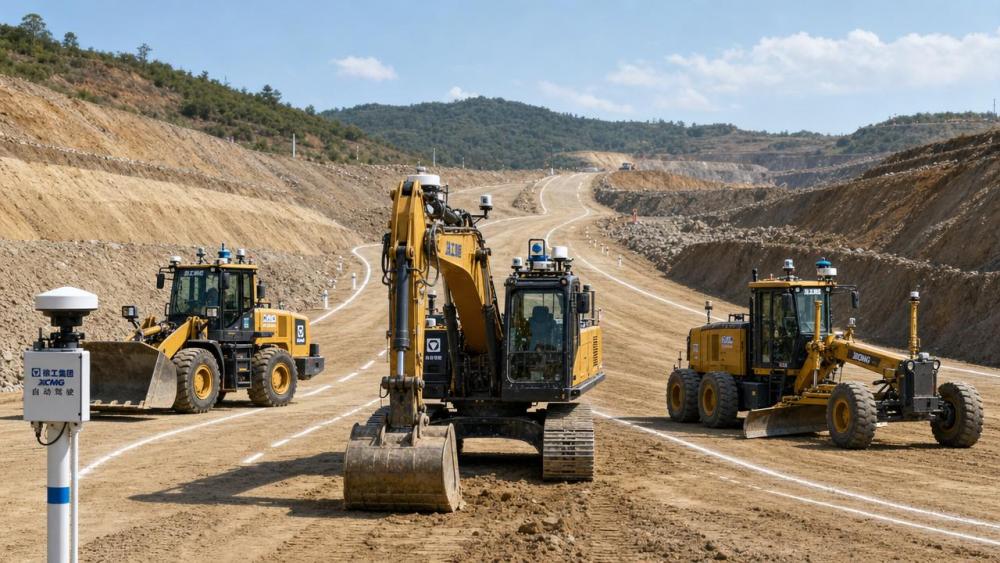
In 2026, autonomous construction is most practical in repeatable, measurable, and geofenced work packages rather than open-ended general contracting environments.
Earthmoving fleets gain when machines follow known haul routes, execute consistent cut-and-fill plans, or operate in mines with controlled traffic rules.
For crawler excavators, automation is strongest in assisted digging, trench profiling, payload guidance, and machine control linked to 3D site models.
Wheel loaders benefit through optimized bucket fill, cycle-time analytics, collision alerts, and semi-autonomous stockpile management under predictable material conditions.
Motor graders are among the clearest winners because GPS, laser sensing, and blade control directly improve surface accuracy and rework reduction.
Decision signals for early deployment
- The task is repetitive enough to standardize routes, operating envelopes, grade tolerances, safety zones, and exception-handling rules.
- The site has measurable downtime, rework, fuel waste, or labor exposure that can be reduced through machine guidance.
- The fleet already generates telematics data, making autonomous construction easier to benchmark against existing utilization and maintenance patterns.
- Supervisors can define human override points, escalation procedures, and connectivity requirements before procurement discussions begin.
EMD’s perspective is grounded in earthmoving physics as much as software capability: traction, breakout force, hydraulic response, and terrain variability still decide results.
Which Machines Are Ready, and Which Still Need Supervision?
Autonomous construction does not arrive evenly across equipment categories. Each machine type faces different control problems, duty cycles, and safety implications.
The table below helps executives compare readiness by application, not by marketing claims or single technology demonstrations.
The practical takeaway is simple: autonomous construction should be selected by task maturity, not by equipment prestige or novelty.
A grader with reliable design data may outperform a highly automated excavator working in uncertain underground conditions.
What Gains Can Executives Measure in 2026?
The strongest business case for autonomous construction comes from measurable operational improvement rather than full replacement of human operators.
Board-level evaluation should focus on utilization, safety exposure, grade accuracy, fuel or energy intensity, maintenance planning, and bid reliability.
Operational metrics that matter
- Equipment utilization improves when idle time, operator shift constraints, and unplanned waiting are reduced through better scheduling logic.
- Safety performance improves when remote operation keeps personnel away from unstable slopes, blasting zones, or toxic mine environments.
- Grade precision improves when machine control continuously compares blade, bucket, or attachment position against digital design surfaces.
- Cost control improves when autonomous construction data exposes underloaded buckets, inefficient haul cycles, and excessive rework.
However, executives should avoid treating autonomy as a single-payback investment. Gains depend on data discipline, maintenance response, and site governance.
A connected bulldozer can generate valuable route and traction data, but only if planners convert that information into changed work methods.
The Limits: Why Full Autonomy Remains Difficult
The limits of autonomous construction are not only technical. They include contractual, regulatory, insurance, workforce, and site coordination barriers.
Heavy equipment operates with massive kinetic energy, changing ground conditions, dust, vibration, reflective surfaces, and occluded blind zones.
Four constraints decision-makers often underestimate
- Sensor reliability declines when mud, rain, dust, snow, vibration, or poor lighting interfere with LiDAR, radar, camera, or GNSS signals.
- Mixed fleets create integration challenges when telematics protocols, control interfaces, and maintenance systems vary across OEM platforms.
- Regulatory approval can differ across countries, regions, mines, roads, airports, and public-private infrastructure projects.
- Liability is complex when software, site design, operator supervision, connectivity, and equipment condition all influence incident outcomes.
Human oversight remains essential where machines must interpret unstable ground, unexpected pedestrians, hidden utilities, or fast-changing work fronts.
In EMD’s analysis, the winning model for 2026 is supervised autonomy: machines execute defined tasks while humans manage exceptions and risk boundaries.
Procurement Guide: How to Select an Autonomous Construction Solution
Procurement teams should move beyond feature lists and request evidence tied to machines, sites, operators, data systems, and compliance obligations.
For autonomous construction, the most expensive mistake is buying a capable system that cannot integrate with the existing fleet or work method.
This selection approach helps separate durable autonomous construction capability from demonstrations that depend on ideal site conditions.
It also supports clearer budgeting because integration, calibration, training, and downtime reserves are visible before final supplier negotiation.
Cost, Alternatives, and Phased Implementation
Most enterprises should treat autonomous construction as a phased transformation, not a one-time fleet replacement program.
Phasing reduces capital risk, builds operator acceptance, and creates operational evidence before expanding across regions or business units.
The lowest-risk entry point is often digital workflow first, followed by guidance systems, then supervised autonomous construction in constrained zones.
This pathway lets executives confirm productivity assumptions before committing to larger fleet purchases or multi-year autonomy contracts.
Compliance, Safety, and Data Governance Questions
Autonomous construction procurement should include legal, safety, IT, operations, and maintenance leaders from the start.
Relevant considerations may include machinery safety, functional safety principles, cybersecurity controls, radio communication rules, and local site-access regulations.
Governance checklist before scale-up
- Define who can approve autonomous operating zones, change digital terrain models, and authorize exceptions during live production.
- Confirm how incident logs, near-miss data, machine commands, and operator overrides will be stored and reviewed.
- Align insurance expectations with documented risk assessments, training records, maintenance history, and supplier responsibilities.
- Create a calibration schedule for sensors, antennas, cameras, control valves, blade systems, and hydraulic response verification.
In sectors such as mining, airport construction, energy infrastructure, and public roads, compliance can decide whether autonomy scales or stalls.
Executives should require clear documentation rather than informal assurances, especially when autonomous construction affects public interfaces or high-risk zones.
FAQ: Practical Questions Before Investing
Is autonomous construction ready for fully unmanned jobsites?
For most enterprises, no. Fully unmanned jobsites remain limited to controlled environments with restricted access, defined routes, and mature digital workflows.
In 2026, the practical target is supervised autonomous construction, where machines automate defined work while people manage planning, exceptions, and safety.
Which project types justify early investment?
Mines, quarries, large earthworks, road grading, landfill shaping, and repetitive loading operations usually present the strongest business case.
These sites offer repeatable routes, measurable productivity baselines, and clearer safety benefits from remote or semi-autonomous operation.
What should procurement teams verify first?
Start with fleet compatibility, positioning reliability, override logic, support availability, data ownership, cybersecurity, and evidence from comparable site conditions.
A supplier demonstration on flat ground is not enough evidence for complex terrain, mixed traffic, or high-production excavation cycles.
Does autonomous construction reduce workforce needs?
It changes workforce requirements more than it eliminates them. Operators, survey teams, planners, and maintenance technicians need stronger digital skills.
The most successful deployments usually reposition experienced operators into supervision, remote control, production analytics, and exception management roles.
Why Choose EMD for Autonomous Construction Intelligence
EMD helps enterprise decision-makers evaluate autonomous construction through the realities of crawler excavators, loaders, graders, bulldozers, and skid steers.
Our Strategic Intelligence Center connects hydraulic performance, payload behavior, 3D spatial algorithms, emissions pressure, and autonomy roadmaps into actionable procurement judgment.
If your organization is comparing suppliers, defining pilot scope, or preparing a board-level investment case, EMD can support the decision process.
Consult us for focused decision support
- Parameter confirmation for machine control, positioning accuracy, hydraulic response, payload sensing, and remote-operation communication architecture.
- Equipment selection guidance across excavators, wheel loaders, motor graders, bulldozers, skid steers, and mixed-fleet automation pathways.
- Pilot planning support, including suitable site selection, productivity baselines, safety boundaries, and phased deployment checkpoints.
- Procurement preparation for quotation comparison, delivery-cycle discussion, integration risk review, and supplier documentation requirements.
- Compliance and certification interpretation for machinery safety, data governance, emissions transition, and project-specific operating constraints.
Autonomous construction in 2026 rewards disciplined buyers. The gains are real, but only when technology, terrain, machines, and governance align.
Contact EMD to clarify your parameters, compare solution routes, and build an autonomy roadmap that protects capital while improving operational performance.