
Related News
- 00
0000-00
How to size heavy-duty loaders for North American mining operations - 00
0000-00
How altitude affects mining excavator performance in Latin America - 00
0000-00
Caterpillar Launches New Cat 6060 and Upgraded Autonomous Mining System - 00
0000-00
When does eco-friendly construction equipment pay for itself? - 00
0000-00
Will a wheel loader quick coupler fit your existing attachments?
Autonomous construction is no longer a distant promise. It is becoming practical where jobsites are structured, repeatable, and measurable. The first wins appear in earthmoving, grading, haul support, and hazardous operations.
That matters across the broader industrial economy. When autonomous construction reduces rework, lowers exposure, and improves machine utilization, project schedules become more resilient and capital efficiency improves.
For sectors tracked by EMD, the early story is clear. Crawler excavators, dozers, motor graders, and loaders gain value fastest when digital workflows, sensing, and predictable terrain conditions already exist.
Autonomous construction is moving from concept to targeted deployment
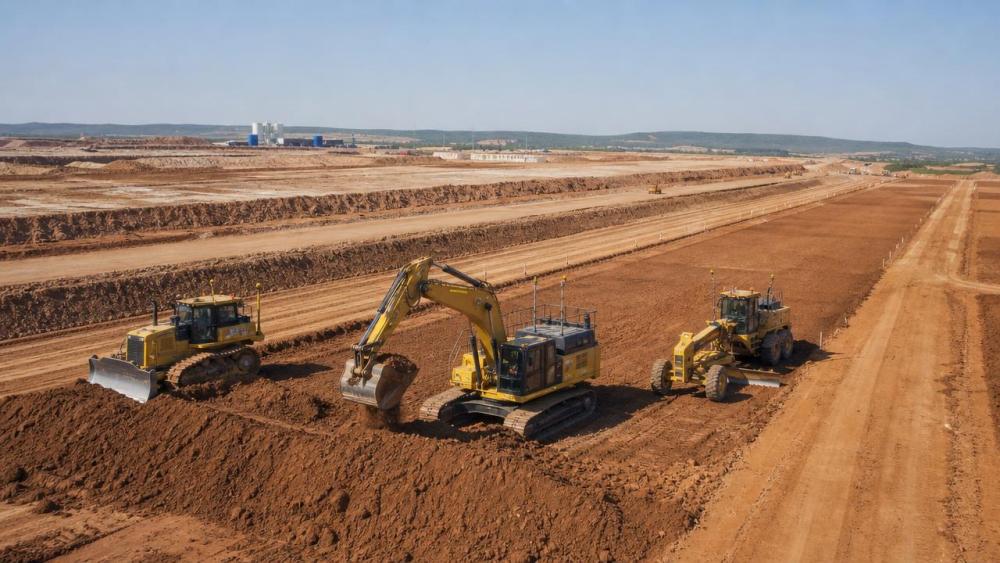
The strongest trend signal is not full jobsite replacement. It is partial autonomy embedded into high-frequency tasks that consume fuel, labor hours, and schedule float.
Autonomous construction performs best where machine paths are defined, work cycles repeat, and terrain can be mapped with confidence. That is why early adoption clusters around cut-and-fill, stockpile work, and finish grading.
Another signal is the shift from operator assistance to supervised autonomy. Guidance, geofencing, collision alerts, and auto-dig functions create the data foundation for more independent machine behavior.
Decarbonization also strengthens the case. Better cycle control, fewer idle events, and less rework support fuel savings today and smoother electrification transitions tomorrow.
Why autonomous construction delivers value first in controlled environments
The economics of autonomous construction are shaped by task variability. Lower variability means algorithms can repeat quality outcomes, and remote supervisors can manage more equipment safely.
This is why autonomous construction usually starts with bounded operating domains. Clear haul roads, known design surfaces, and machine-to-cloud connectivity reduce uncertainty and increase measurable returns.
The strongest early-use cases are repetitive and geometry-driven
- Dozer slot pushing on repeat cycles
- Motor grader finish passes guided by GNSS and surface models
- Excavator trenching with geofenced depths and swing limits
- Loader stockpile movement in defined yard layouts
- Remote or autonomous work in toxic, unstable, or low-visibility zones
Where autonomous construction creates the clearest operational advantage
In crawler excavators, autonomous construction helps most when dig plans are tied to 3D models. The system can limit over-excavation, stabilize cycle patterns, and improve truck loading consistency.
For bulldozers, the value often comes from repeatability. Autonomous blade control can maintain target elevations with fewer correction passes, reducing fuel burn and supporting tighter schedule adherence.
For motor graders, autonomous construction aligns naturally with precision work. Since grading quality directly affects pavement performance, accuracy gains create downstream value beyond the grading phase itself.
Wheel loaders and skid steer loaders usually see earlier gains through semi-autonomous functions. Yard navigation, bucket positioning, and repeat handling cycles improve throughput before full autonomy becomes practical.
Across all equipment categories, the strongest advantage appears when machine control data feeds back into project controls. That turns autonomous construction into both an execution tool and a decision tool.
The impact reaches beyond machines into planning, risk, and project economics
The immediate effect is higher consistency. Autonomous construction reduces variability between shifts, operators, and changing site conditions when the operating envelope is well defined.
The second effect is better risk control. Fewer people near moving equipment, trench edges, and unstable faces can lower incident exposure while preserving output in difficult environments.
The third effect is financial. Less rework, lower idle time, and improved fleet coordination can raise asset utilization, which is especially important for high-capital equipment classes.
- Survey-to-machine workflows become more important than manual stakeout alone
- Maintenance planning shifts toward sensor health and software reliability
- Site sequencing benefits from cleaner handoffs between excavation, hauling, and grading
- Digital records improve claims support, quality verification, and progress visibility
What deserves close attention before scaling autonomous construction
Not every jobsite is ready. Autonomous construction succeeds when technical readiness, site discipline, and operational governance mature together.
Key points worth monitoring
- Terrain data quality and update frequency
- GNSS coverage, correction reliability, and local positioning alternatives
- Interoperability between machine brands, sensors, and project platforms
- Cybersecurity for remote access and fleet communications
- Fallback procedures during weather, visibility, or connectivity disruptions
- Legal accountability, safety validation, and documentation standards
A common mistake is pursuing full autonomy too early. A staged model often delivers better returns because it connects technology adoption to real production bottlenecks.
A practical roadmap for evaluating autonomous construction now
This approach keeps autonomous construction tied to outcome quality. It also prevents technology spending from drifting away from project economics and operational reality.
The next market signal will come from integrated ecosystems, not isolated machines
The next phase of autonomous construction will depend less on a single smart machine and more on connected systems. Survey data, machine controls, telematics, and site planning must work as one loop.
That is especially relevant for EMD’s coverage areas. Excavators, loaders, graders, dozers, and compact machines create the most value when their data improves coordination across the whole earthmoving sequence.
The early winners will likely be organizations that treat autonomous construction as an operating model. They will combine precision sensing, workflow discipline, and machine intelligence around a narrow set of repeatable tasks first.
Start by mapping one process where safety exposure, rework, or labor pressure is already costly. Then test autonomous construction in that bounded workflow, measure the production delta, and scale only when evidence is clear.
In the near term, autonomous construction will not replace the entire jobsite. It will, however, reshape how value is created in the most structured and high-impact parts of the work.