
Related News
- 00
0000-00
How to size heavy-duty loaders for North American mining operations - 00
0000-00
How altitude affects mining excavator performance in Latin America - 00
0000-00
Caterpillar Launches New Cat 6060 and Upgraded Autonomous Mining System - 00
0000-00
When does eco-friendly construction equipment pay for itself? - 00
0000-00
Will a wheel loader quick coupler fit your existing attachments?
In 2026, earthmoving technology is no longer just about bigger machines—it is about cutting rework, protecting margins, and keeping schedules intact. For site execution, the real advantage comes from grading accuracy, connected control systems, and data-driven decisions that stop small mistakes before they become expensive corrections.
Across infrastructure, mining support, urban utilities, and logistics development, rework remains one of the most avoidable cost drivers. Wrong elevations, over-excavation, poor material balance, and delayed coordination often create ripple effects. Modern earthmoving technology addresses these issues through integrated sensing, automation, and machine intelligence.
What Earthmoving Technology Means in 2026
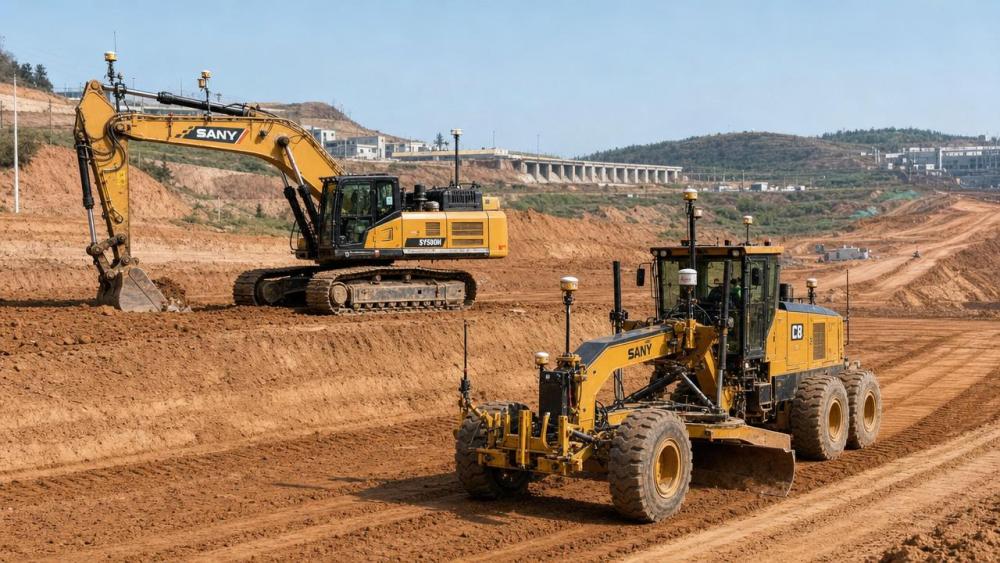
In practical terms, earthmoving technology now combines machine hardware, digital controls, positioning systems, and site data workflows. It covers crawler excavators, wheel loaders, motor graders, bulldozers, and skid steer loaders working within a connected production environment.
The biggest shift is not a single machine upgrade. It is the synchronization of hydraulics, GNSS, IMU sensors, 3D design files, telematics, and semi-autonomous functions. When these layers work together, they reduce human estimation errors and improve first-pass accuracy.
That matters because rework usually starts with misalignment between design intent and field execution. If the operator, survey team, and office use different references, grade drift appears quickly. Advanced earthmoving technology narrows that gap through shared digital models and live machine feedback.
Core capabilities now shaping site performance
- 3D machine control for cut, fill, and slope guidance
- Real-time positioning with tighter grade tolerance
- Electro-hydraulic response tuning for smoother motion
- Payload and pass-count data for material balancing
- Remote diagnostics that prevent downtime-driven shortcuts
- Autonomy features for repetitive and high-risk tasks
Why Rework Has Become the Central Site Issue
Construction schedules are tighter, labor remains uneven, and material movement costs are rising. A few centimeters of grading error can trigger drainage problems, paving delays, utility conflicts, or repeated compaction cycles. In that context, earthmoving technology is now judged by how well it prevents rework.
The 2026 environment also adds pressure from emissions compliance, fuel efficiency targets, and mixed fleets. Sites need machines that do more than push dirt. They must produce consistent outcomes, capture evidence, and support faster decision-making across changing conditions.
The Technologies That Most Directly Cut Rework
Not every innovation has equal impact. The strongest results come from tools that improve layout accuracy, operator consistency, and site visibility. In 2026, several layers of earthmoving technology stand out for direct rework reduction.
3D machine control
This remains the most visible driver. Motor graders, dozers, and excavators can reference a digital terrain model and execute cuts closer to target. Fewer stakes are needed, fewer checks interrupt work, and finish surfaces improve.
Integrated sensor fusion
GNSS alone is useful, but sensor fusion is stronger. IMUs, angle sensors, lasers, and vision systems help machines hold accuracy when signals degrade or terrain shifts. This is especially valuable near structures, slopes, and confined urban worksites.
Electro-hydraulic precision
Improved proportional control gives operators smoother bucket and blade response. That helps avoid overcutting, edge collapse, and inconsistent material placement. On excavators and dozers, refined control often reduces the need for correction passes.
Telematics and production analytics
Telematics now goes beyond location and fuel burn. It shows pass counts, idle trends, payload patterns, and cycle bottlenecks. When supervisors see deviations early, they can correct methods before defects multiply across the site.
Remote support and over-the-air updates
Configuration errors, display issues, and design file mismatches can create hidden rework. Remote support shortens the time to diagnose these problems. Over-the-air updates also help maintain control logic and software stability across mixed fleets.
Application Value Across Major Equipment Types
Different machine categories reduce rework in different ways. The key is matching capability to the error pattern that most often appears on a given job. This is where equipment intelligence becomes a measurable business tool, not just a feature list.
For integrated sites, the value increases when these machines share reference data. If excavators, dozers, and graders work from the same terrain model, handoff errors decline. That single alignment step often delivers better results than isolated hardware upgrades.
Typical Scenarios Where Site Rework Drops Fastest
The strongest gains appear in repeatable workflows with clear tolerance requirements. In those conditions, earthmoving technology can turn uncertain manual judgment into controlled execution.
- Road subgrade preparation where cross-slope must stay consistent
- Airport and logistics platforms needing uniform surface precision
- Utility trenching where exact depth prevents bedding correction
- Mass excavation with strict haul and fill balance targets
- Urban reconstruction with limited working space and high risk of clashes
- Mine support works where remote operation improves consistency and safety
These scenarios also show why EMD’s focus on excavators, loaders, graders, dozers, and compact platforms remains relevant. Rework reduction depends on how machine force, control precision, and spatial intelligence are stitched into one operational system.
Implementation Priorities and Practical Cautions
Adopting earthmoving technology does not automatically reduce errors. Results depend on process discipline. Sites often underperform because digital files are wrong, calibration is skipped, or machine data never reaches field decisions.
High-value implementation priorities
- Use one validated surface model as the active field reference.
- Standardize calibration checks at shift start and after transport.
- Track first-pass yield, not only machine utilization.
- Review telematics exceptions daily, especially idle and extra-pass data.
- Prioritize interoperability across mixed brands and attachment systems.
Common cautions
- Do not rely on automation without verifying site control points.
- Do not separate survey updates from machine control workflows.
- Do not measure success only by speed; measure correction avoidance.
- Do not ignore operator interface simplicity when selecting systems.
Another important caution involves decarbonization. Lower-emission fleets can support cost and compliance goals, but they must still maintain hydraulic responsiveness and runtime reliability. Rework savings disappear quickly if machine availability drops during critical earthmoving windows.
Operational Next Steps for 2026 Planning
The smartest next step is to evaluate earthmoving technology through a rework lens. Start with one recurring error type, such as overcutting, slope correction, or material imbalance. Then match equipment, controls, and data flow to that problem.
A practical review should include model accuracy, machine compatibility, calibration routines, operator usability, and reporting visibility. If those pieces align, technology becomes a production control system rather than a standalone upgrade.
In 2026, the most effective earthmoving technology is the one that reduces uncertainty at the blade, bucket, and site plan level. Better decisions, cleaner execution, and fewer correction cycles are what truly protect schedule certainty and margin performance.
For ongoing analysis of machine intelligence, grading precision, hydraulic evolution, and autonomous site control, EMD continues to track the systems that are reshaping earthmoving performance worldwide. The goal is simple: move more accurately the first time, and rework less.