
Related News
- 00
0000-00
How to size heavy-duty loaders for North American mining operations - 00
0000-00
How altitude affects mining excavator performance in Latin America - 00
0000-00
Caterpillar Launches New Cat 6060 and Upgraded Autonomous Mining System - 00
0000-00
When does eco-friendly construction equipment pay for itself? - 00
0000-00
Will a wheel loader quick coupler fit your existing attachments?
Construction Machinery Components: Quality Checks Before Delivery
Before a machine reaches the jobsite, every inspection decision can affect uptime, safety, and long-term asset value.
Verifying construction machinery components before delivery is the final safeguard against leaks, fatigue, faults, and premature field failures.
This guide explains practical checks for excavators, loaders, graders, bulldozers, and skid steers before shipment or handover.
Scenario Background: Why Delivery Checks Change by Machine Duty
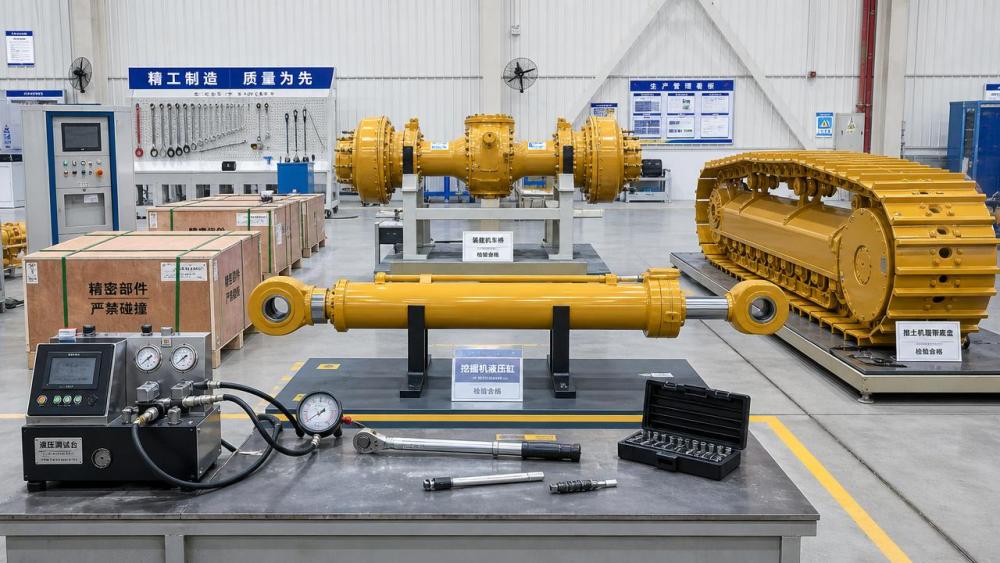
Construction machinery components face very different risks depending on terrain, load cycles, hydraulic demand, and control complexity.
A mining loader stresses axles, pins, frames, and cooling systems through continuous high-load material transfer.
A precision grader depends more on blade geometry, sensor calibration, hydraulic response, and electronic control stability.
A compact skid steer may look simple, yet attachments create demanding hydraulic, electrical, and coupler safety conditions.
Therefore, pre-delivery inspection should not be a generic checklist. It should match the machine’s operating mission.
For EMD’s earthmoving intelligence view, reliability begins when inspection logic connects force, precision, duty cycle, and documentation.
Excavator Scenarios: Hydraulic Force and Structural Integrity
Crawler excavators place extreme demand on booms, arms, buckets, swing systems, pumps, valves, and cylinders.
Before delivery, construction machinery components in the digging system need visual, dimensional, and functional verification.
Weld seams should show no undercut, porosity, cracking, excessive spatter, or heat distortion near high-stress transition zones.
Pin bores, bushings, seals, and retaining hardware should be checked for fit, lubrication, alignment, and surface damage.
Hydraulic cylinders require rod finish checks, leakage inspection, stroke testing, and pressure stability confirmation under load simulation.
Pump noise, valve response, hose routing, and clamp spacing also reveal whether construction machinery components are ready for duty.
Core Checks for Excavator Delivery
- Confirm boom, arm, and bucket weld quality around load concentration areas.
- Measure pin play and verify correct grease flow at every joint.
- Inspect hose abrasion clearance during full boom and swing movement.
- Test pilot control response, relief pressure, and swing braking behavior.
- Record serial numbers for key construction machinery components.
Loader Scenarios: High-Cycle Loading and Powertrain Endurance
Wheel loaders often operate in repetitive loading cycles where small defects become expensive downtime.
Construction machinery components in the driveline, axle, brake, cooling, and linkage systems must be inspected together.
A loader may pass a static inspection but fail when heat, shock, and vibration accumulate during aggressive operations.
Pre-delivery checks should include torque verification, oil level control, leak tracing, brake response, and articulation movement.
Bucket cutting edges, tooth adapters, side cutters, and wear plates should match material density and operating abrasion.
Cooling packages deserve special attention because blocked fins, loose mounts, or incorrect fan settings shorten component life.
High-Intensity Loading Judgment Points
- Check axle housing, hub seals, brake lines, and differential breathers.
- Verify articulation pins, steering cylinders, and frame stops.
- Inspect lift-arm symmetry and bucket rollback position.
- Confirm transmission shift quality under controlled operating temperature.
- Review oil sample history when available before delivery acceptance.
Grader Scenarios: Precision Control and Surface Accuracy
Motor graders are judged by smoothness, accuracy, and predictable blade control rather than raw breakout force.
Their construction machinery components include circle drives, moldboards, hydraulic banks, sensors, receivers, and control modules.
Delivery inspection should confirm blade movement without binding, drift, excessive backlash, or uneven response.
Circle wear, drawbar alignment, saddle condition, and moldboard straightness influence grading accuracy from the first operating hour.
Where GPS, laser, or 3D machine control is installed, calibration records are as important as hardware condition.
Electrical harnesses should be protected from abrasion, moisture intrusion, connector looseness, and electromagnetic interference risks.
Precision Grading Delivery Checks
- Measure blade edge straightness and check moldboard surface damage.
- Inspect circle teeth, drive backlash, and rotation smoothness.
- Test hydraulic drift on blade lift, tilt, and side-shift functions.
- Validate sensor mounting, calibration files, and software versions.
- Confirm construction machinery components support the required grading tolerance.
Bulldozer Scenarios: Traction, Undercarriage, and Heavy Push Loads
Bulldozers rely on mass, track contact, blade geometry, and driveline strength to deliver continuous pushing force.
The undercarriage contains construction machinery components that often determine ownership cost more than any other subsystem.
Track shoes, rollers, idlers, sprockets, chains, guards, and tensioning systems require detailed delivery verification.
Incorrect track tension can cause accelerated wear, steering stress, fuel waste, and operator complaints.
Blade lift cylinders, tilt cylinders, trunnions, C-frames, and ripper assemblies must show correct alignment and secure fastening.
Transmission, hydrostatic drive, steering response, and final drive noise should be verified during controlled movement testing.
Heavy Push Readiness Checks
- Measure track sag according to machine configuration and ground condition.
- Inspect roller leakage, guard clearance, and shoe bolt torque.
- Check blade edge, corner bits, and push-arm mounting points.
- Test steering control, deceleration response, and brake holding ability.
- Document critical construction machinery components before handover.
Skid Steer Scenarios: Attachment Safety and Compact Hydraulic Demand
Skid steer loaders are compact, flexible, and attachment-driven, which makes delivery checks highly scenario-specific.
Construction machinery components in quick couplers, auxiliary hydraulics, lift arms, and safety interlocks require close inspection.
A defective coupler or weak locking indicator can create severe risk when forks, breakers, sweepers, or augers are attached.
Hydraulic flow rate, pressure settings, and connector compatibility must match the intended attachment family.
Cab switches, presence systems, lift-arm supports, alarms, and visibility aids should operate without intermittent faults.
Tire condition, wheel torque, chaincase oil, and drive response also affect compact machine delivery confidence.
Different Scenarios, Different Inspection Priorities
The same inspection format cannot fully protect every machine type or every construction machinery components package.
Scenario Fit Recommendations Before Release
Delivery quality improves when inspection teams move from simple pass-fail checks to scenario-based acceptance logic.
The following recommendations help align construction machinery components with expected operating conditions and reliability goals.
- Define the machine’s first-use scenario before inspection begins.
- Separate safety-critical, performance-critical, and wear-critical components.
- Use functional testing instead of relying only on visual inspection.
- Verify torque marks, fluid levels, calibration data, and software versions.
- Photograph serial plates, weld areas, hose routing, and control screens.
- Link each nonconformity to corrective action and reinspection evidence.
- Keep construction machinery components records accessible for warranty review.
For high-value machines, a short dynamic test is often more valuable than another static checklist page.
Noise, vibration, heat rise, slow response, and drifting movement can expose hidden assembly or component issues.
Common Misjudgments and Overlooked Delivery Risks
One common mistake is accepting clean appearance as proof of reliable construction machinery components.
Fresh paint may hide poor surface preparation, repaired cracks, loose fasteners, or unverified structural work.
Another mistake is checking hydraulic hoses only at rest, instead of through full range movement.
Hoses can rub, twist, stretch, or kink only when the boom, blade, arm, or attachment reaches extreme positions.
Electrical faults are also underestimated because connectors may work during inspection yet fail under vibration or moisture.
Connector locking, routing, sealing, grounding, and diagnostic fault codes should be reviewed before delivery approval.
Documentation gaps are equally costly. Missing torque logs, pressure reports, or calibration files weaken later claim decisions.
In international delivery, unclear component traceability can delay customs review, warranty handling, and field service response.
Action Guide: Turning Inspection into Delivery Confidence
A reliable delivery process combines inspection discipline, operating scenario judgment, and clear records for construction machinery components.
Start with the machine’s mission, then test the systems most exposed to that mission’s load profile.
For excavation, focus on hydraulic force paths. For loading, focus on powertrain heat and linkage durability.
For grading, verify precision control. For pushing, confirm traction systems. For compact work, validate attachment safety.
EMD’s intelligence approach supports this logic by connecting machinery duty cycles, component evidence, and reliability outcomes.
Before release, build a delivery file with photos, test results, serial data, corrective actions, and final acceptance notes.
When construction machinery components leave with verified condition and documented confidence, machines enter service with fewer surprises.
Use the next delivery as a controlled reliability checkpoint, not a rushed shipping milestone.