
Related News
- 00
0000-00
How to size heavy-duty loaders for North American mining operations - 00
0000-00
How altitude affects mining excavator performance in Latin America - 00
0000-00
Caterpillar Launches New Cat 6060 and Upgraded Autonomous Mining System - 00
0000-00
When does eco-friendly construction equipment pay for itself? - 00
0000-00
Will a wheel loader quick coupler fit your existing attachments?
Unplanned stoppages in mining operations rarely begin with a single failure—they often start with missed warning signs during routine inspections.
Effective mining equipment safety checks are more than compliance tasks. They reduce hydraulic leaks, structural fatigue, brake issues, sensor faults, and operator risk.
When disciplined inspection routines meet maintenance intelligence, mines protect people while keeping high-value earthmoving assets working in demanding production environments.
Mining Equipment Safety Checks and Downtime Risk
Mining equipment operates under shock loads, abrasive dust, steep gradients, heat, vibration, and long production cycles.
These conditions accelerate wear across hydraulic systems, drivetrains, brakes, electrical harnesses, tires, tracks, buckets, blades, and attachment points.
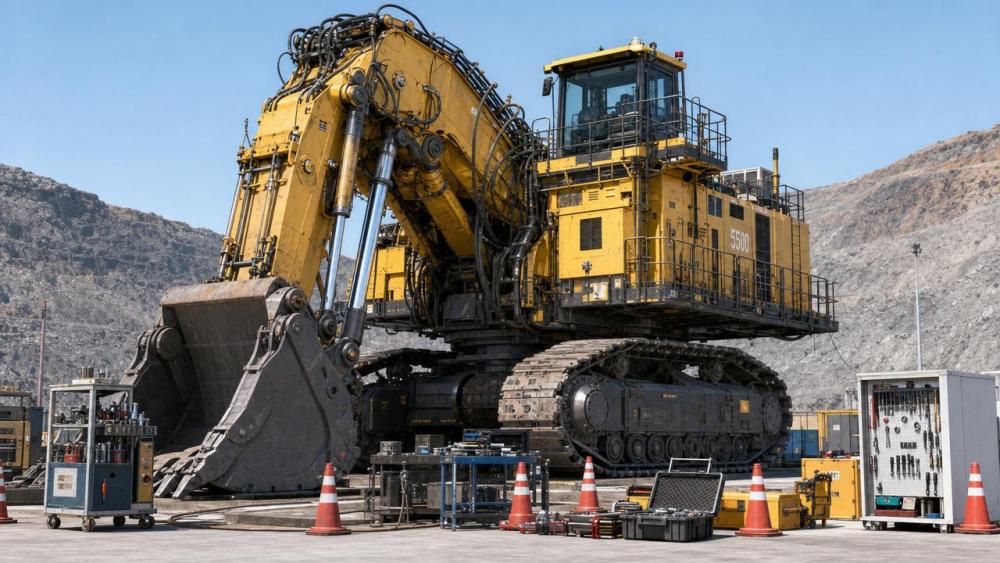
A safety check is a structured inspection that verifies whether mining equipment can operate without unacceptable risk.
It combines visual observation, functional testing, measurement, fault-code review, and documentation before work begins.
The strongest programs treat inspections as production controls, not paperwork afterthoughts.
A leaking cylinder, loose pin, worn hose guard, weak brake response, or abnormal vibration may seem small.
Yet each warning can become a costly failure when mining equipment works near capacity for multiple shifts.
Downtime risk grows when defects are hidden, repeated, undocumented, or normalized by production pressure.
Current Industry Signals Shaping Inspection Priorities
Modern mine sites are changing quickly. Larger fleets, tighter emission rules, autonomous functions, and remote-control systems reshape inspection routines.
Mining equipment safety checks now need mechanical, hydraulic, electrical, software, and data awareness.
High-precision grading systems, payload monitoring, proximity detection, and electro-hydraulic controls improve productivity.
However, they also create new failure modes involving sensors, calibration, connectors, antennas, cameras, and software updates.
The main shift is clear. Mining equipment inspection must move from isolated checklist completion to connected risk management.
The best results come when field observations match telematics, oil analysis, repair history, and component-life planning.
Core Systems That Require Consistent Safety Checks
Every site has different geology, haul profiles, and production targets. Still, most mining equipment shares common risk areas.
These systems deserve consistent attention because their failures can stop production or directly threaten personnel.
Hydraulic circuits and attachments
Hydraulic power drives excavator breakout force, loader lifting cycles, dozer blade control, and grader precision.
Checks should cover hose abrasion, wet fittings, cylinder scoring, pump noise, filter indicators, and attachment locking systems.
A small hydraulic leak on mining equipment can cause fire risk, environmental exposure, and sudden loss of control.
Brakes, steering, and travel systems
Brake performance is critical for haul roads, pit ramps, stockpiles, and confined loading zones.
Mining equipment checks should confirm service brakes, parking brakes, steering response, warning alarms, and retarder performance.
Any delayed response should be treated as a production-critical defect, not a comfort issue.
Structures, frames, pins, and undercarriages
Structural fatigue often appears around welds, boom roots, track frames, loader arms, bucket ears, and ripper mounts.
Mining equipment working in hard rock or high-impact digging needs crack detection and pin-bushing wear monitoring.
Undercarriage checks should include track tension, roller wear, sprocket damage, shoe bolts, and abnormal alignment.
Electrical, sensor, and control systems
Modern mining equipment depends on wiring integrity, controller health, software logic, and accurate sensor feedback.
Inspection routines should include harness chafing, battery condition, emergency stops, lights, cameras, proximity systems, and diagnostic codes.
Sensor faults can reduce grading accuracy, payload reliability, collision awareness, and autonomous operating confidence.
Business Value Beyond Regulatory Compliance
Safety checks protect workers first. They also strengthen production planning, asset reliability, and lifecycle cost control.
A mine loses more than repair time when mining equipment stops unexpectedly.
Idle crews, interrupted haul cycles, delayed blasting support, missed shipping windows, and emergency parts freight add hidden cost.
Reliable inspections help maintenance teams intervene before a defect damages connected components.
For example, early detection of contaminated hydraulic oil can protect pumps, valves, actuators, and precision control systems.
Early brake wear detection can prevent ramp incidents and keep haulage schedules stable.
Early undercarriage intervention can prevent track derailment on excavators, dozers, and high-duty crawler machinery.
This is why mining equipment safety checks belong in reliability strategy, not only in safety files.
- Fewer emergency stoppages and better shift predictability.
- Lower secondary damage from ignored defects.
- Improved operator confidence in demanding mine zones.
- Cleaner maintenance planning and parts forecasting.
- Stronger evidence for audits, investigations, and warranty claims.
Typical Mining Equipment Categories and Check Focus
Different machines create different inspection priorities. A single checklist rarely fits all equipment without adjustment.
The following categories show how mining equipment checks can be focused by asset role.
This classification helps convert generic mining equipment inspection into targeted operational defense.
It also supports more precise training, spare parts planning, and maintenance prioritization.
Practical Inspection Routine for Safer Operations
A strong routine separates inspections by timing, responsibility, and escalation criteria.
Daily checks should be simple enough to complete consistently, yet specific enough to catch meaningful defects.
Weekly and scheduled inspections can include measurements, sampling, calibration, and deeper technical assessment.
- Start with a walkaround before the machine is energized.
- Look for leaks, cracks, loose guards, damaged steps, and blocked visibility.
- Check fluid levels, contamination signs, breathers, filters, and cooling surfaces.
- Test lights, alarms, cameras, emergency stops, seat restraints, and interlocks.
- Verify brake response, steering movement, control smoothness, and abnormal noise.
- Review fault codes, telematics alerts, and previous unresolved defects.
- Record findings with photos, severity, location, and corrective action.
The record matters. Unrecorded defects cannot support trend analysis or maintenance planning.
Digital inspection tools make mining equipment checks easier to compare across shifts, pits, contractors, and fleets.
However, technology should not replace mechanical judgment. It should strengthen it.
Common Mistakes That Weaken Safety Checks
Many downtime events happen because inspection systems exist, but discipline around them is weak.
The most common mistake is accepting repeated minor defects as normal for mining equipment.
Another mistake is using one checklist for every machine, regardless of age, application, or duty cycle.
High-hour excavators, loaders in abrasive ore, and dozers on steep pushes need extra attention.
Poor defect closure also creates risk. A reported issue must have ownership, deadline, and verification.
If the same defect appears repeatedly, the inspection program is detecting risk but not controlling it.
- Avoid tick-box completion without physical verification.
- Avoid vague notes such as “noise” or “leak” without location.
- Avoid returning mining equipment to service without risk ranking.
- Avoid ignoring operator feedback about vibration, smell, heat, or response delay.
- Avoid separating inspection data from maintenance planning systems.
Turning Inspection Data Into Maintenance Intelligence
Inspection value increases when findings are connected with component history and operating conditions.
A brake temperature alert, oil sample trend, and operator note may appear separate.
Together, they can reveal a developing fault before mining equipment is forced out of production.
Condition monitoring tools help identify patterns across pressure, temperature, vibration, payload, idle time, and fuel or energy consumption.
Telematics should be reviewed alongside visual checks, not treated as a separate office report.
For critical mining equipment, establish thresholds for immediate stop, restricted operation, planned repair, and continued monitoring.
This escalation logic prevents uncertainty during busy shifts and reduces subjective decisions under pressure.
Action Path for Reducing Downtime Risk
Begin by reviewing the last twelve months of downtime events, safety incidents, and repeated defects.
Identify which mining equipment categories caused the highest production loss or greatest safety exposure.
Then update checklists around actual failure patterns, not only manufacturer templates.
Prioritize hydraulic integrity, brakes, structural fatigue, undercarriage condition, electrical reliability, and operator protection systems.
Assign clear defect severity levels, repair responsibilities, and return-to-service rules.
Connect inspection records with maintenance planning, parts availability, and condition monitoring dashboards.
Finally, audit the process at the machine, not only through reports.
The strongest mining equipment safety programs are practical, visible, documented, and continuously improved.
For heavy earthmoving fleets, disciplined checks are a direct route to safer work, fewer stoppages, and stronger asset utilization.