
Related News
- 00
0000-00
How to size heavy-duty loaders for North American mining operations - 00
0000-00
How altitude affects mining excavator performance in Latin America - 00
0000-00
Caterpillar Launches New Cat 6060 and Upgraded Autonomous Mining System - 00
0000-00
When does eco-friendly construction equipment pay for itself? - 00
0000-00
Will a wheel loader quick coupler fit your existing attachments?
When tough soil, compacted clay, or mixed ground conditions slow productivity, choosing the right earthmoving attachments can make all the difference. For operators, the right tools mean better breakout performance, cleaner grading results, and less machine strain in demanding jobsites. This guide explores practical attachment options that help improve efficiency, control, and jobsite versatility under harsh working conditions.
For most operators searching for earthmoving attachments, the real question is simple: which attachment helps the machine dig, break, level, or move difficult ground faster without causing unnecessary wear or losing control.
That means this is not just a product search. It is usually a jobsite decision about soil type, machine stability, attachment strength, hydraulic compatibility, and whether a tool will actually improve daily output.
Operators also care about practical issues. They want to know what works in compacted soil, rocky fill, wet clay, frozen ground, and uneven grading conditions, not just what looks good on a specification sheet.
The most useful way to evaluate earthmoving attachments is by matching the attachment to the resistance of the ground, the finish required, and the machine’s real hydraulic and lifting limits.
In tough soil jobs, the wrong attachment often creates multiple problems at once. It lowers penetration, increases cycle time, causes wheel or track slip, and adds stress to pins, bushings, hydraulics, and undercarriage components.
The right attachment, by contrast, improves entry angle, material release, cutting efficiency, and control. That leads to smoother operation, more predictable fuel use, and less operator fatigue over long shifts.
Which earthmoving attachments work best in hard or mixed soil conditions?
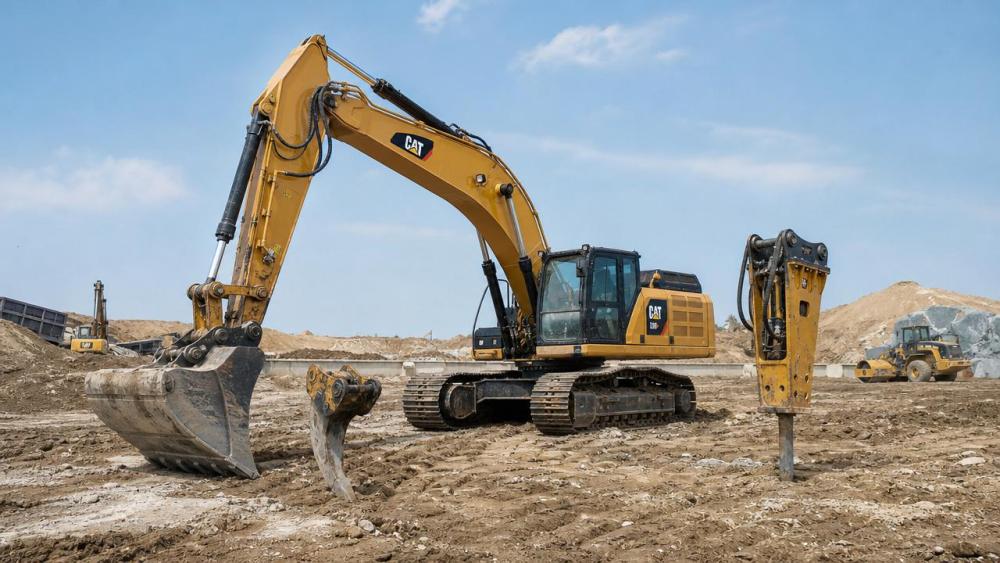
The best earthmoving attachments for difficult ground usually fall into a few practical categories: heavy-duty buckets, ripper attachments, hydraulic breakers, grading blades, compaction tools, and specialty coupler-based combinations.
Each attachment solves a different resistance problem. Some improve penetration into dense material, some fracture compacted layers, and others help reshape disturbed ground after excavation is complete.
For operators, the key is understanding that tough soil is not one condition. Dry compacted clay behaves differently from weathered rock, and mixed demolition fill behaves differently from wet subgrade with embedded debris.
Because of that, attachment choice should start with the job’s main difficulty. If penetration is poor, a ripper or toothed bucket may help most. If breakup is the problem, a breaker may be necessary.
If the challenge comes after excavation, such as trimming, shaping, or restoring grade, a grading bucket, angle blade, or tilting attachment may create faster and cleaner finishing results.
Heavy-duty buckets: the first upgrade for hard digging
In many tough soil applications, a heavy-duty bucket is the first and most cost-effective attachment upgrade. It improves strength, bucket fill consistency, and service life under repeated shock loading.
Compared with a general-purpose bucket, a heavy-duty design usually offers thicker wear plates, reinforced side cutters, stronger edges, and improved tooth retention for aggressive digging conditions.
For compacted clay, dense top layers, and abrasive mixed soils, bucket teeth matter as much as bucket size. Sharp, correctly matched teeth improve entry and reduce the force needed to break the surface.
Operators should also pay attention to bucket width. A narrower bucket often penetrates hard ground better because it concentrates force over a smaller area, even if nominal capacity is lower.
That tradeoff can improve real productivity. A wide bucket that stalls or skates on the surface wastes more time than a narrower bucket that enters cleanly and fills consistently.
Side cutters and wear runners are equally important in abrasive conditions. They protect the bucket body, keep the profile more stable over time, and reduce how quickly digging performance drops.
For wheel loaders and skid steer loaders, cutting edge design plays a similar role. A stronger edge with better material flow helps maintain bucket fill and breakout effectiveness in hard-packed stockpiles.
Rippers and ripper-tooth attachments: when the ground will not open
When a bucket cannot penetrate effectively, a ripper attachment is often the next logical step. Rippers concentrate machine force into a single tooth, creating fractures in compacted or layered ground.
This makes them highly effective in caliche, hard clay, partially weathered shale, frost-affected soil, and mixed sites where buried material interrupts smooth bucket entry.
For excavator operators, a ripper can reduce the need for repeated bucket strikes. Instead of forcing the bucket against resistance, the machine first opens lines in the ground that are easier to excavate.
That usually lowers cycle strain and improves control. It can also reduce track slip and machine pitching because the operator is no longer using brute force on every pass.
Bulldozers also benefit from rear-mounted rippers in hard ground preparation. Breaking the upper layer first allows the blade to move loosened material with less resistance and better production flow.
The main limitation is finish quality. Rippers are for loosening and fracturing, not for final shaping. Operators should plan for a second attachment stage if grade precision matters.
Hydraulic breakers: for localized hard layers and buried obstacles
Some tough soil jobs are not really soil jobs at all. They involve rock seams, old foundations, oversized embedded concrete, or dense obstructions that buckets and rippers cannot handle efficiently.
In those cases, hydraulic breakers become one of the most valuable earthmoving attachments on site. They convert the machine from a digging unit into a targeted impact tool.
Breakers are especially useful when resistance is concentrated rather than continuous. Instead of struggling across an entire cut, operators can remove isolated hard points and return to normal excavation.
This improves time efficiency and protects the rest of the machine. Repeatedly forcing a bucket into material it cannot cut often causes more wear than a controlled breaker intervention.
However, breakers require disciplined operation. Correct tool angle, steady but not excessive downforce, and proper idle timing are critical to avoid blank firing, overheating, and premature bushing wear.
They are also not ideal for every job. If the whole site is uniformly hard but still rippable, a ripper may be faster and cheaper than breaking every section individually.
Grading buckets and tilt attachments: keeping control after the material breaks loose
Many operators focus on breaking tough soil but overlook what happens next. Once the material is loosened, the job often shifts quickly from excavation to cleanup, trimming, shaping, and slope control.
That is where grading buckets and tilt-enabled attachments deliver value. They allow finer contouring, smoother passes, and better edge work without frequent machine repositioning.
A grading bucket with a wider profile is useful for ditch shaping, embankment dressing, final trim, and spreading loosened material after ripping or bucket excavation.
When paired with a tilt coupler or tilt bucket system, operators can maintain a cleaner cut line on side slopes, transitions, and irregular surfaces where a fixed bucket would need repeated repositioning.
This is particularly helpful in road shoulder work, site preparation, drainage channels, and urban utility backfill restoration, where both productivity and finish quality matter.
These attachments are not meant for primary breakout in very hard ground. Their advantage comes after resistance has been reduced by a bucket, ripper, or breaker.
Dozer blades, grading blades, and box-style attachments for controlled soil movement
For bulldozers, motor graders, and some compact machines, blade-based earthmoving attachments are essential once the soil is cut loose and needs to be distributed with control.
Straight blades, semi-U blades, angle blades, and box-style grading tools each move material differently. The best choice depends on whether the operator needs push power, side cast control, or surface precision.
In mixed or tough soil conditions, blade setup matters almost as much as blade type. Cutting edge condition, pitch, and machine balance all affect how the blade enters and carries material.
Motor grader operators working on compacted haul roads or subgrade often rely on scarifiers first. These front or mid-mounted tools loosen the hard crust before the moldboard finishes the surface.
That sequence is efficient because it separates fracture from finish. Trying to grade hard-packed ground without first loosening it usually produces chatter, uneven cuts, and poor final tolerance.
For skid steers and compact track loaders, box blades and land planes can help restore level surfaces after excavation in hard soils, especially in smaller sites where larger grading equipment is impractical.
How operators should choose attachments based on real job conditions
The smartest attachment choice starts with four questions: how hard is the ground, what finish is required, what machine is available, and how often will this condition appear on the job.
If the soil is consistently dense but excavatable, start with a stronger bucket and proper teeth. If the surface will not open, move to a ripper. If isolated hard inclusions stop progress, use a breaker.
If grade quality and cleanup are the bottleneck, add a grading bucket, blade, or tilt solution. The right sequence often matters more than choosing a single “perfect” attachment.
Operators should also check hydraulic flow, pressure rating, coupler compatibility, machine lift capacity, and transport weight before committing to any attachment change.
Oversized or poorly matched attachments can reduce safety and control. A tool that exceeds machine balance limits may create unstable lifting geometry, especially on slopes or rough underfoot conditions.
Visibility matters too. Some attachment profiles improve precision, while others limit the operator’s view of the cutting edge. On fine work, that difference can directly affect finished quality.
Common mistakes that reduce productivity in tough soil jobs
One common mistake is using a general-purpose bucket long after the site has shown it needs a more aggressive setup. Operators lose time gradually and may not notice how much output is slipping.
Another mistake is choosing attachment size based only on capacity. In hard ground, penetration and control are usually more important than carrying the largest possible volume per cycle.
Poor tooth maintenance is another major issue. Worn teeth increase resistance, raise fuel consumption, and make the machine work harder for every cut, even when the attachment itself is structurally sound.
Some operators also overuse breakers where ripping would be faster, or try to finish grade with breakout-oriented tools that are not designed for precision shaping.
Finally, attachment changes without checking pin fit, coupler lock condition, hose routing, and hydraulic settings can create avoidable downtime or safety hazards on site.
Maintenance and operating habits that protect machine and attachment life
Even the best earthmoving attachments will underperform if daily inspection is inconsistent. Hard soil jobs accelerate wear, so operators should check edges, teeth, pins, bushings, and weld zones frequently.
Hydraulic attachments need extra attention. Hose abrasion, seal leakage, abnormal heat, and loose couplers can quickly turn a productive shift into a repair event if left unnoticed.
Greasing intervals also matter more in abrasive and shock-heavy conditions. Dry joints increase play, reduce precision, and transfer impact loads deeper into the machine structure.
From an operating standpoint, smooth controlled force usually outperforms aggressive repeated impacts. Good technique reduces energy loss, lowers component stress, and keeps the attachment working in its intended geometry.
That is especially true for excavators. Correct boom, arm, and bucket coordination can improve breakout efficiency far more than simply increasing throttle and forcing the machine against resistance.
Final takeaway: the best earthmoving attachments solve the specific resistance problem
For operators, the best earthmoving attachments are not the heaviest or most complex options. They are the tools that match the actual resistance in the ground and the result required afterward.
Heavy-duty buckets improve hard digging. Rippers open ground that will not cut. Breakers remove localized hard obstacles. Grading buckets and blades restore control once the material is loosened.
When those tools are selected with soil type, hydraulic fit, machine stability, and finish expectations in mind, productivity rises and machine strain drops.
In tough soil jobs, better attachment decisions often create the biggest practical gains. They help operators work faster, maintain cleaner results, and keep equipment performing reliably under pressure.