
Related News
- 00
0000-00
Motor Graders vs Dozers for Roadbase Leveling: Key Trade-Offs - 00
0000-00
Earthmoving Machinery Downtime: Common Causes and Fast Fixes - 00
0000-00
Construction Equipment Manufacturers: What to Check Before Shortlisting - 00
0000-00
Earthmoving Technology Trends Shaping Jobsite Efficiency in 2026 - 00
0000-00
How to Compare Heavy Construction Equipment Lifecycle Costs
Choosing the right earthmoving attachments can determine whether a rocky jobsite stays on schedule or burns through time, fuel, and wear parts. For project managers and site leaders, the challenge is not just moving material, but matching attachment performance to rock density, machine capability, and production targets. This guide explores the best solutions for boosting rocky site productivity with greater control, durability, and cost efficiency.
In blasted ground, fractured shale, granite seams, or mixed overburden, attachment selection directly affects cycle times, bucket fill factor, operator fatigue, and unplanned downtime. For teams managing crawler excavators, wheel loaders, bulldozers, and skid steer loaders, the right earthmoving attachments are not optional accessories. They are productivity tools that can change output by 15% to 40% across a full work week when matched correctly to site conditions.
For project leaders responsible for schedule certainty, cost control, and equipment utilization, the priority is clear: reduce rehandling, protect the base machine, and keep rock movement predictable. That requires a disciplined view of attachment geometry, material hardness, hydraulic demand, wear package design, and maintenance intervals.
Why Rocky Sites Demand Specialized Earthmoving Attachments
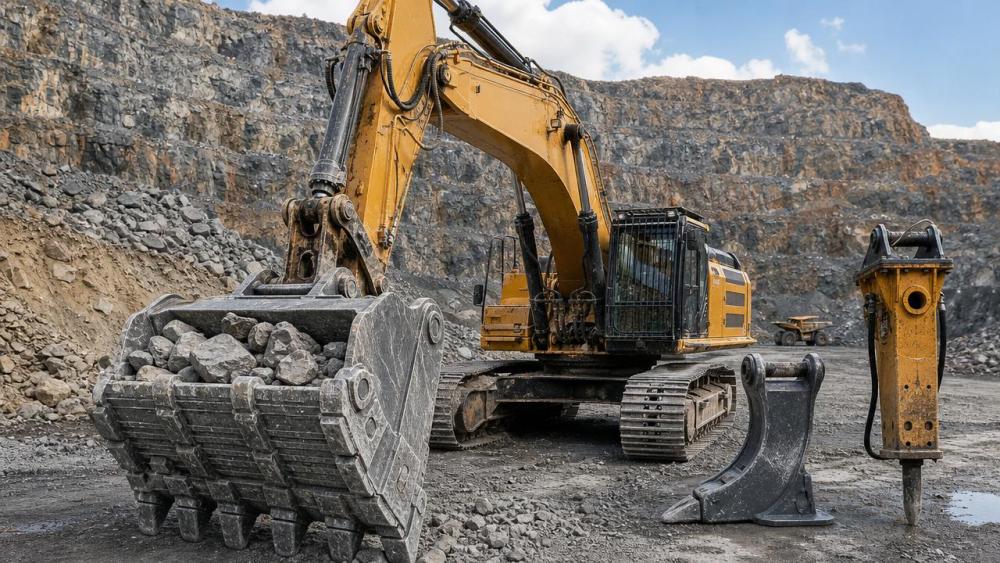
Rocky jobsites amplify every weakness in a standard setup. A general-purpose bucket that performs well in loam or clay may stall production in fractured basalt or weathered granite. Teeth wear faster, cutting edges deform sooner, and breakout force is wasted if the attachment cannot penetrate efficiently.
On many infrastructure and quarry-adjacent projects, rock conditions vary within 10 to 50 meters. One section may allow direct digging, while the next requires ripping, hammering, or staged loosening before loading. That variation is why project managers should evaluate earthmoving attachments by application zone, not by a single site-wide assumption.
The Main Productivity Pressures in Rock Handling
Three factors usually control performance: penetration resistance, fragmentation size, and haul path efficiency. If rock fragments exceed the bucket throat size or ripper spacing, cycle times increase sharply. If the attachment is too heavy, usable payload drops. If hydraulic flow is mismatched, fuel burn rises without proportional output.
- Higher tooth and GET wear, often requiring inspection every 40 to 60 operating hours
- Lower bucket fill factors, sometimes dropping from 95% in loose material to 60% to 75% in blocky rock
- More vibration and shock loading, which can shorten pin, bushing, and coupler life
- Longer truck loading cycles, especially when boulders need repositioning or secondary breaking
Why Attachment Selection Matters at the Management Level
From a management perspective, the cost difference between average and optimized earthmoving attachments is rarely just purchase price. It shows up in 4 measurable areas: tons moved per hour, liters of fuel per ton, wear-part consumption per 250 hours, and machine availability over a 30-day production window.
A heavier-duty bucket or dedicated ripper may cost more upfront, but if it reduces excavation passes from 5 to 3 per cut or lowers hammer dependency by 20%, the payback can be relatively fast on large earthworks, mine stripping, pipeline trenching, or access road construction.
Best Earthmoving Attachments for Rocky Site Productivity
The best earthmoving attachments for rocky conditions are usually those that improve penetration, fragmentation control, and loading efficiency without overloading the carrier. Selection should also reflect whether the goal is primary excavation, material separation, grading, stockpile handling, or trench formation in broken rock.
1. Heavy-Duty Rock Buckets
A heavy-duty rock bucket is often the first upgrade on excavators and wheel loaders working in abrasive or blocky ground. Compared with general-purpose buckets, rock buckets typically include thicker side cutters, reinforced wear plates, stronger lip design, and tooth systems built for higher penetration loads.
For project managers, the main advantage is balanced productivity. A well-sized rock bucket can maintain acceptable fill while resisting distortion under repeated impact. In many operations, bucket capacity should be reduced by 5% to 15% relative to soft-ground configurations to preserve breakout efficiency and maintain faster cycles.
Best use cases
- Blasted rock loading
- Hard overburden removal
- Quarry face cleanup
- Road cut excavation with mixed rock sizes
2. Single-Shank Rippers
When rock is too competent for efficient bucket penetration but not hard enough to justify continuous hammering, a single-shank ripper is one of the most effective earthmoving attachments available. It concentrates force into a narrow tip, creating fractures and loosening compacted layers before loading begins.
Rippers are valuable where production targets depend on reducing idle time for primary extraction. In weathered rock, caliche, frozen ground, or laminated shale, a ripper can lower excavation resistance enough to improve bucket productivity in the next pass by 20% or more.
3. Hydraulic Breakers
Hydraulic breakers are essential for oversized rock, trench bottoms with hard inclusions, and zones where blasting is restricted by safety or permitting limits. The key is not simply choosing the largest breaker. It is choosing one that matches the excavator’s hydraulic flow, pressure range, and front-end stability.
On many sites, breaker productivity depends on 3 variables: proper point selection, consistent blank-fire prevention, and rock positioning. Oversizing can increase stress on the boom and stick, while undersizing leads to extended strike time and poor fuel efficiency.
The table below compares common attachment choices for rocky excavation by task objective, operating strength, and management impact.
For most rocky sites, no single tool handles every phase well. The highest productivity usually comes from a planned attachment mix: rip first, break only where needed, then load with a reinforced bucket sized to the machine and haul unit.
4. Skeleton Buckets and Screening Buckets
When the job requires separating fines from reusable rock or preparing cleaner trench backfill, skeleton buckets can reduce double handling. On utility, road, and foundation works, separation at the point of excavation often saves one extra machine pass and reduces stockpile contamination.
These earthmoving attachments are especially useful where disposal cost is high or where 30% to 50% of excavated material can be reused after sorting. Project managers should check bar spacing or screening size against the target gradation before approving procurement.
5. Multi-Shank Rippers for Dozers
On larger sites, bulldozers equipped with multi-shank rippers can precondition long runs of hard ground ahead of excavators. This approach is effective for haul roads, pad preparation, and broad stripping zones where excavator-only ripping would slow fleet balance.
Dozer ripping is often a strong option when the target is area coverage rather than precise trench geometry. It can be particularly efficient over 500 to 2,000 square meter work fronts, where production benefits come from continuous ground loosening rather than point attack.
How to Match Attachments to Machine Class and Rock Conditions
Attachment performance depends on the relationship between the tool, the carrier, and the rock mass. A durable attachment still underperforms if hydraulic pressure is too low, stick geometry is unfavorable, or the machine lacks operating weight to stabilize impact loads.
Key Matching Criteria
- Machine operating weight and lift chart capacity
- Hydraulic flow and pressure range for powered tools
- Coupler compatibility and pin dimensions
- Rock hardness, fracture pattern, and average fragment size
- Production target in cubic meters or tons per hour
As a practical rule, attachment weight should not consume so much front-end capacity that cycle stability suffers. On excavators, managers should verify not only static fitment but also real operating balance at full reach, trench depth, and swing angle.
Typical planning questions
- Is the material ripped, blasted, or in-situ hard rock?
- Will the machine spend more than 25% of the shift hammering?
- Are fines valuable for reuse, or is all material going to haul-out?
- Does the fleet need one versatile attachment or two specialized tools?
The following matrix helps project teams screen earthmoving attachments by machine role and site condition before final supplier discussions.
This type of planning reduces procurement errors. It also helps fleet managers decide whether to standardize one attachment across several machines or assign specialized tools to the highest-value production bottlenecks.
Procurement, Maintenance, and Risk Control for Long-Term Output
Buying earthmoving attachments for rocky work should be treated as a life-cycle decision, not a one-time accessory purchase. In abrasive conditions, maintenance intervals, wear-part access, and rebuild practicality can influence total cost as much as initial price.
What to Check Before Purchase
- Steel reinforcement layout on sidewalls, heel shrouds, and lip areas
- Availability of replaceable teeth, adapters, side cutters, and wear strips
- Lead time for consumables, ideally within 7 to 15 days for active projects
- Hydraulic hose protection and service access on breakers and powered tools
- Compatibility with quick couplers and site safety lock procedures
Project managers should also ask suppliers for expected inspection frequency and wear thresholds. For example, daily visual checks, torque confirmation every 40 to 50 hours, and deeper structural inspection every 250 hours are common field practices in heavy rock applications.
Common Selection Mistakes
Choosing capacity over penetration
A larger bucket may look attractive on paper, but in dense rock it can reduce effective fill and slow the entire loading pattern. Penetration and clean breakout often matter more than nominal volume.
Ignoring the cost of changeovers
If crews switch between ripper, bucket, and breaker several times per day, coupler speed and attachment staging matter. Saving 8 to 12 minutes per changeover can recover meaningful production over a two-shift operation.
Underestimating wear-part logistics
Even the best earthmoving attachments lose value if teeth, moils, side cutters, or bushings are unavailable during peak demand. Spare-parts planning should cover at least the next 30 days of scheduled production on remote or fast-moving sites.
Maintenance Practices That Protect Productivity
Reliable output on rock jobs depends on disciplined maintenance. Teams should monitor cracks at high-stress corners, pin play, tooth retention, breaker tool wear, and hydraulic leakage. Small issues that go unaddressed for 1 week can become structural failures during peak production periods.
A simple 5-point routine often works well: pre-shift inspection, mid-shift wear check, end-of-day cleaning, weekly fastener review, and scheduled component replacement before catastrophic wear. This approach supports better uptime and more predictable budget control.
Building a Smarter Rocky-Site Attachment Strategy
The most productive rocky sites are rarely those with the most attachments. They are the sites with the right attachment sequence, clear machine-task alignment, and disciplined service planning. For most project teams, that means combining 2 to 3 core tools around the actual production bottleneck instead of overspending on rarely used options.
Heavy-duty rock buckets remain the foundation for loading. Rippers add value where material must be loosened before excavation. Breakers solve hard-point problems and oversize reduction. Screening or skeleton buckets become important where reuse, sorting, or cleaner backfill affects project economics.
For project managers and engineering leads, the decision should be guided by hourly output, wear life, changeover time, and the ability to keep the carrier working inside its optimal range. That is the practical route to stronger productivity, lower rehandling, and better asset utilization on rock-heavy jobs.
If you are evaluating earthmoving attachments for a demanding site, now is the right time to review your machine class, material profile, and maintenance plan together. Contact us to discuss a tailored attachment strategy, compare suitable configurations, and get more solutions for improving rocky site performance.