
Related News
- 00
0000-00
How to size heavy-duty loaders for North American mining operations - 00
0000-00
How altitude affects mining excavator performance in Latin America - 00
0000-00
Caterpillar Launches New Cat 6060 and Upgraded Autonomous Mining System - 00
0000-00
When does eco-friendly construction equipment pay for itself? - 00
0000-00
Will a wheel loader quick coupler fit your existing attachments?
In heavy equipment operations, overlooking early defects can lead to costly downtime, safety incidents, and supply chain setbacks. For quality control and safety managers, evaluating heavy machinery parts before failure is essential to protecting equipment performance and project continuity. This article explores how to identify hidden quality risks early, using practical inspection insights and reliability-focused thinking across demanding construction and earthmoving environments.
Across crawler excavators, wheel loaders, motor graders, bulldozers, and skid steer loaders, a failed pin, seal, hose, tooth, bearing, or hydraulic component can interrupt production within minutes. In high-duty fleets, the difference between a 500-hour replacement cycle and a 1,500-hour service interval often starts with part quality, not only machine design.
For B2B buyers, inspectors, and safety leaders, early risk detection is not just about rejecting visibly damaged items. It is about verifying whether heavy machinery parts match duty class, material expectations, tolerance ranges, installation conditions, and traceability requirements before they enter the machine and create a downstream failure chain.
Why Early Quality Screening Matters in Heavy Equipment Fleets
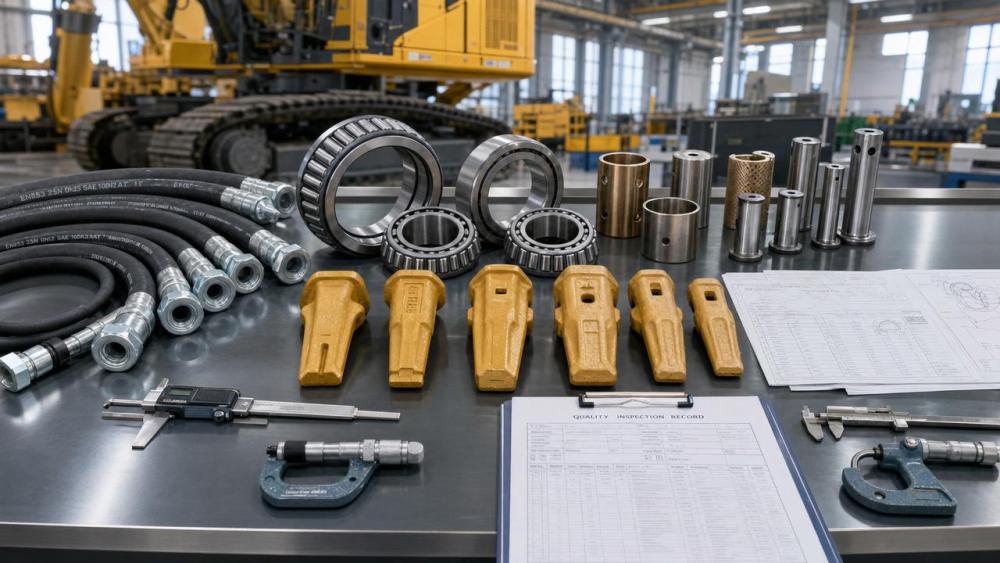
In earthmoving environments, quality risks rarely stay isolated. A substandard bushing may accelerate pin wear by 2 to 4 times. A hose with poor reinforcement may burst under pressure spikes. A cutting edge with inconsistent hardness can shorten tool life during abrasive rock handling, increasing both replacement frequency and safety exposure.
This is especially relevant for equipment working 8 to 20 hours per day in mining, roadbuilding, bulk material transfer, or airport grading. Under high load, vibration, dust, moisture, and thermal cycling, weak heavy machinery parts fail faster and often trigger secondary damage to pumps, cylinders, undercarriage systems, or operator controls.
The hidden cost behind one defective component
A part that is 5% cheaper at purchase can be 30% to 50% more expensive over its service life if it causes unplanned stoppages, rework, or collateral damage. For safety managers, the larger concern is that early-stage defects are often invisible during routine operation until failure becomes abrupt, such as a fractured bolt, detached tooth, or hydraulic oil leak near hot surfaces.
That is why incoming inspection, supplier qualification, and installation verification should be linked into one control loop. In practice, 3 checkpoints matter most: before receiving, before installation, and after the first 50 to 100 operating hours.
Which part categories carry the highest early risk
Not all parts fail in the same way. Wear parts degrade progressively, while structural or hydraulic parts can fail suddenly. Quality teams should prioritize categories with high failure impact, high replacement volume, or tight dimensional dependency.
- Hydraulic hoses, seals, fittings, and cylinder kits exposed to pressure cycling
- Undercarriage parts such as rollers, track chains, idlers, and sprockets
- Ground engaging tools including bucket teeth, adapters, cutting edges, and ripper tips
- Pins, bushings, bearings, and articulated joints with close tolerance requirements
- Fasteners and mounting hardware used in high-vibration structures
The table below helps quality and safety teams map part categories to likely risk signals and operational consequences before acceptance or installation.
The key lesson is simple: risk is highest where pressure, friction, impact, and dimensional precision overlap. These are the areas where heavy machinery parts should receive stricter incoming controls and shorter feedback loops from field performance.
How to Inspect Heavy Machinery Parts Before Failure Starts
Effective inspection does not require a lab for every shipment. In many cases, a disciplined 4-step method can detect 70% to 80% of practical quality issues before installation. The goal is to combine visual checks, dimensional checks, documentation review, and application matching.
Step 1: Verify traceability and specification alignment
Start with packaging labels, batch references, material declarations where applicable, and part-number consistency. If one shipment contains mixed markings, incomplete labels, or no batch identification, the risk of uncontrolled substitution rises sharply. For critical heavy machinery parts, traceability should at minimum link the part number, lot, supplier, and receiving date.
Safety teams should also confirm that the part is suitable for the actual load profile. A component used in a 20-ton excavator trenching in soft soil may not survive the same duty cycle in quarry rock, even if the nominal dimensions match.
Basic specification questions to ask
- Is the part matched to machine model, serial range, and attachment configuration?
- Is the rated application light-duty, general-duty, or severe-duty?
- Are hardness, seal material, pressure class, or wear resistance relevant to the site environment?
- Can the supplier provide a consistent batch history over the last 6 to 12 months?
Step 2: Perform visual and surface-condition checks
Visual inspection remains one of the fastest tools for quality control. Cracks, porosity, misaligned welds, uneven paint, damaged threads, and surface contamination often indicate weak process control upstream. On seals and elastomers, check for cuts, flattening, edge tearing, or hardness changes caused by poor storage.
For hydraulic assemblies, inspect crimps, bend radius, hose cover uniformity, and fitting seating. For pins and bushings, look for machining marks, burrs, and inconsistent finish. A rough surface may increase friction and reduce grease retention from day one.
Step 3: Measure what matters, not everything
A practical inspection plan focuses on a few critical dimensions. For example, inside diameter, outside diameter, concentricity, hole spacing, and mounting face flatness often predict fit and wear behavior better than a long checklist. For many fleet operations, setting acceptance thresholds such as ±0.1 mm to ±0.5 mm on relevant dimensions can prevent poor fit-up and premature movement.
Sampling can also be risk-based. High-volume, low-risk items may use AQL-style sampling. Critical heavy machinery parts tied to braking, steering, lifting, or hydraulic retention may justify 100% inspection on first lots or new suppliers.
Step 4: Validate installation readiness
Many part failures are blamed on manufacturing when the actual cause is installation mismatch. Before release, confirm lubrication points, torque guidance, orientation marks, sealing surfaces, and mating-part condition. Installing a new bushing into a worn bore or pairing a new seal with a scored rod can create failure within 10 to 50 hours.
The table below summarizes an efficient receiving-to-installation inspection workflow used by many maintenance and safety teams.
This workflow keeps inspection practical. It also creates evidence when discussing recurring issues with suppliers, maintenance contractors, or procurement teams responsible for vendor approval.
Common Quality Risks That Safety and QC Teams Miss
Many failures are not caused by obvious defects. They result from small mismatches that appear acceptable on paper. For heavy machinery parts, early warning often sits in the gap between specification and real operating conditions.
Risk 1: Correct dimensions, wrong material behavior
A part may fit perfectly and still fail early if hardness, heat treatment consistency, or elastomer compatibility is unsuitable. This is common with bucket teeth, wear strips, bushings, and sealing components. In abrasive applications, a small material downgrade can cut useful life by hundreds of hours.
Risk 2: Cosmetic finishing that hides manufacturing inconsistency
Fresh coating can conceal weld defects, surface pitting, or casting irregularities. Safety managers should treat unusually thick paint, inconsistent color zones, or reworked surfaces as inspection triggers. On structural or mounting components, visible repair marks deserve technical review before installation.
Risk 3: Incomplete control of storage and handling
Even well-made heavy machinery parts degrade if stored incorrectly. Seals may age under UV exposure. Bearings can absorb moisture. Precision parts can corrode after 30 to 60 days in poor packaging. Hoses bent below their recommended storage radius may later crack at installation.
Simple warehouse controls that reduce hidden risk
- Use FIFO for elastomers, adhesives, and shelf-life-sensitive parts
- Keep sealed items away from direct sunlight and high humidity
- Separate heavy cast parts from precision-machined components
- Record opening dates for protective packaging on critical kits
Risk 4: Assuming supplier consistency without periodic review
A part that performed well last year may not perform identically today if tooling, sub-suppliers, or process control changed. A 6-month or 12-month review cycle for high-risk parts helps catch drift before field failures rise. This matters especially for multi-site fleets that source parts through distributors, resellers, or mixed channels.
Building a Reliable Risk-Control Program for Heavy Machinery Parts
Early detection works best when it becomes a system rather than a one-time inspection effort. For organizations managing mixed fleets or high equipment utilization, a risk-control program should link procurement, warehouse, maintenance, and field reporting into one practical framework.
Create part criticality tiers
Start by dividing heavy machinery parts into 3 tiers: safety-critical, uptime-critical, and routine wear. Safety-critical parts include steering, braking-related components, hydraulic retention items, and structural fasteners. Uptime-critical parts include undercarriage, cylinder kits, and filtration-sensitive items. Routine wear includes predictable consumables with lower failure escalation.
Each tier should have different inspection depth. A tier-1 part may require full traceability, first-article confirmation, and early-life follow-up. A tier-3 part may need only visual checks and fit verification unless field feedback changes the risk level.
Use field feedback as a quality signal
When operators report unusual heat, noise, leakage, movement, or faster-than-normal wear, that information should go back to the receiving and sourcing teams. If similar parts fail within the first 100 to 300 hours across 2 or more machines, investigate the batch immediately rather than treating each event as isolated maintenance noise.
Align procurement with real duty cycles
Procurement decisions should not rely only on unit price. For severe-duty sites, ask suppliers for application guidance tied to abrasion, impact, pressure, temperature, and machine utilization. The right heavy machinery parts for a municipal utility contractor may differ significantly from the right parts for a quarry, port, or remote mine.
Five control measures worth standardizing
- Approved supplier list with periodic performance review
- Critical-dimension check sheets for repeat part families
- Batch traceability records for high-impact items
- 50-hour and 100-hour post-install inspection routine
- Cross-functional review of early failures within 48 hours
FAQ for QC and safety managers
How often should incoming inspection be updated?
Review checklists every 6 to 12 months, or sooner if you add a new supplier, a new machine platform, or a recurring failure pattern. Inspection criteria should evolve with field evidence.
Which parts justify the strictest controls?
Focus first on hydraulic components, articulation points, undercarriage assemblies, structural fasteners, and any part whose failure could stop the machine or create immediate safety exposure.
Can visual inspection alone be enough?
For low-risk consumables, sometimes yes. For critical heavy machinery parts, visual checks should be backed by at least basic dimensional verification and traceability review, especially on first lots or changed supply sources.
Spotting quality risks early is one of the most practical ways to protect fleet uptime, maintenance budgets, and workforce safety. The strongest programs do not depend on one final inspection. They combine supplier discipline, targeted measurements, installation readiness checks, and early-life performance feedback across the full equipment cycle.
For organizations managing excavators, loaders, graders, bulldozers, or skid steers in demanding environments, a structured approach to heavy machinery parts can reduce avoidable failures and support more confident purchasing decisions. If you want to refine your inspection criteria, evaluate part-risk categories, or build a more reliable sourcing framework, contact us to discuss tailored solutions and deeper industry guidance.