
Related News
- 00
0000-00
When do OEM heavy machinery parts justify their higher cost? - 00
0000-00
What to compare among construction equipment manufacturers in North America - 00
0000-00
How a supplier solution database reduces sourcing risk - 00
0000-00
How market insight content shapes equipment demand forecasts - 00
0000-00
When does stainless steel bulk material transfer equipment prevent contamination?
A bulldozer can look perfectly suitable on paper: enough drawbar pull for heavy cuts, a blade sized for the material, a familiar undercarriage layout, and an engine output that matches the work plan. Then the project moves across a border, a machine is transferred from a quarry fleet to an urban infrastructure contract, or a used unit is considered for import. Suddenly, the question is no longer only whether the dozer can push efficiently. It becomes whether it can legally enter the site, receive the right fuel and service support, and remain productive when its emissions system needs attention.
That is why people often ask, does global non-road emission regulation affect bulldozer selection? It does, and the effect reaches far beyond the engine badge. Non-road rules influence the type of powertrain, aftertreatment hardware, diagnostic requirements, fuel sensitivity, resale options, maintenance planning, and even whether a machine can be redeployed between projects. A bulldozer chosen solely for purchase price or rated power may create avoidable downtime if its compliance profile does not match the places where it will actually work.
The selection problem usually appears after the machine has already been shortlisted
Consider a common planning situation. A contractor expects to work on remote land development first, then move the same bulldozer to a regulated city project or a transport corridor. The operating team is focused on terrain, blade type, slope control, and daily production. Procurement is comparing engine hours, parts availability, and financing terms. Environmental requirements may seem like a paperwork item to review later.
That approach creates friction because bulldozers are long-lived assets. Their operating environments change more often than their engines do. A machine that is acceptable in one market may face restrictions, additional documentation requirements, or limited import eligibility in another. Even where use remains legal, local fuel quality, dealer capability, diagnostic tools, and operator familiarity can affect the real cost of keeping the dozer working.
Global rules are not identical, but many modern non-road frameworks pursue similar outcomes: lower particulate matter and nitrogen oxide emissions from diesel engines. Examples commonly encountered in procurement discussions include EU Stage V, U.S. EPA Tier 4 Final, China IV, and comparable national or regional requirements. Their exact applicability depends on engine power category, machine type, manufacturing date, local implementation rules, exemptions, and import status. The practical lesson is simple: do not treat one standard name as a universal passport.
Emissions tier changes the machine beneath the hood
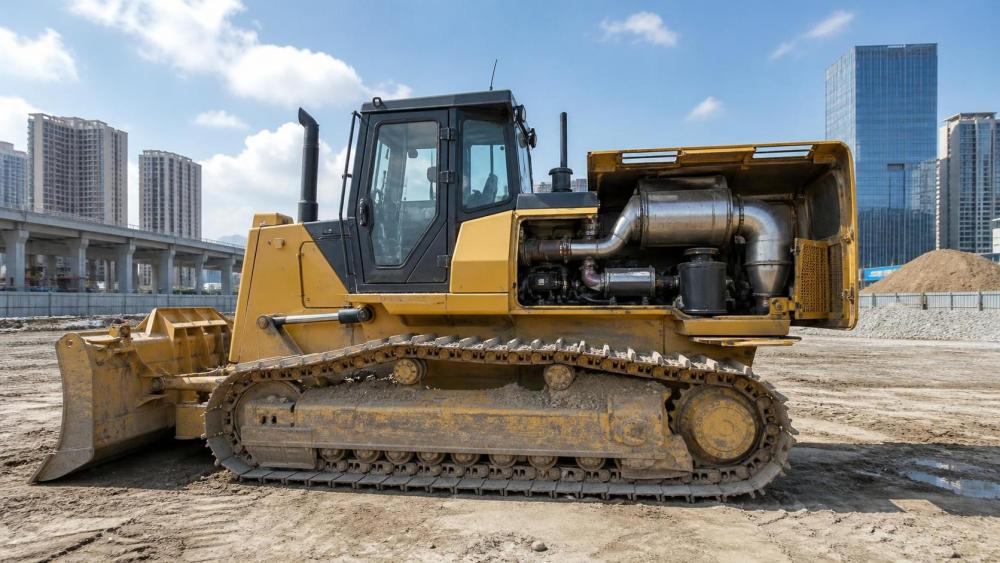
Older diesel bulldozers often rely on comparatively simple mechanical or electronic fuel systems. Many newer compliant machines use a more integrated package that may include high-pressure common-rail injection, cooled exhaust gas recirculation, diesel oxidation catalysts, diesel particulate filters, selective catalytic reduction, or a combination of these technologies. The exact architecture varies by engine and emissions category.
These systems can reduce regulated emissions substantially, but they change ownership routines. A dozer with a diesel particulate filter may need operating conditions that allow proper regeneration. A selective catalytic reduction system requires diesel exhaust fluid handling. Sensors, control modules, exhaust temperature management, and fault diagnostics become part of routine fleet readiness. None of this makes a modern machine inherently unsuitable for demanding earthmoving; it means the application and support environment must be evaluated together.
For a bulldozer spending long periods under steady load—such as bulk pushing, stripping, or heavy slot dozing—exhaust temperatures may support normal aftertreatment operation more readily than in a machine that idles extensively or performs intermittent light-duty work. Yet no buyer should assume the duty cycle alone will solve every issue. Operator behavior, ambient temperature, maintenance quality, fuel condition, and software fault strategies also matter.
Comparing the main choices without reducing the decision to “new versus old”
It is tempting to divide the market into compliant late-model machines and simpler older machines. In reality, the more useful comparison is between the project’s regulatory exposure and the fleet’s ability to support the engine technology.
The table is not a verdict in favor of one category. A basic machine may be the rational choice for a stable local operation where regulations permit it, fuel conditions are understood, and maintenance capability is strong. A highly regulated configuration may be the safer long-term choice for fleets that move equipment among jurisdictions or pursue public and urban work. The mistake is assuming either option is automatically cheaper over the machine’s working life.
Start with the work location, not the brochure
A reliable evaluation begins by mapping where the bulldozer will operate during its expected ownership period. This should include the current site, likely future projects, cross-border movements, temporary imports, and resale destination. A fleet that works only within one established territory has a different decision path from a contractor that mobilizes equipment internationally.
For each likely location, confirm the applicable requirement with the authority, importer, dealer, or qualified compliance adviser. Ask whether the rule concerns the engine’s original certification, the machine’s date of manufacture, the date it enters the market, on-site operation, or a combination of those factors. These distinctions can be important. A machine may have an engine label that appears familiar but still require records that prove its configuration and market status.
Documentation deserves the same attention as the blade and ripper specification. Preserve engine emissions labels, serial numbers, conformity documents where applicable, maintenance records, import paperwork, and any modification history. When a used bulldozer has changed hands across several markets, incomplete records can slow verification even if the machine itself appears compliant.
Match emissions technology to the actual duty cycle
Once legal eligibility is clear, examine how the dozer will work. The same engine family can behave differently in landfill work, quarry stripping, road formation, forestry clearing, mine support, and finish grading. A bulldozer fitted with machine control may spend time in precise, lower-speed passes; another may run near full load for long periods in dense material. Neither pattern is automatically problematic, but both should be discussed with the service team before purchase.
Pay particular attention to idling. Bulldozers frequently wait for survey checks, trucks, blasting clearance, or other trades. Excessive idle time consumes fuel and can complicate exhaust temperature management on certain aftertreatment-equipped machines. Establishing sensible shutdown, warm-up, and regeneration procedures is more useful than relying on operators to improvise around warning lamps.
Remote jobsites add another layer. If diesel exhaust fluid is required, storage conditions and replenishment need planning. If diagnostic intervention is needed, determine whether a trained technician can reach the site, whether remote diagnostic support is available through the local service channel, and whether the fleet can recognize an alarm before it develops into a derate event. This is not a reason to reject advanced emissions systems; it is a reason to budget for the operating discipline they require.
Fuel quality can decide whether a compliant machine stays compliant in practice
Fuel planning is often overlooked during early comparison. Modern diesel engines and emissions systems generally depend on fuel that meets the specification required for that machine and market. High sulfur content, water contamination, poor filtration, or unsuitable storage can harm components and trigger recurring faults. In remote regions, “diesel is available” is not enough information.
Before approving a model, clarify the fuel standard routinely supplied to the site, the condition of on-site tanks, filtration practices, and the process for monitoring contamination. Also check whether the machine’s required lubricants, filters, sensors, and exhaust-system parts can be obtained locally. A lower initial price can be quickly offset by delays caused by a filter or sensor that must be sourced from another country.
This is where comparison should become practical rather than theoretical. Ask the service provider to describe normal maintenance intervals, typical consumables, fault-code access, required software tools, and the procedures to follow if a regeneration request or emissions-related warning occurs. Answers should be specific to the exact engine configuration, not merely the bulldozer model name.
Do not confuse engine compliance with total project compliance
An emissions-certified engine is only one part of a project’s environmental obligations. Some sites impose additional controls for visible smoke, idle duration, fuel storage, machine inspection, maintenance records, or reporting. Public works contracts and urban projects may set their own equipment conditions beyond the baseline legal requirement. A bulldozer can meet the relevant engine standard and still create an issue if its maintenance condition is poor or the contractor cannot provide required documentation.
Similarly, retrofits deserve careful scrutiny. In some circumstances, a retrofit solution may be permitted or useful; in others, it may not provide the certification status needed for import or contract eligibility. Do not assume that adding an exhaust component makes an earlier machine equivalent to a factory-certified configuration. Verify the local acceptance route before committing funds.
A practical decision path before placing the order
When comparing bulldozers, first define the jurisdictions and contracts the machine must serve. Next, identify the required emissions category for those locations and obtain confirmation for the exact machine, engine family, and intended method of entry. Then review the engine’s aftertreatment arrangement against the expected load profile, idle pattern, climate, fuel supply, and service coverage.
After that, look at the machine as a production asset: blade configuration, undercarriage wear expectations, transmission behavior, visibility, grade-control compatibility, operator station, and attachment needs still matter. Emissions compliance should not replace these fundamentals. It should narrow the shortlist to machines that can legally and reliably perform the physical work.
The most useful purchase file includes more than a quotation. Keep a record of the emissions label details, serial-number verification, local support contacts, required consumables, operator guidance, and the regions where the machine is expected to work. This makes future transfer decisions less dependent on memory or assumptions.
When the answer should change
The answer to does global non-road emission regulation affect bulldozer selection becomes especially important when equipment will cross borders, operate in cities, enter government-funded projects, or be purchased used from another market. It also matters when a site has uncertain fuel quality or limited access to diagnostic support. In those cases, choosing the highest apparent specification without examining local conditions can be as risky as choosing the simplest machine without checking legal access.
A sound selection balances four things: lawful operation in the intended market, compatibility with the jobsite’s fuel and service reality, fit with the duty cycle, and enough future flexibility to protect the asset’s usefulness. The bulldozer that is best for a project is not necessarily the one with the largest blade or the newest emissions label. It is the one whose engine, documentation, support arrangement, and earthmoving capability all fit the work that lies ahead.