
Related News
- 00
0000-00
How Middle East climate conditions should shape heavy equipment selection - 00
0000-00
Can an industrial equipment sourcing supplier directory improve vendor selection? - 00
0000-00
How earthmoving equipment is applied in canal construction - 00
0000-00
Which accuracy metrics matter in autonomous construction control software? - 00
0000-00
What to verify in an earthmoving equipment supplier reference
Choosing between an electric and a diesel loader is no longer a simple comparison of purchase price, fuel cost, or rated bucket capacity. At a mine site, the machine choice determines what must happen around the machine: power generation, substations, haul-road planning, maintenance staffing, refuelling access, ventilation, shift handovers, and contingency procedures.
That is why the question behind electric vs diesel loader charging infrastructure mine site planning is usually broader than “Where will we charge it?” The more useful question is: Can the site supply energy to this loader fleet without creating a new production bottleneck? For a wheel loader working at a crusher feed, stockpile, underground ore pass, or ROM pad, availability matters as much as emissions.
The answer will vary by mine type, operating hours, climate, grid access, fleet size, and material flow. A small loader doing intermittent yard work can fit into a relatively simple charging plan. A high-intensity loading machine operating across continuous shifts needs a power and dispatch strategy designed with the same discipline as fuel supply or blasting schedules.
What infrastructure does an electric loader need at a mine site?
An electric loader needs more than a charger placed near the workshop. The practical system normally includes a reliable electrical source, site distribution equipment, appropriately rated charging hardware, protected cable routes, parking and queuing space, and operating rules that prevent charging from interfering with production.
The starting point is a load study. Mine teams need to understand the loader’s expected duty cycle rather than relying on an advertised runtime figure. A loader repeatedly climbing ramps, loading wet blasted rock, or working in extreme cold will draw energy differently from one moving loose aggregate on a flat stockpile. Auxiliary loads also matter: cab heating or cooling, lighting, telematics, hydraulic cooling, and battery thermal management all affect the real energy requirement.
From there, the power team should assess whether the existing mine grid, diesel generator plant, or renewable microgrid can absorb charging demand. A charger may appear manageable on paper, but several machines charging during the same meal break or shift change can create a sharp demand peak. If the site has limited electrical capacity, upgrades may involve transformers, switchgear, protection systems, distribution cabling, and in some cases energy storage to smooth peak loads.
For remote operations, this is often the decisive issue. An electric loader does not automatically eliminate diesel from the site if charging electricity is produced by local diesel gensets. It may still offer lower underground emissions, less noise, and simpler machine-side energy handling, but the project economics need to account for where the power originates and how efficiently it reaches the machine.
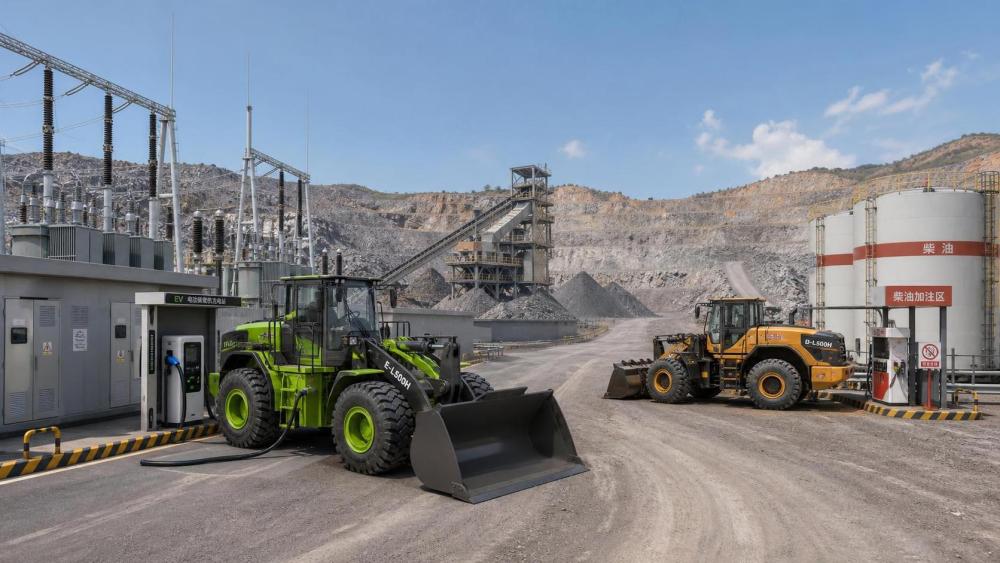
Charging location is a production decision, not a parking decision
The best charging location is rarely chosen solely for electrical convenience. It should sit where charging can occur during a natural pause in the operating cycle: a scheduled operator change, a planned break, a material-flow gap, or an existing service interval. If loaders must travel a long distance to charge, the mine is effectively adding unproductive travel into every shift.
A charging bay also needs to work in real mine conditions. Consider turning radius, muddy tires, visibility, traffic separation, drainage, lighting, dust exposure, and safe access for emergency response. Cable management deserves more attention than it usually gets in early layouts. Cables and connectors should not cross active haul routes or become trip hazards in a wet workshop environment. In open-pit applications, charger enclosures must be selected and positioned with weather, dust, vibration, and accidental vehicle impact in mind.
For underground mines, the layout challenge becomes tighter. Charging stations may need dedicated bays, fire-protection measures consistent with local requirements, clear escape routes, and procedures for isolating equipment. The absence of diesel exhaust is a major operational advantage underground, but it does not remove the need for disciplined electrical safety planning.
How does diesel-loader infrastructure differ?
Diesel infrastructure is familiar, but it is not “infrastructure-free.” A dependable diesel loader fleet relies on bulk fuel storage, delivery access, pumps, filtration, spill containment, fuel quality controls, fire protection, and a refuelling routine that does not delay the loading cycle. In very remote locations, fuel logistics can become one of the largest operational vulnerabilities. Bad weather, road closures, shipping disruption, or a delayed supplier can threaten machine availability even when the loaders themselves are mechanically sound.
Diesel machines also require more ongoing management of fluids, filters, exhaust aftertreatment components, and engine-related maintenance. Modern emissions-control systems can perform well when maintained correctly, but they add another layer of service discipline. Mines operating in dusty, cold, high-altitude, or stop-start conditions need maintenance schedules based on actual working conditions rather than generic calendar intervals.
Underground operations face an additional consideration: ventilation. Diesel equipment contributes heat and exhaust contaminants that ventilation systems must manage. The exact impact depends on the fleet, mine geometry, local rules, and ventilation design, so it should not be reduced to a simple universal formula. Still, where ventilation capacity is already constrained, moving some loading work to battery-electric equipment can change the broader infrastructure equation in a meaningful way.
Can an existing mine electrical system support electric loaders?
Sometimes yes, but that should be verified through a site-specific power assessment. Mines already operating crushers, conveyors, dewatering pumps, processing plants, workshops, and accommodation facilities may have substantial electrical infrastructure. Yet “substantial” does not necessarily mean spare capacity exists at the point where loaders need to charge.
The critical questions are usually practical ones. Is there unused capacity at the relevant substation? What happens to demand during crusher start-up or peak processing periods? Can chargers be managed so they do not all run at full output simultaneously? Is the available voltage compatible with the charging equipment? How far must new cable runs travel, and what civil work is required to protect them?
Smart charging controls can help sequence charging events and limit site peaks, but software cannot create electrical capacity that is not there. Battery energy storage may be useful where the mine wants to buffer intermittent generation or avoid short-duration demand spikes. It should be evaluated as part of the whole energy architecture, not treated as an automatic add-on.
Is battery swapping better than fixed charging?
Battery swapping can reduce machine downtime in certain repetitive applications, especially where loaders work hard for long periods and the operation can support a controlled exchange process. But it shifts complexity into the battery room or swap station. The site needs lifting or handling equipment, storage space, battery tracking, charging racks, electrical protection, trained personnel, and a clear process for inspecting batteries before they return to service.
Fixed charging is operationally simpler in many cases, particularly where loaders have predictable idle periods. Its weakness is obvious: if the duty cycle leaves no meaningful charging window, production can become dependent on charger speed and dispatch discipline. There is no universal winner. The decision should follow the machine’s cycle study, not a preference for the newest-looking technology.
What maintenance and workforce changes should a mine expect?
Electric loaders generally reduce routine engine-related service work, but they introduce high-voltage systems, battery cooling, charging connectors, insulation checks, and software diagnostics. Maintenance teams need manufacturer-specific training and well-defined lockout and isolation procedures. This is not a reason to avoid electrification; it is a reason to involve the workshop early, before equipment arrives on site.
A common planning mistake is to treat charging as the responsibility of only the electrical department. In practice, the mine planner, loading superintendent, maintenance manager, safety team, IT or telematics lead, and power engineer all influence whether the system works. Dispatch data can be particularly valuable. If the mine understands idle time, queue time, travel distance, payload variation, and operator behaviour, it can design charging around actual operations instead of assumptions.
This is also where the broader earthmoving view matters. Wheel loaders do not work in isolation: excavators feed faces, bulldozers shape dumps, graders maintain haul routes, and crushers set the pace at processing points. A loader that needs to leave a critical stockpile at the wrong moment can disrupt several connected activities. EMD’s focus on heavy loading machinery, hydraulic performance, autonomous systems, and site-level equipment intelligence reflects this reality: machine technology only delivers its promise when the operating system around it is ready.
Which option makes more sense for a remote or harsh mine?
Diesel still has a strong case where the mine is highly mobile, power is scarce, shifts are long and unpredictable, or the fleet must work far from fixed infrastructure. A diesel loader can be refuelled relatively quickly wherever a safe fuel service is available. That flexibility remains valuable during early-stage mining, temporary stripping campaigns, and changing pit layouts.
Electric loaders tend to become more compelling where work is repetitive, charging can be located near the work zone, electricity is dependable, and emissions, heat, noise, or ventilation are significant operating constraints. They may also fit well in semi-fixed applications such as crusher loading, underground production zones, port-adjacent bulk handling, or established surface mines with robust electrical networks.
Harsh weather does not rule out either technology, but it raises the importance of specification and operating discipline. Cold conditions can affect battery performance and charging behavior; dust and water challenge electrical connections; high ambient temperatures increase cooling demands. Diesel systems face their own cold-start, fuel-quality, filtration, and heat-management concerns. Mine managers should ask how the proposed machine and support equipment are intended to operate in their actual climate—not in a generic test cycle.
What should be assessed before committing to an electric loader fleet?
Before making a fleet decision, map the loading cycle in detail and test the infrastructure plan against the worst realistic operating period, not the average day. Include wet material, high production demand, night shifts, power interruptions, road diversions, and maintenance downtime. A plan that works only when every charger and every loader is available is not a resilient mine plan.
- Measure loader hours, payload patterns, travel distance, idle time, and peak production windows.
- Confirm available electrical capacity at the required charging locations, not merely at the main site connection.
- Decide how charging, breakdowns, and power loss will be handled without starving the crusher or stockpile.
- Review civil works, drainage, vehicle segregation, connector protection, and emergency access around charging bays.
- Plan workshop training, spare-parts support, diagnostic access, and high-voltage safety procedures.
- Compare the full site system: fuel logistics, generation costs, ventilation implications, maintenance labor, and expected asset utilization.
The practical choice between electric and diesel loaders is rarely ideological. Diesel infrastructure favors mobility and established field routines. Electric infrastructure can support lower local emissions and a different maintenance profile, but it demands earlier coordination between operations and power engineering. The strongest projects do not begin with a charger specification or a fuel-tank size. They begin with a clear picture of how material moves through the mine, hour by hour, when conditions are least forgiving.