
Related News
- 00
0000-00
When do OEM heavy machinery parts justify their higher cost? - 00
0000-00
What to compare among construction equipment manufacturers in North America - 00
0000-00
How a supplier solution database reduces sourcing risk - 00
0000-00
How market insight content shapes equipment demand forecasts - 00
0000-00
When does stainless steel bulk material transfer equipment prevent contamination?
The premium for OEM heavy machinery parts is justified when the part controls machine uptime, safety, calibrated performance, or a warranty-sensitive system—and when the financial consequence of a failure is materially greater than the purchase-price difference. It is less justified for low-risk, non-critical consumables with transparent specifications and a proven equivalent supplier.
The practical question is not whether OEM parts are inherently “better” than aftermarket parts. Some independent manufacturers produce high-quality replacements, and some components originate from the same upstream supply base. The procurement decision turns on a narrower issue: can the buyer verify that the replacement will fit, perform, arrive, and remain supportable at the level required by the machine’s operating conditions?
For excavators, wheel loaders, bulldozers, motor graders, and skid steer loaders, that answer differs sharply between a bucket tooth, a hydraulic pump, an emissions sensor, a final-drive bearing, and a machine-control antenna. Treating every replacement as a simple unit-price comparison is where avoidable cost enters the maintenance budget.
Price is visible; downtime exposure is not
An OEM part often carries a higher invoice price because it incorporates more than the physical component. Depending on the manufacturer and region, the price can reflect engineering validation, controlled revisions, traceability, dealer inventory, technical bulletins, warranty administration, and access to current software or calibration information. None of these benefits matters equally for every part. They matter when a part failure stops production or causes a second, more expensive repair.
A useful way to assess the premium is to compare the total exposure rather than the unit cost:
Total replacement exposure = part price + installation labor + lost production + recovery or transport cost + collateral-damage risk + warranty and compliance risk.
A $400 saving on a replacement component has little value if an incorrect fitment requires a second teardown, immobilizes a machine in a remote quarry, or damages a connected hydraulic circuit. By contrast, a meaningful price saving on an easily replaced cab lamp, standard fastener, or non-critical wear plate may be entirely rational if the specification and supplier quality are clear.
The calculation should use the actual operating context. A loader supporting a continuous crushing plant, a dozer working on a time-bound earthworks package, or a grader maintaining final road tolerances can have a much higher downtime cost than an identical machine used intermittently in a yard. The machine model alone does not determine whether OEM is worth paying for; the consequence of interruption does.
OEM is most defensible where the part is part of a system
Heavy equipment is increasingly a combination of mechanical assemblies, hydraulic control logic, electronic modules, sensors, and software. In these areas, dimensional similarity is not enough. A replacement may install correctly but still deliver an unstable signal, incorrect pressure response, unsuitable material behavior, or incompatible communication with the machine controller.
Hydraulic components with tight performance dependencies
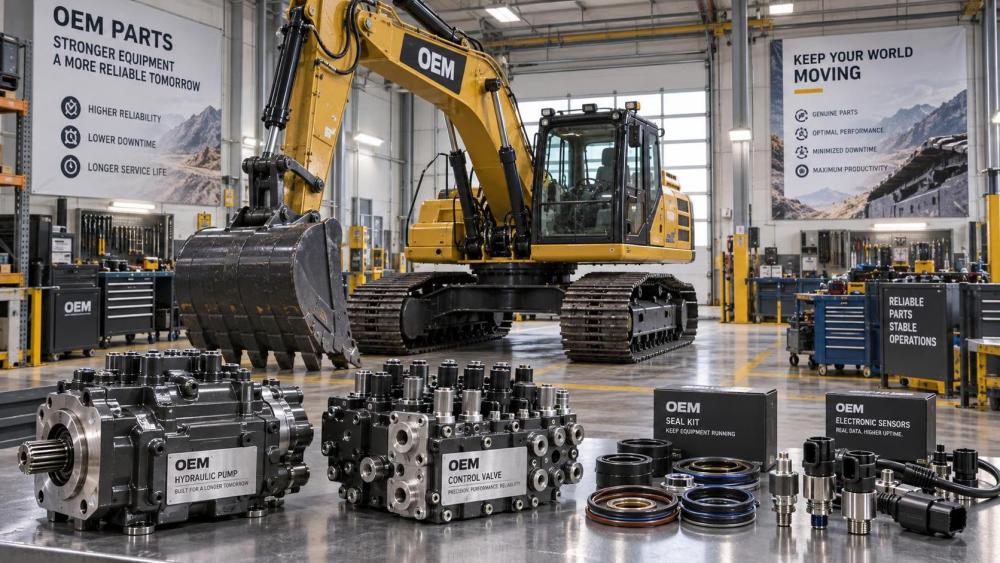
Main hydraulic pumps, control valves, travel motors, swing motors, pilot-control components, and electronically controlled injectors are strong candidates for OEM purchasing when machine availability is important. These components operate within a system designed around specified pressure, flow, tolerances, contamination limits, and control response. A lower-cost substitute can create problems that are difficult to isolate: slow cycle times, overheating, erratic attachment behavior, pressure alarms, or accelerated wear elsewhere in the circuit.
This does not mean every hydraulic replacement must be purchased through the machine brand. A reputable specialist remanufacturer or component maker may be a viable source when it can document the exact part number, revision compatibility, test process, warranty terms, and service support. The key distinction is evidence. An equivalent should be bought as an engineered and traceable alternative, not as an assumption based on appearance.
Electronic, sensor, and machine-control parts
OEM parts are frequently justified for engine aftertreatment sensors, engine-control components, electro-hydraulic solenoids, display modules, wiring harnesses, telematics hardware, and grade-control interfaces. Modern excavators, graders, and dozers depend on electronic inputs for functions that once relied primarily on mechanical adjustment. A sensor with a similar connector may not have the same signal range, firmware compatibility, sealing standard, or diagnostic behavior.
Motor graders and dozers equipped with 2D or 3D grade-control systems deserve particular caution. Positioning hardware, inertial sensors, antennas, control modules, and related harnesses affect not only availability but also the quality of finished work. A seemingly minor compatibility issue can consume substantial time in diagnostics and recalibration. Where the equipment is under a service agreement or relies on dealer software access, OEM supply may reduce the risk of a repair becoming a multi-party dispute.
Safety-critical and load-bearing parts
OEM pricing is easier to defend for braking components, steering-system parts, ROPS/FOPS-related cab elements, seat-belt assemblies, boom and lift-arm pins subject to critical loading, and components whose failure could cause loss of control or injury. The issue is not merely whether an aftermarket item works on installation. Material properties, heat treatment, machining tolerances, sealing performance, and fatigue behavior may matter over the component’s service life.
For equipment operating under site safety rules, insurer requirements, rental-fleet policies, or contractual maintenance obligations, documentation is also part of the value. A part with clear origin and traceability may simplify incident investigation, inspection records, and asset handover. Saving money on a safety-relevant part can be difficult to justify if the supplier cannot provide reliable technical documentation.
Fitment accuracy becomes expensive on older and globally sourced machines
Part-number matching is more complex than many purchasing systems suggest. A model designation may cover several serial-number ranges, engine configurations, hydraulic arrangements, emissions variants, regional electrical systems, and running production changes. A machine built for one market can differ from an apparently identical unit built for another.
This is particularly important in cross-border procurement. A replacement listed for a familiar model may be correct only for a different serial range or for an earlier production revision. The visible cost of the wrong item includes return freight, customs handling, storage, and emergency local sourcing. The hidden cost is the machine that remains unavailable while the error is corrected.
OEM dealer channels are not immune to ordering errors, but they generally have access to serial-number-based parts catalogs, supersession records, and manufacturer technical notices. That support has value when the purchase is complex, urgent, or expensive to reverse. It is less valuable where the part is standardized and the buyer has already established a reliable internal cross-reference.
Before approving a non-OEM substitute for a high-value repair, require more than a model reference. The purchase file should tie the item to the machine serial number, current OEM part number, any superseded numbers, component revision, and applicable attachment or software configuration. This is a modest administrative step compared with the cost of a mismatched pump, controller, or harness.
Warranty protection is valuable only when the boundary is clear
OEM parts can reduce warranty uncertainty, but “using aftermarket parts voids the whole machine warranty” is too broad to be a useful purchasing rule. Warranty rights and limitations depend on the sales contract, jurisdiction, maintenance terms, and the relationship between a failure and the replacement part used. The commercially relevant issue is whether a disputed repair could delay recovery or leave the owner carrying the full cost.
During the machine warranty period, or while a dealer-supported maintenance agreement is in force, OEM supply is often prudent for components connected to powertrain, hydraulics, electronics, emissions systems, or safety functions. It creates a cleaner chain of responsibility: the machine manufacturer or its authorized channel supplied the part, installed it or recognized it, and has access to the relevant diagnostics.
After warranty expiry, the equation changes. The buyer can accept more alternative sourcing where the part is non-critical, specifications can be verified, and a competent repair provider stands behind the installation. Yet even on mature equipment, a low-cost replacement that prevents access to diagnostic support or creates an unresolved fault code can cost more than the OEM option.
Warranty should be reviewed as a practical service question, not simply a legal label. Ask who pays for labor, travel, fault diagnosis, software programming, freight, and secondary damage if the component fails. A supplier warranty that covers only the returned part may offer little protection when removing that part requires a major teardown.
When aftermarket and alternative supply can be the better decision
OEM procurement should not become an automatic default. It can tie a fleet to high prices, long lead times, and unnecessary dependence on one channel. Alternative sourcing is often commercially sound when the performance requirement is well understood and the failure consequence is manageable.
Common candidates include selected ground-engaging tools, cutting edges, bucket teeth, wear liners, track pads, glass, mirrors, lamps, filters from established filtration manufacturers, hoses assembled to verified specifications, and standard bearings or seals from recognized industrial brands. Even here, the part category is not enough on its own. A bucket tooth used in abrasive mining conditions has a very different risk profile from one used in light utility work, while an incorrect filter can compromise a hydraulic or fuel system.
For non-OEM heavy machinery parts, procurement should establish a qualification threshold appropriate to the risk. At minimum, it should include a clear manufacturer identity, exact fitment confirmation, technical specification, batch or traceability information where relevant, defined warranty terms, and evidence that the supplier can replenish the item. An alternative supplier that cannot identify material grade, sealing material, filtration rating, or dimensional tolerance is offering a price, not a controlled replacement solution.
Do not confuse “OEM” with every product carrying an OEM-style claim
The term OEM is used inconsistently in the replacement-parts trade. It may mean a part purchased from the original machine manufacturer’s authorized network. It may also mean a part made by the original component manufacturer, or simply a part claimed to match OEM specifications. These are not equivalent supply propositions.
A genuine component from the original manufacturer of a hydraulic pump, engine fuel system, axle, bearing, or filtration assembly may be technically appropriate, provided the exact application and revision are confirmed. A product marketed as “OEM quality,” however, does not establish origin, validation, or compatibility. Procurement specifications should distinguish between:
- authorized machine-brand parts;
- parts from identified original component manufacturers;
- independent aftermarket parts with documented specifications and warranty; and
- unverified equivalents or marketplace listings with limited technical evidence.
This distinction prevents a common sourcing failure: comparing the official part price with an unknown item as if both represented the same quality and support level. The meaningful comparison is between supply options that carry known and acceptable technical risk.
Lead time can reverse the apparent value of an OEM choice
Availability is not automatically an argument for OEM. Dealers may have strong local inventory for fast-moving service parts but long lead times for low-volume assemblies. Independent distributors may stock alternatives closer to the jobsite. The right decision depends on both the part’s criticality and the credibility of the delivery promise.
For fleet-critical assemblies, a planned stock strategy is often more effective than emergency sourcing. Identify parts with a high downtime consequence, low local availability, and lengthy replacement process—such as critical sensors, hydraulic control components, final-drive repair kits, or specialized undercarriage items. Then decide whether to hold OEM stock, qualified alternative stock, or a service-exchange arrangement.
Emergency purchases distort judgment because every option appears expensive once a machine is idle. A structured critical-spares list allows buyers to reserve OEM spending for parts where it protects availability, while using approved alternatives for categories where price competition is legitimate.
A disciplined approval test before paying the premium
The OEM premium is commercially justified when the answer is “yes” to one or more of the following questions:
- Would failure create a significant safety, environmental, or operational-control risk?
- Does the component require software coding, calibration, or verified electronic compatibility?
- Could an incorrect part damage an expensive connected system?
- Is the machine under warranty, a maintenance agreement, or a contractual condition requiring traceable parts?
- Is removal and reinstallation labor costly enough that repeat work would erase the initial saving?
- Is the machine in a high-utilization role where downtime materially affects project delivery or production?
- Is there no qualified alternative supplier able to prove equivalent fitment, specification, warranty, and delivery capability?
If the answers are largely “no,” an approved aftermarket or original-component-manufacturer source deserves serious consideration. If several answers are “yes,” the higher OEM price is often not a premium for branding; it is an expenditure to reduce a specific and measurable operational risk.
The strongest purchasing policy does not mandate OEM parts across the fleet or pursue the lowest line-item price across every category. It classifies parts by consequence of failure, fitment complexity, support dependency, and supply risk. That approach protects project margins where they are most exposed while preserving competitive sourcing where the technical and commercial risks are genuinely controllable.