
Related News
- 00
0000-00
How an earthmoving equipment portal helps vet factory capabilities - 00
0000-00
How to assess equipment specifications against applicable standards - 00
0000-00
How Middle East climate conditions should shape heavy equipment selection - 00
0000-00
Can an industrial equipment sourcing supplier directory improve vendor selection? - 00
0000-00
How earthmoving equipment is applied in canal construction
A New Investment Cycle Is Taking Shape in the Heavy Machinery Industry
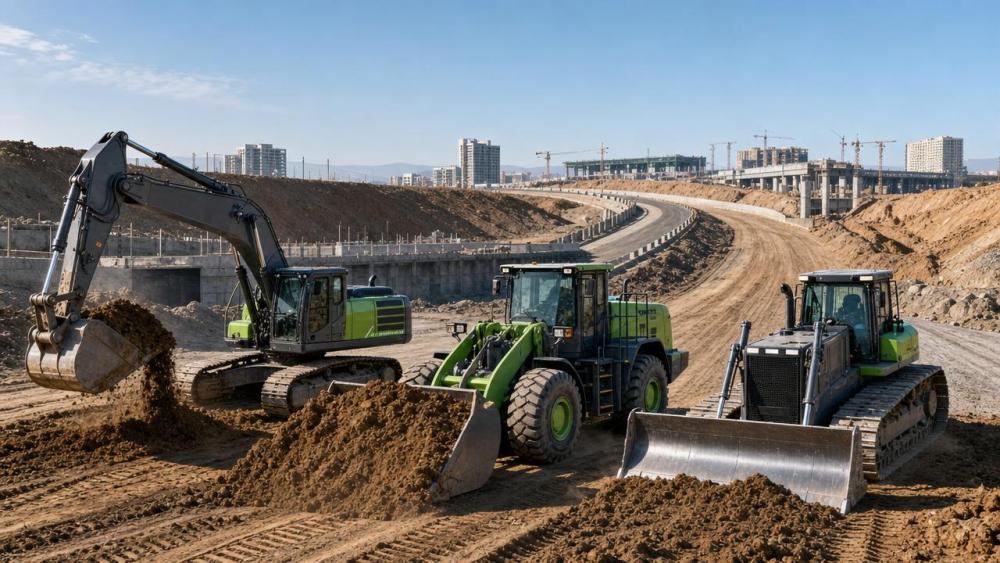
The heavy machinery industry is no longer moving on replacement demand alone.
A broader reset is underway across infrastructure, mining, logistics, and public works.
Capital is shifting toward equipment that improves utilization, lowers emissions exposure, and keeps projects productive under tighter cost controls.
That change is especially visible in crawler excavators, wheel loaders, motor graders, bulldozers, and skid steer loaders.
These machine categories now sit at the center of site efficiency, fuel strategy, and automation planning.
From recent market behavior, the strongest signal is not simple volume growth.
It is the redefinition of what counts as a smart equipment investment in the heavy machinery industry.
For businesses evaluating fleets, projects, or supply chain exposure, performance is now judged across operating hours, digital capability, maintenance predictability, and regulatory resilience.
This is also where EMD’s perspective becomes relevant.
Its close reading of earthmoving dynamics connects machine physics, site realities, and the strategic direction of global infrastructure investment.
Why the Shift Is Becoming More Visible Now
Several forces are converging at the same time.
Governments are prioritizing transport corridors, urban upgrades, energy infrastructure, and resilience projects.
At the same time, emissions rules for non-road equipment are becoming harder to ignore.
Financing conditions also reward equipment with longer service life and clearer productivity data.
In practical terms, the heavy machinery industry is being pushed to prove value beyond engine power or purchase price.
Machines must now fit stricter operating environments.
They must work efficiently in dense cities, harsh mines, remote sites, and digitally managed projects.
That is why demand is leaning toward assets with telematics, electro-hydraulic precision, remote monitoring, and lower total lifecycle uncertainty.
- Infrastructure spending is becoming more targeted, with stronger emphasis on speed, compliance, and measurable output.
- Contract risk is increasing, making unplanned downtime more expensive than before.
- Labor gaps are encouraging automation support, simpler controls, and remote operation capability.
- Fuel volatility is making hydraulic efficiency and machine right-sizing more important investment criteria.
This mix is reshaping purchasing logic across the heavy machinery industry.
The Equipment Story Is Changing Machine by Machine
The shift is not uniform across all equipment classes.
Crawler excavators remain the anchor asset for many projects, but expectations are rising.
Breakout force still matters, yet buyers increasingly compare control smoothness, attachment flexibility, and digital integration.
Wheel loaders are being evaluated through cycle speed, payload consistency, and fuel burn under continuous use.
Motor graders are seeing renewed interest where road quality and airport precision directly affect downstream cost.
Bulldozers are benefiting from demand in quarrying, site preparation, and heavy push work, especially where traction and blade control support tighter schedules.
Skid steer loaders, meanwhile, are gaining strategic value in compact urban projects.
Their attachment versatility makes them useful where job scopes shift quickly.
EMD has long framed these categories as the operational pillars of infrastructure civilization.
That framing now looks less descriptive and more predictive.
The heavy machinery industry is rewarding platforms that combine raw force with data visibility and adaptable controls.
Where investment criteria are shifting fastest
Automation and Decarbonization Are Now Linked, Not Separate Themes
A few years ago, automation and sustainability were often discussed in separate conversations.
That separation is fading across the heavy machinery industry.
Digital machine control reduces overcutting, idle time, fuel waste, and rework.
Remote diagnostics help keep components within optimal operating ranges.
Autonomy features also improve repeatability, which matters when margins are tight.
This is why smart control systems are becoming part of decarbonization planning rather than an optional upgrade.
EMD’s coverage of electro-hydraulic proportional control and low-latency remote communication reflects this deeper shift.
The market is moving toward machines that can sense, adjust, and document performance in real time.
For evaluators, that means the heavy machinery industry should be read through system capability, not only hardware specification.
Impact Is Spreading Across the Whole Operating Model
The consequences go beyond fleet selection.
Residual value assumptions are changing as cleaner and more connected machines become easier to redeploy.
Maintenance planning is also becoming more data-led.
Machines with better sensor feedback can reduce surprise failures and improve parts forecasting.
Project bids increasingly reflect confidence in equipment uptime and compliance readiness.
In urban work, compact equipment with low noise and flexible attachments can open access to projects that older fleets struggle to serve.
In mining and hazardous environments, remote-controlled systems are shifting from niche capability to operational safeguard.
This broader effect explains why the heavy machinery industry is increasingly evaluated through asset ecosystems.
A single machine matters less than the way it connects with site software, emissions strategy, and service support.
Signals worth tracking over the next planning cycle
- Growth in mini-excavator and skid steer demand tied to secondary urbanization and infill construction.
- Stronger preference for graders and dozers with integrated guidance systems in transport projects.
- Higher value placed on fuel mapping, idle reduction, and machine health analytics.
- More scrutiny of supplier depth in hydraulics, controls, and post-sale technical support.
What Smarter Heavy Machinery Industry Evaluation Looks Like
The next phase of decision-making is less about chasing every new feature.
It is about matching machine capability with real operating exposure.
A productive review starts by separating high-hour core assets from flexible support equipment.
Then it becomes easier to judge where automation delivers payback and where simpler platforms remain efficient.
It is also useful to compare site types.
A quarry loader, an airport grader, and an urban skid steer face very different value drivers.
That sounds obvious, yet many investment errors still come from applying one benchmark across all conditions.
EMD’s intelligence model suggests a better approach.
Read machine choice through force, precision, control architecture, and decarbonization pathway at the same time.
That creates a more realistic view of future competitiveness in the heavy machinery industry.
Practical next steps
- Recheck fleet assumptions against new emissions rules and reporting requirements.
- Map each major equipment class to utilization, downtime cost, and digital readiness.
- Compare whether hydraulic efficiency or control precision now affects project margins more than nominal horsepower.
- Watch where autonomous or remote-assisted functions reduce risk enough to change asset priority.
- Build phased investment plans instead of relying on single-cycle replacement logic.
The heavy machinery industry is entering a period where equipment decisions increasingly shape commercial resilience.
The clearest advantage will come from reading technical change, infrastructure demand, and asset efficiency as one connected story.
That is the signal worth following next.