
Related News
- 00
0000-00
How to size heavy-duty loaders for North American mining operations - 00
0000-00
How altitude affects mining excavator performance in Latin America - 00
0000-00
Caterpillar Launches New Cat 6060 and Upgraded Autonomous Mining System - 00
0000-00
When does eco-friendly construction equipment pay for itself? - 00
0000-00
Will a wheel loader quick coupler fit your existing attachments?
Heavy equipment in 2026 will be measured less by raw horsepower and more by how intelligently it works on site. Across earthmoving, mining, roadbuilding, and urban infrastructure, contractors are weighing fuel exposure, emissions risk, operator availability, machine precision, and uptime with far more discipline than before.
That shift matters because the equipment mix behind modern projects is also changing. Excavators, wheel loaders, motor graders, bulldozers, and skid steer loaders now sit inside a broader operating system shaped by software, sensors, regulation, and capital efficiency.
For organizations tracking fleet direction, the main question is no longer which machine is strongest. The real question is which heavy equipment platforms can deliver predictable production, compliance, and long asset life under tighter cost control.
The Job Site Is Becoming a Managed Data Environment
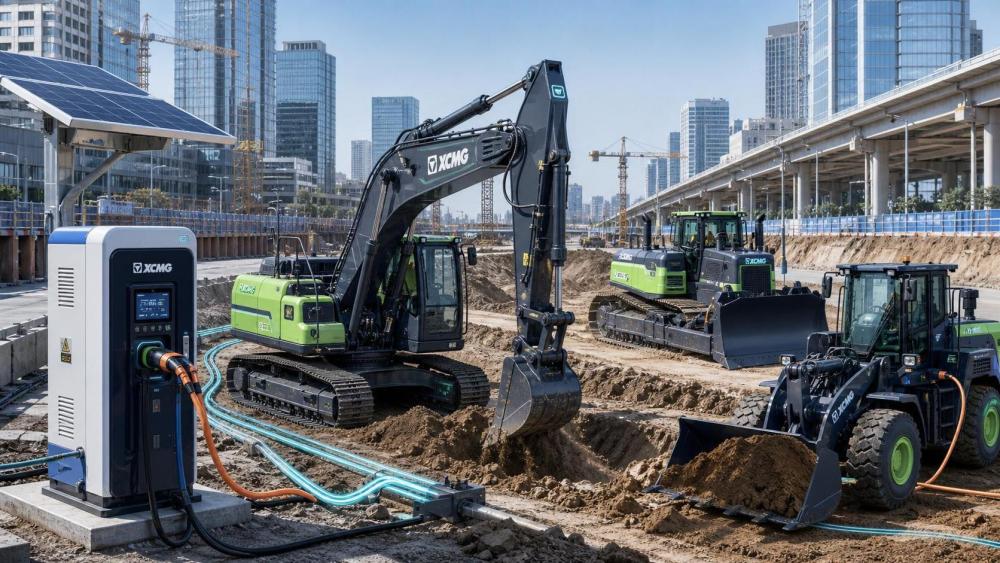
A 2026 job site will still look physical, noisy, and demanding. Yet underneath that familiar surface, heavy equipment is becoming part of a connected decision layer.
Production tracking, machine health, grade control, fuel burn, idle time, and operator behavior are now visible in ways that were difficult to standardize a few years ago.
This is especially visible in the categories followed closely by EMD. Crawler excavators are gaining smarter electro-hydraulic control. Motor graders are becoming more dependent on positioning intelligence. Bulldozers are integrating traction, blade control, and remote capability into a more unified workflow.
In practical terms, heavy equipment is moving from isolated iron to managed infrastructure assets. That changes how fleets are specified, how operators are trained, and how project risk is measured.
Electrification Will Expand, But Selectively
Electrification remains one of the most discussed heavy equipment trends, but 2026 will not be a uniform switch from diesel to battery power. The transition will be uneven by duty cycle, geography, and machine class.
Compact and mid-size machines are the most realistic early winners. Skid steers, mini excavators, and some wheel loaders fit better into charging windows, municipal regulations, and lower daily travel demands.
Large crawler excavators and bulldozers face a harder equation. High breakout force, long shifts, and remote project locations still favor advanced diesel, hybrid systems, or transitional power architectures.
The business issue is not whether electrification is coming. It is how quickly each machine category can adopt it without compromising runtime, payload movement, or charging logistics.
That means fleet planning in 2026 should separate symbolic decarbonization from workable decarbonization. The best heavy equipment choices will depend on energy access, site rotation, and utilization intensity.
Where electrification creates clear value
- Urban projects with strict noise and emissions limits
- Indoor, tunnel, or semi-enclosed construction environments
- Short-cycle fleets with predictable return-to-base patterns
- Rental applications where ease of operation is a selling point
Autonomy Will Grow Through Assisted Operations First
Fully autonomous heavy equipment will remain limited to controlled environments in 2026. Hazardous mines, repetitive haul routes, and isolated work zones will lead adoption.
The broader change will come through assisted operations. Machines will steer, grade, dig, and position with more software guidance, while the operator remains central to site judgment.
Excavators are a good example. Smarter electro-hydraulic proportional control can reduce over-digging, smooth bucket response, and shorten cycle time without forcing a full autonomous leap.
Motor graders show the same pattern. GPS, laser, and 3D site models are making blade accuracy less dependent on repeated manual correction. Precision is becoming a system capability, not just an operator skill.
This matters because autonomy should be judged by economic function. If assisted heavy equipment reduces rework, labor exposure, and fuel waste, it already changes the job site in a meaningful way.
Compliance and Reliability Will Shape Buying Decisions
Emissions regulation is no longer a background issue. In many markets, non-road equipment standards are becoming stricter, while public projects increasingly connect compliance to bidding credibility.
That creates a sharper divide between machines that merely meet minimum standards and heavy equipment platforms designed for regulatory durability over several years.
At the same time, reliability expectations are rising. A machine with advanced controls but poor parts support can become more disruptive than an older platform with fewer features.
This is where intelligence sources such as EMD add value. Tracking transmission efficiency, control logic, remote communication architecture, and macro infrastructure cycles helps separate headline innovation from operationally useful innovation.
In 2026, heavy equipment decisions will increasingly depend on the total confidence stack: compliance readiness, service access, software stability, hydraulic performance, and residual value.
Signals worth monitoring before fleet investment
Each Equipment Class Is Changing in a Different Way
One mistake in heavy equipment planning is to treat all categories as if they are following the same innovation curve. They are not.
Crawler excavators remain the strategic center of many fleets. In 2026, improvement will focus on hydraulic precision, semi-automated digging functions, lower fuel intensity, and better attachment integration.
Wheel loaders are being pushed toward faster material movement with tighter fuel discipline. In quarry, mining support, and bulk transfer, efficiency per ton moved is becoming a stronger buying metric.
Motor graders are becoming more digital than visual. Surface accuracy, especially in airports and road construction, increasingly depends on software, sensors, and site model quality.
Bulldozers are evolving around traction management, hydrostatic efficiency, and remote work capability. Their future is less about brute force alone and more about controllable pushing performance.
Skid steer loaders continue to benefit from urbanization and constrained sites. Their value in 2026 comes from attachment versatility, compact electrification potential, and fast redeployment across tasks.
What This Means for Cost, Risk, and Asset Strategy
The strongest fleets in 2026 will not necessarily own the newest heavy equipment. They will own machines aligned with their project mix, operator depth, emissions exposure, and maintenance discipline.
That raises the importance of asset utilization. A premium machine that sits idle, lacks charging support, or overwhelms the service team may destroy value despite impressive specifications.
By contrast, a well-matched machine can improve bid confidence, reduce labor friction, and stabilize job costing. This is especially relevant when infrastructure spending is active but margins remain under pressure.
The 2026 heavy equipment market also rewards standardization. Common control logic, shared telematics, and repeatable parts support can matter as much as headline performance on a demo site.
Useful decision filters
- Map machine choice to actual duty cycle, not marketing category
- Price energy and compliance risk over the full asset horizon
- Compare productivity with rework reduction, not output alone
- Test software usability as carefully as mechanical performance
- Review dealer support in remote and high-pressure operating conditions
A Practical Way to Read 2026
The most important heavy equipment trend in 2026 is convergence. Powertrain change, autonomy, grade control, telematics, and compliance are no longer separate conversations.
They now shape one another. A machine’s value depends on how these elements perform together in real production conditions.
For that reason, the next step is not chasing every new feature. It is building a clearer internal framework for evaluating site demands, machine roles, infrastructure constraints, and lifecycle economics.
Heavy equipment will continue to reshape the physical world in 2026. The advantage will belong to organizations that read these shifts early, compare platforms carefully, and turn equipment selection into a disciplined strategic decision.