
Related News
- 00
0000-00
How to size heavy-duty loaders for North American mining operations - 00
0000-00
How altitude affects mining excavator performance in Latin America - 00
0000-00
Caterpillar Launches New Cat 6060 and Upgraded Autonomous Mining System - 00
0000-00
When does eco-friendly construction equipment pay for itself? - 00
0000-00
Will a wheel loader quick coupler fit your existing attachments?
Electrified earthmoving equipment is entering a more serious adoption phase
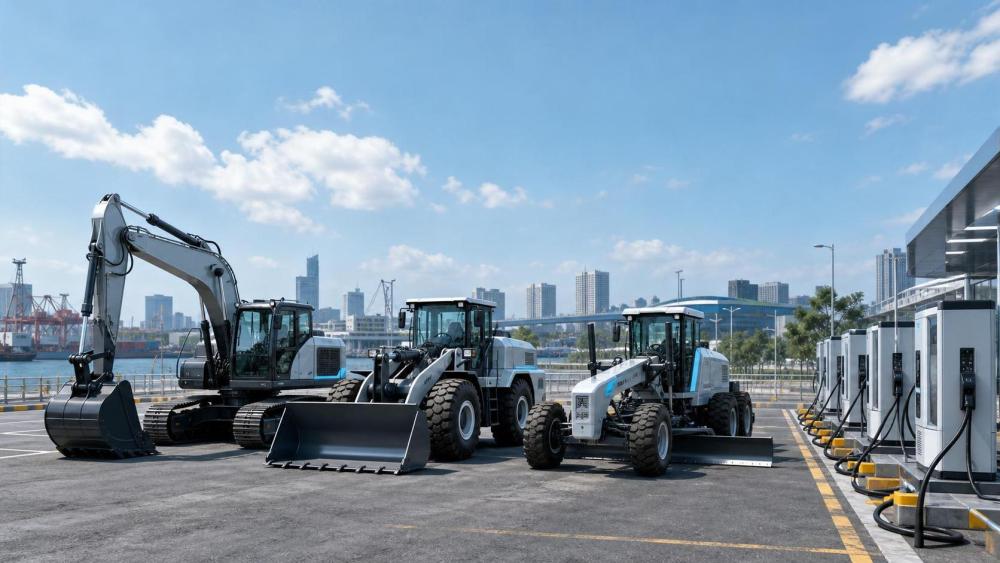
In 2026, electrified earthmoving equipment is no longer defined by isolated pilots or branding exercises. It is becoming part of real fleet planning.
That shift matters because infrastructure spending remains uneven, while emissions compliance and energy volatility keep tightening asset decisions.
The market signal is not that diesel disappears quickly. The stronger signal is that mixed fleets are becoming the working assumption.
Across crawler excavators, wheel loaders, motor graders, bulldozers, and skid steer loaders, the adoption curve now depends on task profile more than broad enthusiasm.
This is where the conversation has matured. Battery capacity alone is no longer the headline issue.
Business evaluation now centers on operating windows, charging access, hydraulic duty cycles, software integration, and residual value confidence.
Seen through the lens of EMD’s intelligence focus, electrified earthmoving equipment sits at the intersection of force, control precision, and decarbonization strategy.
That combination explains why adoption is accelerating in some segments, while remaining selective in the heaviest pushing and stripping applications.
Why the change is becoming more visible now
Several forces are converging at once, and they are changing how electrified earthmoving equipment is evaluated in 2026.
The first is regulation. Non-road emissions rules are getting harder to navigate, especially near cities, ports, tunnels, and public infrastructure sites.
The second is economics. Fuel costs remain exposed to regional shocks, while electricity pricing is becoming easier to model over long equipment cycles.
The third is technology readiness. OEMs are improving electro-hydraulic control, thermal management, and software diagnostics at the same time.
More importantly, these gains are showing up in work quality, not only in laboratory efficiency numbers.
On precision grading, for example, electric drivetrains pair naturally with GPS, laser sensing, and digital blade control.
On compact urban sites, quieter operation and better low-speed response can be as valuable as lower tailpipe emissions.
EMD has long tracked how performance credibility shapes heavy equipment demand. That remains true for electrified earthmoving equipment.
No market moves at scale until hydraulic responsiveness, payload rhythm, and uptime discipline look dependable under jobsite pressure.
The drivers are not equal across every machine class
The adoption pattern differs because each machine family carries different energy intensity, idle behavior, and space constraints.
Demand is shifting from machine ownership to system readiness
A notable 2026 change is that electrified earthmoving equipment is being judged as part of an operating system, not as a standalone unit.
Charging layout, power availability, fleet scheduling, and service response now shape purchase confidence as much as machine specifications.
This especially affects projects with fixed boundaries, repeatable shifts, and digital site coordination.
More fixed-cycle jobs can absorb charging windows without severe productivity loss. Remote, scattered, or multi-shift operations still face friction.
That is why adoption often starts with compact excavators, skid steers, and certain loaders before it reaches large bulldozers.
Another shift is data visibility. Connected machines now produce cleaner evidence on idle time, energy use, and attachment utilization.
For electrified earthmoving equipment, this data matters because utilization gaps can erase expected total cost benefits.
EMD’s emphasis on strategic intelligence is relevant here. The strongest market advantage comes from linking machine behavior with site workflow and energy infrastructure.
Where business pressure is being felt most
- Urban redevelopment projects where noise, air quality, and restricted working hours directly affect site productivity.
- Airports, ports, and municipal corridors where public visibility raises pressure for low-emission fleet choices.
- Mining support zones and enclosed industrial facilities where ventilation savings can improve the operating case.
- Road and grading programs where digital control systems already support more advanced machine management.
What this means for excavators, loaders, graders, and dozers
The market is not rewarding every category in the same way, and that distinction matters for realistic forecasting.
Crawler excavators remain central because they combine high hydraulic demand with broad application diversity.
In lighter excavation, trenching, and utility work, electrified earthmoving equipment can already offer competitive performance and better control smoothness.
Wheel loaders show promise in quarries, depots, and batch operations where routes are repetitive and charging can be planned around material flow.
Motor graders are a more specialized case. Their appeal comes less from headline energy savings and more from precision, low-speed modulation, and digital compatibility.
Bulldozers remain the toughest frontier. High tractive effort and long heavy pushes expose current battery limits quickly.
Even so, hybrid architectures and tethered or fast-charge concepts are keeping the segment under close watch.
Skid steer loaders may be the quiet winner. Their compact footprint, attachment flexibility, and dense urban usage make electrified earthmoving equipment especially practical here.
The real evaluation gap is between claimed performance and usable economics
One reason the market still feels cautious is that headline claims often hide major differences in operating assumptions.
Range estimates can depend on light duty cycles. Charging times may assume ideal power access. Maintenance savings may exclude software and battery service risks.
That is why electrified earthmoving equipment needs a more disciplined comparison frame in 2026.
A credible review usually tests five variables together, rather than isolating purchase price.
- Net productive hours under real hydraulic loads.
- Energy replenishment time within the actual shift pattern.
- Impact of ambient temperature on performance consistency.
- Software maturity for diagnostics, remote support, and fault isolation.
- Residual value confidence after battery aging and technology turnover.
When these factors are modeled together, some machines look investment-ready, while others still depend on subsidies, premium contracts, or restricted use cases.
The next signals to watch are less about hype and more about operating proof
The next stage for electrified earthmoving equipment will be decided by evidence from demanding sites, not by concept launches.
Three signals deserve close attention over the coming cycle.
- Whether OEMs can deliver standardized charging and service ecosystems across multiple machine classes.
- Whether large contractors and public programs begin specifying low-emission earthmoving performance in bid frameworks.
- Whether autonomous and remote-control features begin pairing more naturally with electric drivetrains and digital controls.
This final point is often underappreciated. Electric platforms can simplify certain control architectures and improve response consistency for automated tasks.
For an intelligence platform like EMD, that matters because electrification is not an isolated trend. It is tied to autonomy, precision grading, and asset utilization.
The practical next step is to compare electrified earthmoving equipment by job pattern, infrastructure access, and OEM support depth, rather than by headline category alone.
A staged assessment works best: map high-fit applications first, validate energy workflow second, then track total cost against uptime and resale assumptions.
That approach will reveal where adoption is commercially durable, where it is still early, and where the next market advantage is likely to emerge.