
Related News
- 00
0000-00
How to size heavy-duty loaders for North American mining operations - 00
0000-00
How altitude affects mining excavator performance in Latin America - 00
0000-00
Caterpillar Launches New Cat 6060 and Upgraded Autonomous Mining System - 00
0000-00
When does eco-friendly construction equipment pay for itself? - 00
0000-00
Will a wheel loader quick coupler fit your existing attachments?
Which construction machinery components usually decide uptime first?
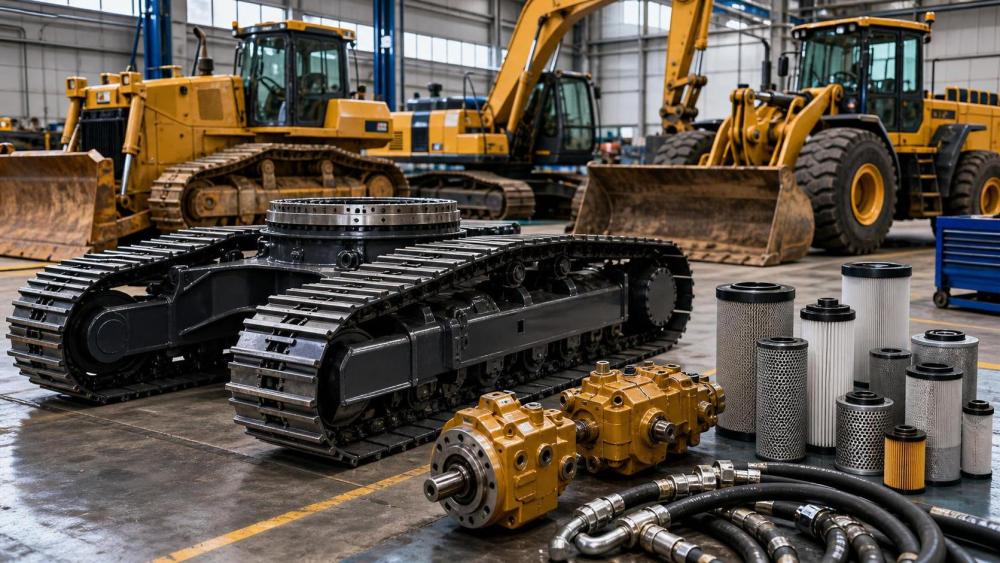
Maintenance cost rarely starts with one dramatic failure. It usually grows through repeat downtime, delayed troubleshooting, and parts replaced too late.
That is why construction machinery components deserve attention as cost drivers, not just spare items on a shelf.
Across crawler excavators, wheel loaders, motor graders, bulldozers, and skid steer loaders, the same pattern appears.
A small group of parts controls most of the maintenance budget and a large share of unplanned stoppages.
In practical service work, the highest-impact construction machinery components are usually these:
- Hydraulic pumps, valves, hoses, and cylinder sealing kits
- Undercarriage parts such as tracks, rollers, sprockets, and idlers
- Engine air, fuel, and hydraulic filtration systems
- Pins, bushings, wear edges, and bucket ground engaging tools
- Sensors, wiring harnesses, joysticks, and electronic control modules
EMD’s coverage of heavy earthmoving equipment shows why this matters more now.
Machines are becoming more precise, more automated, and more dependent on clean hydraulic and electronic performance.
When a grader loses position accuracy, or an excavator suffers pressure instability, uptime drops before total failure appears.
So the real question is not only which parts wear out. It is which parts create secondary failures when ignored.
Why do hydraulic and undercarriage parts consume so much of the budget?
Because they work at the highest load, in the dirtiest environment, and with the lowest tolerance for neglect.
On crawler excavators and bulldozers, undercarriage wear can absorb a major share of total operating cost.
Track chain pitch extension, roller leakage, and sprocket wear do not stay isolated for long.
Once alignment degrades, vibration rises and travel efficiency falls. Fuel use increases while wear accelerates across the whole assembly.
Hydraulic systems behave in a similar way, but the damage path is less visible.
A weak main pump, contaminated oil, or unstable proportional valve can reduce breakout force, travel response, and attachment control.
On high-intensity loading machinery, that often shows up as cycle-time loss before a fault code appears.
The cost problem becomes sharper when one failed component contaminates others.
Metal debris from a hydraulic pump can spread through valves and actuators. A failed seal can ruin a much larger assembly.
That is why these construction machinery components should be monitored by condition, not only by replacement interval.
How can you tell whether a part is truly high-risk or just routinely worn?
A useful check is to separate cosmetic wear from uptime-critical degradation.
Some construction machinery components are consumed normally. Others trigger downtime cascades.
The table below helps sort that difference during inspection planning.
This kind of sorting is especially useful on mixed fleets, where not every machine justifies the same stocking strategy.
More advanced graders and remote-ready excavators need closer attention to electronics than older mechanical platforms.
Are cheaper construction machinery components really saving money?
Sometimes yes, but only when the part has low failure consequence and stable quality control.
That is where many maintenance budgets drift off target.
Price comparison alone can be misleading because different construction machinery components carry very different risk profiles.
A lower-cost cutting edge or standard hose may be acceptable if material specification and fit are proven.
A low-grade seal kit inside a main hydraulic cylinder is a different decision entirely.
More common mistakes include these:
- Buying by unit price instead of installed cost
- Ignoring contamination sensitivity in hydraulic parts
- Mixing undercarriage wear levels across one track system
- Replacing sensors without checking wiring and grounding
- Using standard intervals in unusually abrasive or wet applications
EMD often highlights how machine design is shifting toward precision control, emissions compliance, and automation support.
That trend makes component quality more visible in daily performance, especially in electro-hydraulic systems.
In other words, low purchase price can still produce the highest cost per operating hour.
What should be stocked first when downtime is expensive?
The best stock list is built from failure consequence, lead time, and fleet commonality.
Routine fast movers should not be treated the same as long-lead critical assemblies.
A practical stocking structure for construction machinery components usually looks like this:
- Tier 1: filters, seals, hoses, sensor connectors, wear edges, and common pin kits
- Tier 2: travel motor seals, solenoid valves, injectors, joysticks, and roller groups
- Tier 3: pumps, control modules, final drives, and matched undercarriage packages
The point is not to stock everything. It is to avoid waiting weeks for one known failure point.
For wheel loaders and skid steers, hose assemblies and electrical connectors often deserve higher priority than expected.
For bulldozers and excavators in abrasive ground, undercarriage measurement tools can save more money than extra emergency stock.
For motor graders, sensors tied to blade control and positioning should be treated as uptime parts, not just electronics.
How do smarter diagnostics change the way these parts are managed?
They shift maintenance from reaction to evidence.
That matters because modern construction machinery components fail less like isolated mechanical pieces and more like connected systems.
A pressure sensor issue can mimic pump wear. A software calibration fault can look like valve instability.
On precision grading equipment, inaccurate feedback signals can create rework long before a visible breakdown.
Useful diagnostic habits include:
- Trend hydraulic pressure, temperature, and cycle response together
- Use oil sampling before major hydraulic replacement decisions
- Record undercarriage wear by measurement, not visual estimate alone
- Check harness routing near articulation, vibration, and heat sources
- Link fault codes to actual machine behavior before ordering parts
This is where EMD’s intelligence-led perspective is useful.
As electrification, autonomy, and remote control spread, parts planning must reflect both mechanical wear and signal integrity.
That broader view helps reduce unnecessary replacement and protects uptime more effectively.
So where should the next cost review begin?
Start with the construction machinery components that combine three traits: high failure consequence, short diagnostic clarity, and long replacement delay.
In many fleets, that means hydraulic parts, undercarriage systems, contamination-control items, and critical electronics.
Then compare spend by component family against actual downtime hours, not invoice totals alone.
That usually reveals where routine wear is acceptable and where hidden failures are draining availability.
A useful next step is to build a simple review sheet for every major machine group.
Track top failure parts, lead time, contamination history, wear trend, and whether the last replacement solved the root cause.
When those records are tied to machine type and application severity, decisions become much clearer.
That is how construction machinery components move from spare parts administration into real uptime control.