
Related News
- 00
0000-00
How Middle East climate conditions should shape heavy equipment selection - 00
0000-00
Can an industrial equipment sourcing supplier directory improve vendor selection? - 00
0000-00
How earthmoving equipment is applied in canal construction - 00
0000-00
Which accuracy metrics matter in autonomous construction control software? - 00
0000-00
What to verify in an earthmoving equipment supplier reference
How Middle East Climate Conditions Should Shape Heavy Equipment Selection
For project managers operating across the Gulf, desert interiors, and fast-growing urban corridors, heavy equipment selection Middle East is a strategic decision shaped by extreme heat, abrasive dust, unstable ground conditions, and demanding uptime targets. From crawler excavators and wheel loaders to bulldozers and motor graders, the right machine configuration can protect productivity, reduce lifecycle costs, and keep critical infrastructure schedules on track.
The mistake is to treat “Middle East conditions” as one operating environment. A road package in a dry inland corridor, a coastal industrial expansion, a quarry in rocky terrain, and a dense urban utility project may all sit within the same region while imposing very different demands on cooling, filtration, undercarriage, tyres, visibility, and service planning. Climate is only one input, but it changes how every other input should be interpreted.
A machine with enough rated power on paper can still become a poor project asset if its cooling package clogs rapidly, its cab does not protect operators through long shifts, or its local parts support cannot keep pace with a high-utilisation site. The practical question is not simply which machine is biggest or cheapest. It is which configuration can keep working predictably in the site’s actual heat, dust, surface conditions, and work cycle.
Heat Changes the Meaning of Machine Performance
High ambient temperatures put the entire machine under pressure. Cooling systems have less temperature margin. Hydraulic oil, engine oil, transmission components, batteries, electronic controls, and air-conditioning systems all operate in a more demanding environment. In earthmoving work, that stress is amplified by repeated loading cycles, long travel distances, steep pushes, or sustained hydraulic attachment use.
This does not mean every project needs the largest available cooling system or the highest engine output. It means the cooling package should be evaluated against the duty cycle rather than viewed as a catalogue line. A wheel loader feeding a crusher continuously faces a different thermal pattern from a loader handling intermittent stockpile work. An excavator trenching deep utility routes may spend long periods at high hydraulic demand, while a skid steer in an urban site may face shorter, stop-start cycles but greater cab heat load and restricted airflow.
During procurement reviews, project teams should ask suppliers to clarify the machine’s intended ambient operating range, derating behaviour, fan control strategy, radiator access, and warning logic for elevated coolant or hydraulic oil temperatures. The answers matter more than broad claims about “hot climate readiness.” A well-designed system is not only capable of rejecting heat; it can be inspected, cleaned, and serviced without turning routine maintenance into a major interruption.
Operator comfort belongs in the same discussion. In very hot conditions, an effective pressurised cab and reliable HVAC system influence concentration, reaction time, and shift consistency. For graders working to tight levels, or excavators operating near services and structures, visibility and operator alertness are operational controls, not comfort extras. Cab filtration, sun protection, seat ventilation where available, and access to replacement HVAC components should be assessed alongside engine and hydraulic performance.
Dust Is an Abrasive Operating Cost, Not Just a Housekeeping Issue
Fine sand and airborne dust enter every decision. They challenge engine air intake systems, cab filters, cooler cores, electrical connectors, pins and bushes, brake components, and the seals around moving structures. On a wind-exposed site, dust can also compromise camera lenses, machine guidance sensors, and the visibility of grade references.
The most useful selection criterion is maintainable filtration. Look beyond the number of filters listed in a brochure. Can the air filter be inspected safely? Is there a clear restriction indicator? Does the pre-cleaner arrangement match the expected dust loading? Can technicians clean cooler packs without damaging fins or leaving compacted material behind? A machine that requires difficult daily access may receive inconsistent maintenance when schedules tighten.
Dust also changes the value of protection around vulnerable systems. Sealed connectors, protected routing for hoses and wiring, guarded cylinder rods, and robust access covers can reduce avoidable exposure. These details are especially relevant on equipment expected to work across undeveloped plots before roads, drainage, and wash facilities are in place.
For motor graders and other precision machines, the sensor environment deserves a separate review. GPS, laser, and machine-control systems can improve grading consistency, but they must be matched to site conditions and maintenance discipline. Dust on receivers or cameras, damaged cables, weak correction coverage, and poorly trained operators can erase the expected benefit. The right decision is often not “guidance or no guidance,” but which level of guidance the site can support reliably.
Ground Conditions Determine Whether Tracks, Tyres, and Weight Work for You
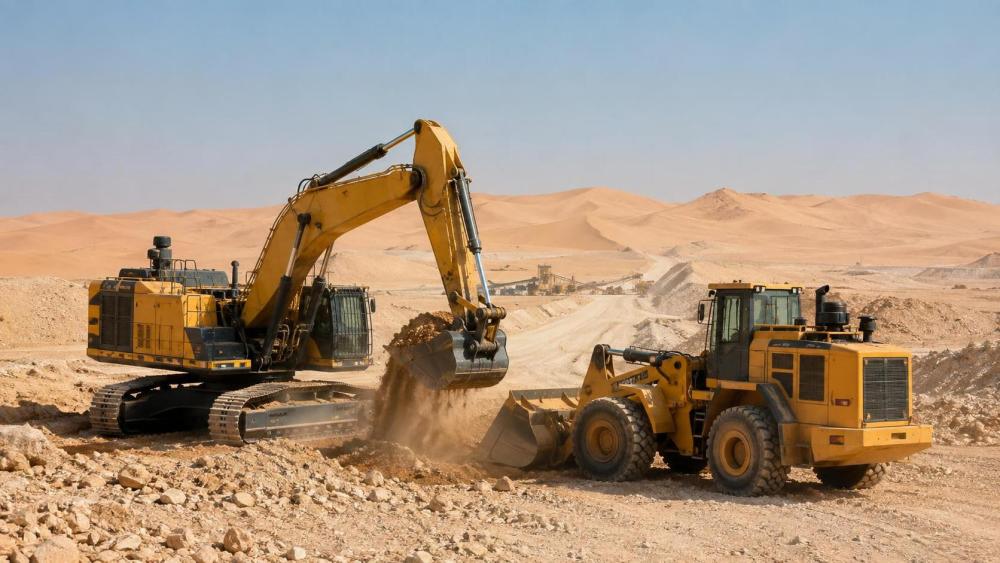
Desert terrain is not automatically easy terrain. Loose sand, compacted fill, caliche-like hard layers, rocky ground, reclaimed coastal land, and partially prepared urban sites present different traction and flotation problems. Machine weight, ground pressure, track width, tyre pattern, axle configuration, and work-tool choice all affect how efficiently the machine converts power into useful work.
Crawler excavators and bulldozers are often favoured where traction and stability matter more than travel speed. Wider track shoes can help reduce ground pressure in softer material, yet they are not automatically the answer. On abrasive or rocky terrain, shoe selection must account for wear, side loading, turning behaviour, and transport constraints. An overly broad shoe can be less suitable where the machine must work around trench edges, compact platforms, or hard uneven surfaces.
Wheel loaders need a similarly specific review. Tyre choice should reflect material, haul distance, heat build-up, cut resistance, and the likelihood of sharp debris. A loader that repeatedly travels across rough blasted rock faces a different tyre risk from one handling sand or aggregate on maintained haul roads. The procurement team should evaluate tyre availability locally, expected replacement lead times, and whether the wheel-and-tyre package supports the required payload without creating unnecessary ride, traction, or maintenance penalties.
On coastal developments, salinity and moisture may be as important as heat. Corrosion protection, paint quality, electrical sealing, storage procedures, and regular wash-down plans deserve attention. These factors are often overlooked when specifications focus only on desert heat, even though a port, marine works, or reclaimed-land project may expose equipment to a very different combination of contaminants.
Match the Machine to the Work Cycle Before Choosing the Model
Equipment categories provide a starting point, not a final answer. A crawler excavator may be the core production machine for bulk excavation, deep trenching, rock handling, or heavy lifting within its rated limits. Its selection should turn on digging depth, reach, bucket capacity, breakout force, lift requirements, attachment demand, transport method, and ground bearing conditions. In hot, dusty work, service access and cooling resilience should sit beside those familiar specifications.
Wheel loaders are defined by the complete loading system: bucket size, material density, boom configuration, tipping load, cycle time, truck match, and travel route. Selecting an oversized bucket for light material may look productive until it creates stability concerns or poor truck loading control. Selecting too small a machine for dense aggregate can extend cycle times and increase fuel and tyre exposure. The target is a stable, repeatable cycle rather than a theoretical maximum payload.
Bulldozers should be evaluated as traction and control systems, not merely as pushing machines. Blade type, undercarriage configuration, ripper requirement, slope conditions, material type, and finish tolerance all matter. For mass earthworks, a machine that can maintain traction through variable material may outperform a nominally more powerful unit that loses efficiency through track slip or poor blade matching. Where finish levels affect downstream paving or drainage, machine-control readiness may deserve consideration early rather than being added after mobilisation.
Motor graders require the most disciplined application review. Their value is tied to blade control, articulation, drawbar performance, visibility, tyre condition, and the operator’s ability to maintain the required surface. Airport, road, and large-platform projects may justify advanced grade-control systems, but the project must also establish calibration, digital design-file management, and field verification processes. Precision hardware cannot compensate for incomplete site control.
Skid steer loaders and compact equipment deserve attention in rapidly developing urban corridors. Their advantage is manoeuvrability and attachment versatility, particularly in constrained utility, landscaping, demolition, and finishing work. Yet compact size should not be confused with low operating risk. Cooling airflow, debris management, attachment hydraulic demand, and safe operation on loose or uneven ground are still decisive.
A Practical Climate-Adjusted Selection Review
Before finalising a fleet, it helps to separate “must-have” operating protections from optional features. The table below is not a universal specification; it is a structured way to turn site conditions into questions that can be answered by machine data, dealer support commitments, and the project’s own operating plan.
Uptime Depends on Support Architecture, Not Only Machine Design
A climate-ready specification is incomplete without a maintenance and support plan. Remote desert projects can have limited workshop access, while urban projects may have strict working hours that leave little room for repairs. In both cases, the availability of filters, hoses, seals, wear parts, fluids, tyres, and trained technicians can affect schedule risk more than a marginal difference in purchase price.
Project leaders should clarify which service items will be held on site, who owns daily inspections, how fluid cleanliness is controlled, and how machine health alerts are handled. Telematics can help identify idle time, fault codes, excessive temperatures, or maintenance intervals, but it only has value when someone is assigned to review the information and act on it. The same is true of remote support: low-latency communications and remote diagnostics may be useful in hazardous or isolated operations, but network availability, cybersecurity requirements, and local response procedures need confirmation.
This is also where fleet commonality can be valuable. Standardising selected machine families, attachments, fluids, and service processes may simplify technician training and spare-parts planning. It should not become an excuse to force one machine into every task. A common fleet is helpful only when it still fits the site’s production, terrain, and safety requirements.
Make the Decision on Lifecycle Exposure
The strongest heavy equipment selection Middle East process begins with a site-specific operating profile: material characteristics, expected temperature exposure, dust severity, terrain, daily hours, travel distances, attachments, grade tolerance, fuel or charging strategy, and available maintenance support. That profile should then be tested against the proposed machine’s actual configuration, not its generic product category.
The Global Earth-Mover Dynamics (EMD) follows this intersection of machine physics, digital precision, and project reality across crawler excavators, wheel loaders, motor graders, bulldozers, and skid steers. For decision-makers, the useful perspective is to connect hydraulic breakout force and tractive effort with thermal resilience, service access, machine-control readiness, and the transition toward lower-emission or increasingly autonomous equipment where the project can support it.
Before committing, request configuration-specific documentation, inspect access points where possible, review local support capacity, and run the expected duty cycle through a realistic operating-cost model. In the Middle East, climate rarely causes a single dramatic failure. More often, it exposes small selection errors every day until lost time, wear, and maintenance complexity accumulate. Choosing for those conditions early is usually easier than correcting for them after mobilisation.