
Related News
- 00
0000-00
How much does a 3D grader guidance system cost fully installed? - 00
0000-00
How to verify capacity before sourcing equipment from manufacturers - 00
0000-00
When to choose LGP dozers for infrastructure site preparation - 00
0000-00
How to size heavy-duty loaders for North American mining operations - 00
0000-00
How altitude affects mining excavator performance in Latin America
Tags
- crawler excavators
- wheel loaders
- motor graders
- bulldozers
- skid steer loaders
- earthmoving equipment
- hydrostatic transmission
- precision grading equipment
- loading machinery
- earthmoving equipment supplier reference
- hydrostatic transmission efficiency
- crawler excavator
- wheel loader
- motor grader
- bulldozer
- skid steer loader
- wheel loader for aggregate handling
What to Verify in an Earthmoving Equipment Supplier Reference
Before committing capital to heavy machinery, procurement teams need more than a supplier’s brochure or price list. A thorough earthmoving equipment supplier reference can reveal real-world reliability, parts availability, service response times, operator support, and lifecycle value across demanding jobsites. This matters whether the requirement is a crawler excavator for bulk excavation, a wheel loader for aggregate handling, a motor grader for road finishing, a bulldozer for heavy pushing, or a skid steer loader working in restricted urban spaces.
A reference check is not simply a request for three customer names. It is a structured attempt to compare what the supplier promises with what equipment owners actually experience after delivery. The most useful references are similar in application, working hours, climate, duty cycle, fleet size, and service environment. A supplier that performs well on light municipal work may not be the right partner for quarry loading, mine stripping, high-temperature construction, or remote infrastructure projects.
Start with references that match the intended duty cycle
The first question is not “Is this supplier reputable?” It is “Reputable for what?” Equipment performance is closely tied to the conditions in which it works. A reference for a compact excavator used intermittently on landscaping projects may provide little insight into a large crawler excavator operating long shifts in abrasive soil. Similarly, a skid steer loader reference should be assessed alongside attachment use, hydraulic flow requirements, surface conditions, and the frequency of transport between sites.
Ask the supplier to identify references with a comparable operating profile, while remembering that supplier-selected references are naturally positive. Procurement teams should request permission to speak with owners or fleet managers directly and, where possible, seek independent opinions from contractors, maintenance providers, rental companies, or dealers familiar with the same equipment category.
- What material does the machine handle, cut, push, or grade?
- How many hours does it typically work each month?
- Does it operate in a remote, dusty, cold, hot, or high-altitude environment?
- Is the machine used by one trained team or by rotating operators?
- Are attachments, 3D control systems, telematics, or remote-operation functions part of the work?
These questions help separate a genuine performance reference from a convenient but weak comparison.
Verify reliability through maintenance records, not adjectives
Terms such as “reliable,” “durable,” and “low maintenance” are too broad to support a purchasing decision. Ask how the owner defines reliability and what records can substantiate the answer. Useful evidence may include scheduled maintenance history, unscheduled repair events, parts replacement patterns, warranty claims, and the time required to return a machine to operation.
The goal is not to demand a universal failure rate. Different sites maintain machines differently, and a reference owner may not disclose complete operational data. Instead, look for patterns. Repeated hydraulic leaks, premature undercarriage wear, overheating, electrical faults, transmission problems, or attachment-related failures may indicate a mismatch between the machine and the duty cycle—or weaknesses in support and setup.
For crawler excavators and bulldozers, undercarriage condition deserves particular attention because tracks, rollers, idlers, sprockets, and related components can be heavily affected by abrasive ground and operating technique. For wheel loaders, examine the relationship between bucket loading, tire wear, articulation components, axle performance, and cycle productivity. For motor graders, reliability also includes the stability of control systems, sensors, hydraulic functions, and blade positioning equipment. The correct verification points vary by machine type.
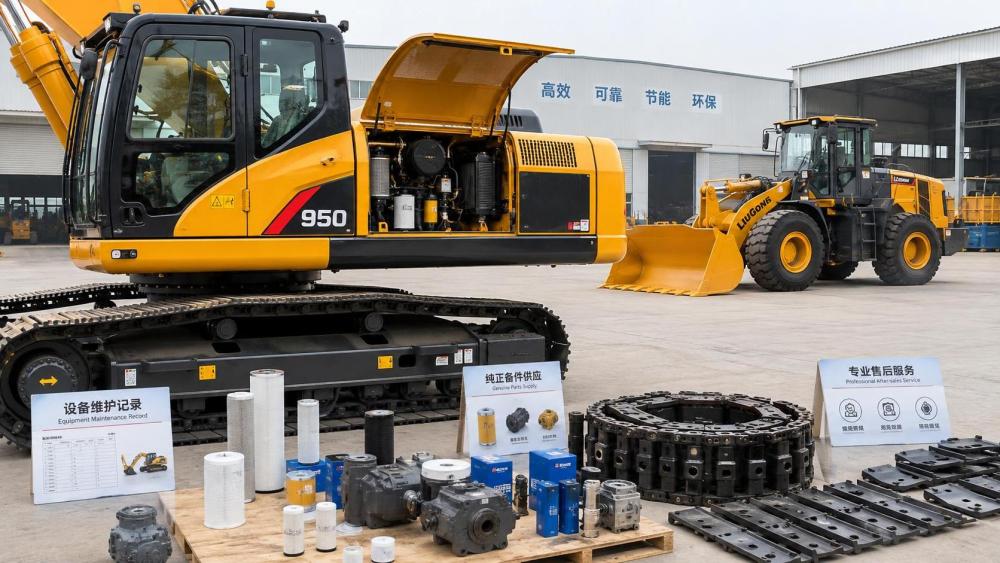
Ask how the supplier responds when production stops
A machine that cannot work because of a missing seal, sensor, hose, filter, or control component can create more cost than the original part price suggests. Reference calls should therefore examine service behavior under pressure, not only routine maintenance.
Ask the reference owner to describe the most serious service issue they experienced and what happened next. How quickly did the supplier acknowledge the problem? Was remote troubleshooting available? Did a technician arrive with the correct diagnostic tools and parts? Was the root cause explained clearly, or was the issue treated as a series of temporary repairs?
Also verify the actual service structure in the equipment’s working region. A global brand name does not automatically mean local support capacity. Procurement teams should confirm whether assistance comes from a factory representative, an authorized dealer, an independent service partner, or a subcontractor. Each model can affect response time, technical authority, warranty handling, and parts access.
Parts availability requires more than a warehouse claim
Ask which parts are stocked locally, which are imported, and which have longer replenishment cycles. Critical assemblies such as hydraulic pumps, travel motors, electronic controllers, transmission components, or machine-specific sensors may follow a different supply path from routine filters and wear parts. The supplier should be able to explain ordering procedures, part identification, supersession rules, and escalation channels.
A strong reference can reveal whether these processes work in practice. It is worth asking if the owner has ever had to use an emergency parts order, how accurately the supplier identified the failed component, and whether substitute parts or temporary solutions were clearly controlled.
Check operator support and commissioning quality
Even well-designed equipment can underperform when operators are unfamiliar with its controls, work modes, attachment limits, or daily inspection requirements. A supplier reference should therefore cover commissioning, handover, operator training, and post-delivery support.
Ask whether the supplier helped configure the machine for its actual application. For an excavator, that may involve selecting the correct boom, arm, bucket, hydraulic attachment circuit, or operating mode. For a grader, it may involve integrating GPS, laser, or 3D machine-control equipment and confirming how calibration is managed. For a skid steer loader, auxiliary hydraulic compatibility and attachment changeover can determine whether the machine is genuinely versatile or merely advertised as such.
Training should not be judged by whether someone delivered a manual. Ask whether operators learned safe startup and shutdown procedures, inspection routines, efficient control habits, and fault-code interpretation. If the equipment includes telematics, semi-autonomous functions, or remote-control architecture, confirm who trains users and who is responsible for system updates and troubleshooting.
Look beyond purchase price to lifecycle value
The lowest quoted price may not be the lowest-cost procurement decision. A reference check should help estimate the practical cost of ownership, even when precise numbers are unavailable. Discuss fuel or energy consumption in comparable work, routine service intervals, wear-part life, tire or undercarriage replacement, software or telematics fees, technician requirements, and expected resale or redeployment options.
The comparison must remain application-specific. A grader with advanced positioning technology may justify its cost where finish accuracy and rework control matter, but not every project needs the same level of digital integration. An electric compact machine may suit an urban site with charging access and noise constraints, while a remote bulk-earthmoving operation may require a different energy and service plan. Decarbonization is changing equipment selection, but the practical answer depends on duty cycle, infrastructure, local requirements, and total operating conditions.
Ask reference owners whether the supplier was transparent about these trade-offs. A credible partner should be willing to explain where a technology fits, where it does not, and which assumptions affect the business case.
Confirm delivery, documentation, and compliance responsibilities
Delivery risk often appears before the machine reaches the jobsite. Reference checks should cover whether the supplier delivered the specified configuration, met the agreed schedule, supplied complete technical documentation, and handled commissioning without shifting unexpected work to the buyer.
For international procurement, verify the practical details: shipping condition, spare-parts packaging, manuals in the required language, service documentation, training materials, warranty terms, and responsibilities for import or local registration. Emission requirements, safety rules, machine-control compatibility, and electrical standards can differ by market. These matters usually need confirmation against the destination country’s current requirements and the exact equipment configuration; they should not be assumed from a general product brochure.
Ask references whether promised documentation arrived before or after the machine, whether technical changes were communicated, and whether warranty exclusions were understood at the time of purchase. Disputes often begin with assumptions that were never written into the supply agreement.
Use the reference call to test commercial honesty
The most revealing question may be: “What would you verify more carefully if you were buying this equipment again?” A candid answer can uncover limitations that a formal testimonial will not mention. Listen for comments about slow communication, unclear warranty boundaries, difficult software integration, operator turnover, unusual consumable costs, or dependence on one local technician.
It is also useful to ask why the customer selected the supplier, what alternatives were considered, and whether the supplier’s performance changed after the sale. A reference that praises the machine but criticizes after-sales support should not be dismissed; it may indicate that the equipment is sound while the ownership risk remains high.
Keep written notes and score references against the same criteria. Separate verified evidence from personal impressions, and distinguish equipment problems from operator practice, site conditions, or maintenance quality. This prevents one enthusiastic or negative conversation from dominating the decision.
A reference is one part of a wider procurement decision
A supplier reference cannot replace technical inspection, application trials, contract review, or a clear total-cost assessment. It is most valuable when used to challenge assumptions before they become expensive commitments. The final shortlist should connect the reference findings with machine capacity, hydraulic performance, control precision, attachment compatibility, energy requirements, service coverage, and project schedule.
This broader view is central to the work of Global Earth-Mover Dynamics (EMD), an intelligence portal focused on crawler excavators, loading machinery, precision grading equipment, bulldozers, and skid steer loaders. EMD’s perspective links machine mechanics with the wider infrastructure system: hydraulic breakout force, hydrostatic transmission efficiency, electro-hydraulic control response, 3D positioning, emission transitions, and remote-operation requirements all influence how procurement risk should be assessed.
Before approval, ask the supplier to provide evidence for the specific application rather than general reputation. Confirm who will support the machine after delivery, which parts and skills are available locally, what the warranty actually covers, and which assumptions still require validation. A well-chosen earthmoving equipment supplier reference does not make the decision on its own. It makes the remaining risks visible enough to negotiate, budget, and manage.