
Related News
- 00
0000-00
How to size heavy-duty loaders for North American mining operations - 00
0000-00
How altitude affects mining excavator performance in Latin America - 00
0000-00
Caterpillar Launches New Cat 6060 and Upgraded Autonomous Mining System - 00
0000-00
When does eco-friendly construction equipment pay for itself? - 00
0000-00
Will a wheel loader quick coupler fit your existing attachments?
Construction equipment trends are moving faster than many expected. Electrification, automation, emissions compliance, and connected fleet systems are no longer fringe topics.
They now shape machine design, project economics, maintenance planning, and equipment lifecycle decisions across the broader industrial landscape.
For earthmoving equipment, the biggest shifts are visible in crawler excavators, wheel loaders, motor graders, bulldozers, and skid steer loaders.
These segments reveal how infrastructure demand, digital control, and decarbonization are converging into one new operating model.
Understanding construction equipment trends matters now because machine capability alone is no longer enough. Intelligence, compliance, uptime, and energy efficiency increasingly define real value.
What Construction Equipment Trends Mean in Today’s Market
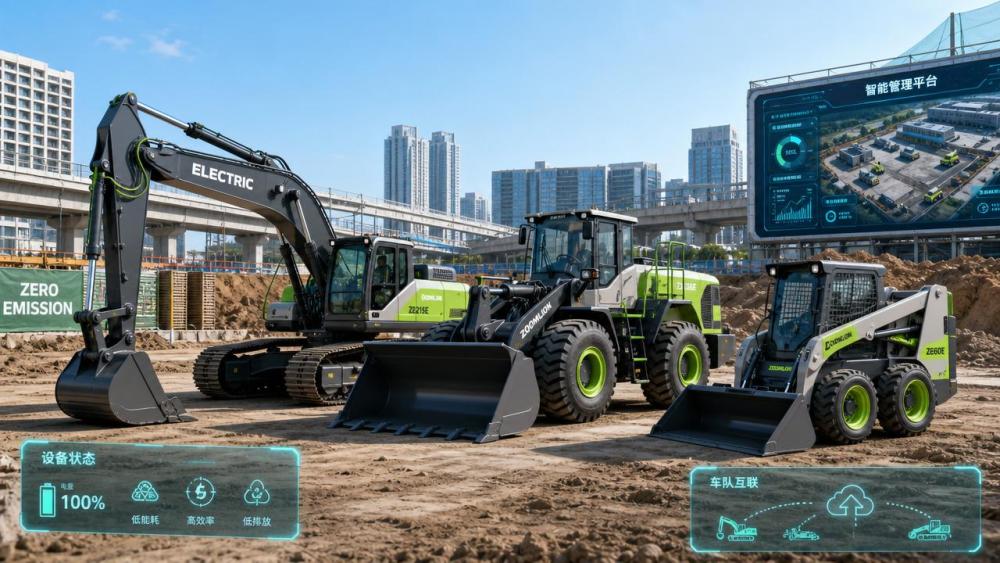
At a basic level, construction equipment trends describe the major technical, commercial, and regulatory changes influencing machine development and field performance.
These trends affect how equipment is powered, controlled, monitored, serviced, and integrated into jobsite workflows.
In practical terms, current construction equipment trends center on five connected themes:
- Low-emission and electric powertrains
- Autonomous and semi-autonomous functions
- Precision guidance and digital jobsite control
- Telematics, diagnostics, and predictive maintenance
- Platform flexibility for changing project demands
For a portal focused on earthmoving dynamics, these shifts are especially important because heavy machines remain central to global infrastructure productivity.
The strongest signals often appear first in high-duty equipment, where fuel use, hydraulic efficiency, and uptime create immediate operational consequences.
Industry Signals That Deserve Immediate Attention
Several market indicators explain why construction equipment trends have become more urgent across the comprehensive industrial sector.
Among all construction equipment trends, emissions compliance is one of the strongest forces because it affects every stage of machine development.
At the same time, data connectivity has become a competitive baseline rather than a premium extra.
Machines are now expected to report health status, utilization, fault codes, fuel patterns, and maintenance intervals in near real time.
The Shifts Affecting Earthmoving Equipment Most
Electrification Beyond Small Equipment
Battery-electric compact loaders and mini-excavators are expanding, especially where noise limits and indoor work create clear benefits.
The larger question is how electrification scales into heavier crawler excavators, wheel loaders, and dozers with demanding duty cycles.
This makes energy density, charging strategy, and thermal management central to future construction equipment trends.
Smarter Hydraulic and Electro-Hydraulic Control
Hydraulics remain the heart of earthmoving performance. The trend is not replacing hydraulics, but making them more responsive, efficient, and digitally controlled.
Electro-hydraulic proportional systems support finer motion control, lower wasted energy, and better integration with assist and autonomous functions.
Automation Moving from Pilot to Practice
Automation is progressing in layers. First came guidance, then grade control, then operator assistance, and now remote or semi-autonomous task execution.
In hazardous mines and sensitive sites, low-latency remote operation is becoming one of the most practical construction equipment trends to watch.
Precision Workflows as a Productivity Driver
Motor graders and excavators increasingly rely on GPS, IMU, laser, and 3D modeling inputs.
The goal is not only cleaner finish quality. It is fewer passes, reduced rework, and lower total project cost.
Why These Construction Equipment Trends Matter for Business Value
The business impact of construction equipment trends goes well beyond technology headlines. The real question is how these changes improve measurable outcomes.
- Higher uptime through predictive maintenance and remote diagnostics
- Better fuel economy through optimized hydraulic and engine control
- Improved site safety through automation and remote operation
- Tighter grading accuracy through digital guidance systems
- Stronger residual value through compliance-ready machine platforms
These factors matter because equipment investment is increasingly judged by lifecycle performance rather than purchase price alone.
For example, a bulldozer with efficient hydrostatic transmission and remote diagnostics may reduce unplanned stoppage enough to justify a higher initial cost.
Likewise, a motor grader using advanced sensing can create value through surface precision, lower material waste, and faster project completion.
Representative Equipment Categories and Trend Direction
This comparison shows that construction equipment trends do not move at the same speed across every category.
Compact platforms often lead electrification, while larger earthmovers lead in automation, hydraulic refinement, and remote-control architecture.
Practical Considerations When Evaluating Current Shifts
Not every trend should be adopted at once. Useful evaluation starts with operating environment, duty intensity, and support readiness.
- Match powertrain choices to actual duty cycles and charging or fueling infrastructure.
- Review telematics quality, data ownership, and integration with maintenance workflows.
- Check whether automation features reduce rework, idle time, or safety exposure.
- Assess sensor durability in dust, vibration, heat, and high-shock conditions.
- Compare lifecycle service support, software updates, and spare parts availability.
These steps help separate meaningful construction equipment trends from short-lived feature marketing.
In many cases, the most valuable upgrade is not the most dramatic one. It may be improved diagnostics, better attachment control, or cleaner grade data.
Priority Areas for the Next Stage of Observation
Looking ahead, the most important construction equipment trends will likely combine mechanical strength with software intelligence.
Three areas deserve especially close monitoring:
- Scalable electrification for heavier earthmoving classes
- Reliable remote and semi-autonomous operation in harsh sites
- Integrated machine intelligence linking sensors, hydraulics, and fleet analytics
For EMD’s field of focus, this is where breakout force, grading precision, and decarbonization goals will increasingly intersect.
Construction equipment trends matter most now when they improve measurable performance under real site conditions, not just in controlled demonstrations.
A practical next step is to track one equipment category, one operating metric, and one emerging technology at the same time.
That approach makes construction equipment trends easier to compare, validate, and apply with confidence as the market continues to evolve.