
Related News
- 00
0000-00
How to assess equipment specifications against applicable standards - 00
0000-00
How Middle East climate conditions should shape heavy equipment selection - 00
0000-00
Can an industrial equipment sourcing supplier directory improve vendor selection? - 00
0000-00
How earthmoving equipment is applied in canal construction - 00
0000-00
Which accuracy metrics matter in autonomous construction control software?
Construction equipment technology is moving fleet planning into a new phase
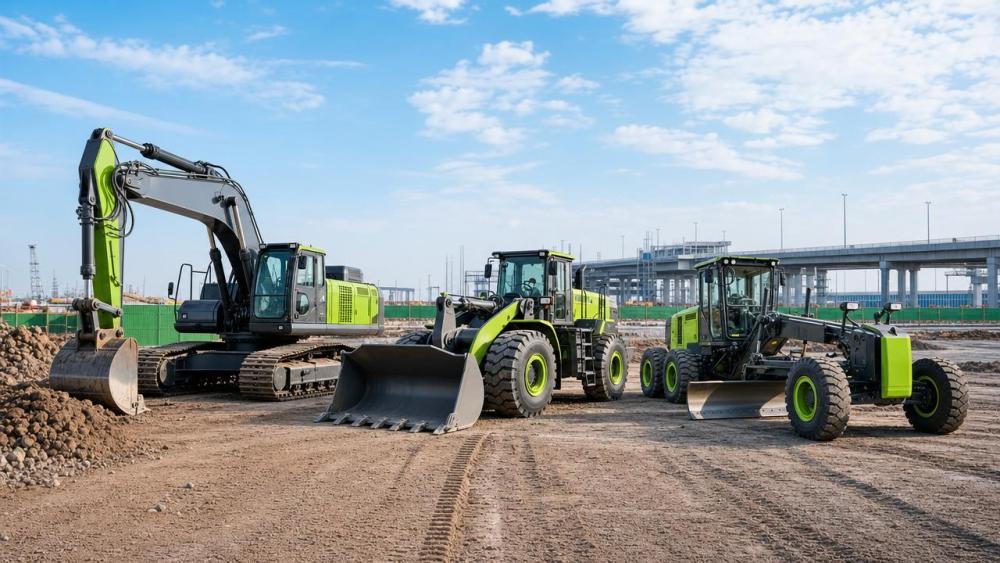
Construction equipment technology is no longer a side topic in fleet planning. It now shapes capital timing, utilization assumptions, and residual value expectations.
That shift is especially visible in earthmoving fleets. Excavators, loaders, graders, bulldozers, and skid steers are becoming data-rich operating assets, not just mechanical equipment.
From recent market signals, the real change is not one breakthrough. It is the convergence of electrification, automation support, emissions control, and intelligent hydraulic management.
For business evaluation, that changes the way construction equipment technology should be assessed. Purchase price matters less in isolation, while lifecycle adaptability matters much more.
This is also where EMD’s market lens becomes relevant. Its focus on crawler excavators, wheel loaders, motor graders, bulldozers, and skid steer loaders reflects where infrastructure productivity is actually being redefined.
Across mega-projects, mines, road works, and urban sites, construction equipment technology is reshaping how fleets are planned for uptime, compliance, precision, and future retrofit potential.
Why the change is becoming more visible now
Several forces are arriving at the same time. That is why construction equipment technology has moved from technical interest to investment priority.
Non-road emissions rules are tightening across major regions. Fleets must now consider not only current compliance, but also the risk of early obsolescence.
At the same time, fuel volatility keeps exposing the weakness of old fleet assumptions. Machines with better electro-hydraulic control and load sensing now change operating economics in measurable ways.
A second driver is labor pressure. Advanced operator assistance, remote monitoring, and semi-automated grading reduce dependence on scarce high-skill operation capacity.
A third factor is project complexity. Modern infrastructure requires tighter tolerances, better digital records, and faster coordination between machine output and planning systems.
What stands out is that these pressures reinforce each other. Construction equipment technology now affects both margin protection and bidding credibility.
The strongest technology signals are coming from core earthmoving categories
The most meaningful developments are happening in the machines that move the most material and define project tempo.
Crawler excavators are becoming digital productivity anchors
In excavators, construction equipment technology increasingly centers on electro-hydraulic precision, attachment recognition, telematics, and semi-autonomous digging support.
This matters because excavators often set cycle rhythm for the whole site. Better control logic improves fuel burn, breakout consistency, and rework rates.
Wheel loaders and bulldozers are turning efficiency into a software question
For loaders and bulldozers, hydrostatic transmission refinement, traction management, and payload intelligence are changing expected output per shift.
This is where construction equipment technology affects valuation beyond hardware. Smarter machine response reduces operator variability in harsh loading and pushing conditions.
Motor graders and skid steers show how specialization is widening
Motor graders are advancing through GPS, laser sensing, and blade control systems. The result is tighter finish accuracy and fewer corrective passes.
Skid steers are moving in another direction. Their value now depends heavily on attachment ecosystems, urban maneuverability, and quick-change hydraulic performance.
Viewed together, these categories confirm a wider pattern. Construction equipment technology is pushing fleets toward role-specific optimization, not broad equipment averaging.
The impact does not stop at machine performance
The first impact is financial modeling. Old comparisons based on engine size and rated capacity miss too much of the value story.
A machine with stronger telematics, cleaner emissions architecture, and automation interfaces may cost more upfront, yet produce a better risk-adjusted return.
The second impact is deployment flexibility. Fleets now need machines that can move between quarry work, road packages, urban infrastructure, and regulated zones.
The third impact is tender competitiveness. Increasingly, project owners and partners look at carbon performance, control precision, and uptime transparency.
- Residual value depends more on software compatibility and emissions relevance.
- Utilization rates depend more on machine versatility across changing site conditions.
- Maintenance planning depends more on diagnostic depth than on service intervals alone.
- Project risk depends more on precision and uptime data that can be verified quickly.
This is why construction equipment technology now influences strategic fleet composition, not just equipment replacement cycles.
What deserves closer attention before capital is committed
In practical evaluation, several details now carry more weight than headline specifications.
Look at control architecture, not only power output
Responsive electro-hydraulic systems can change productivity more than modest engine gains. This is especially true in repetitive excavation and high-precision grading tasks.
Check whether data systems are usable across the fleet
Telematics value drops quickly if reporting is fragmented. Construction equipment technology creates more value when diagnostics, fuel data, payload signals, and location data connect cleanly.
Treat decarbonization readiness as a phased capability
Not every site is ready for full electrification. Still, hybrid functions, idle reduction, and efficient hydraulics can improve carbon intensity before infrastructure catches up.
Measure automation readiness realistically
Remote control and autonomous functions are advancing fast, especially in hazardous mines and controlled worksites. Yet site connectivity and process discipline remain decisive.
EMD’s intelligence perspective is useful here because it tracks both the machine layer and the infrastructure cycle behind it. That combination helps separate durable signals from short-lived feature hype.
The next wave will reward selective, not blanket, adoption
One common mistake is treating all construction equipment technology upgrades as equally urgent. The market is moving, but adoption value still depends on duty profile.
For high-hour excavators and loaders, fuel efficiency, predictive maintenance, and control refinement often produce the fastest measurable returns.
For graders, accuracy technologies can shift project economics by reducing passes, survey friction, and handoff delays.
For skid steers in urban work, attachment flexibility and compact automation support may matter more than raw machine scale.
The broader point is clear. Construction equipment technology should be mapped against job mix, compliance exposure, and expected resale horizon.
- Rebuild cost models around fuel, uptime, software, and retrofit potential.
- Segment fleets by duty intensity instead of treating all earthmoving assets the same.
- Track emissions and automation rules by region before replacement timing is locked.
- Compare machine platforms by integration depth, not only by purchase discount.
Fleet planning is becoming a technology judgment as much as an equipment judgment. The strongest decisions will come from reading where machine capability, infrastructure demand, and regulatory pressure are meeting next.
A useful next step is to review each core asset class against three questions: where utilization is highest, where compliance risk is rising, and where construction equipment technology can change output quality fastest.